If we are going to defend freedom, we have to have to defend ‘two and two equals four.’
David Icke on the Rich in Success podcast.
Categories
David Icke

If we are going to defend freedom, we have to have to defend ‘two and two equals four.’
David Icke on the Rich in Success podcast.

You don’t comb the mirror, you comb your own hair and the mirror changes.
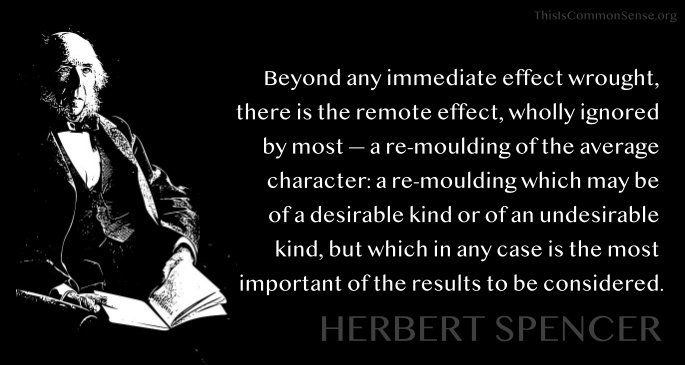
[I]f adaptation is everywhere and always going on, then adaptive modifications must be set up by every change of social conditions.
To which there comes the undeniable corollary that every law which serves to alter men’s modes of action — compelling, or restraining, or aiding, in new ways — so affects them as to cause, in course of time, fresh adjustments of their natures. Beyond any immediate effect wrought, there is the remote effect, wholly ignored by most — a re-moulding of the average character: a re-moulding which may be of a desirable kind or of an undesirable kind, but which in any case is the most important of the results to be considered.
Herbert Spencer, “The Sins of Legislators,” in The Man versus the State (1884).

Facts do not cease to exist because they are ignored.
Aldous Huxley, “Note on Dogma,” Proper Studies (1927).
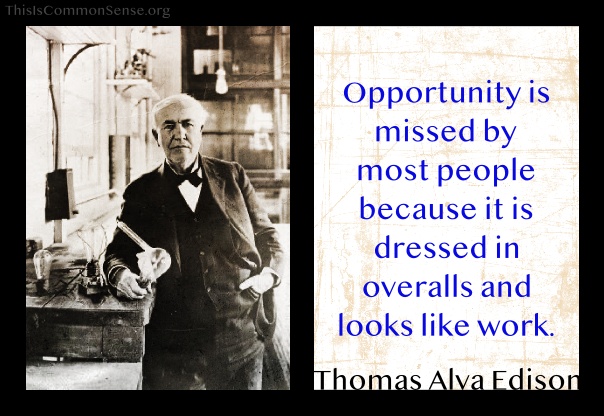
Opportunity is missed by most people because it is dressed in overalls and looks like work.
Thomas Alva Edison, as quoted in An Enemy Called Average (1990) by John L. Mason, p. 55.
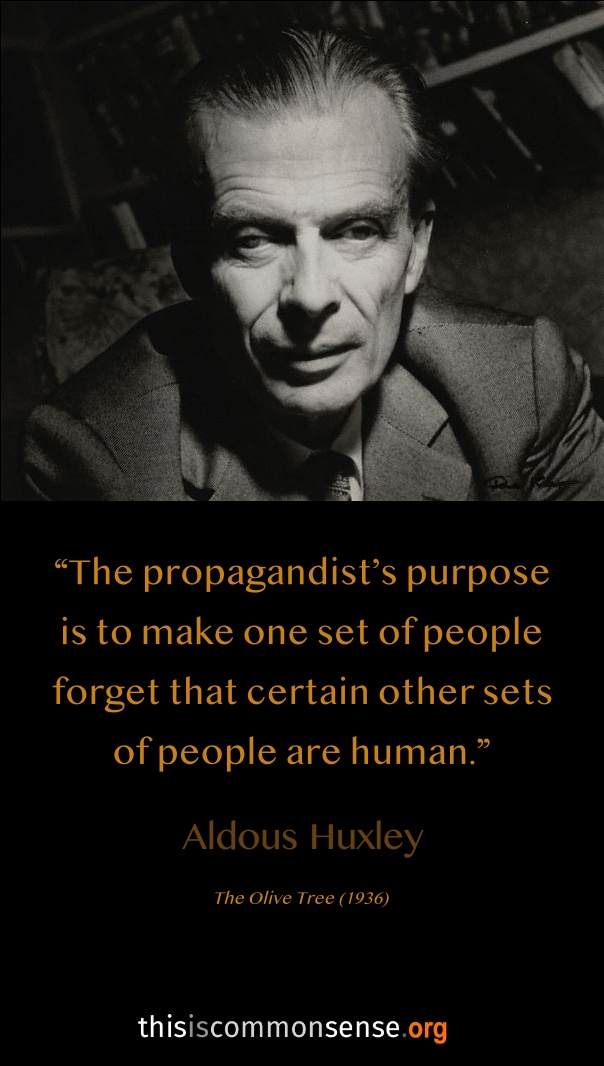
The propagandist’s purpose is to make one set of people forget that certain other sets of people are human.
Aldous Huxley, The Olive Tree (1936)
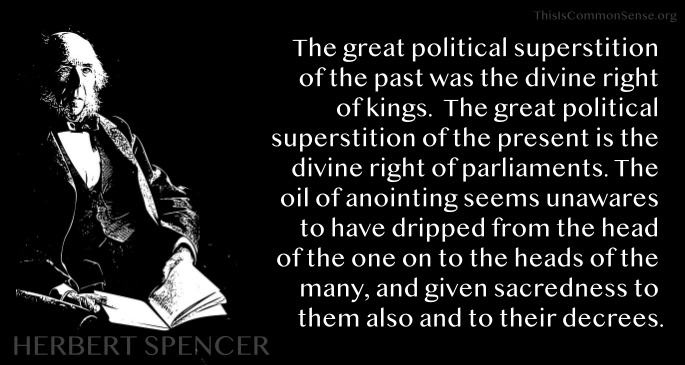
The great political superstition of the past was the divine right of kings. The great political superstition of the present is the divine right of parliaments. The oil of anointing seems unawares to have dripped from the head of the one on to the heads of the many, and given sacredness to them also and to their decrees.
Herbert Spencer, “The Great Political Superstition,” in The Man versus the State (1884).
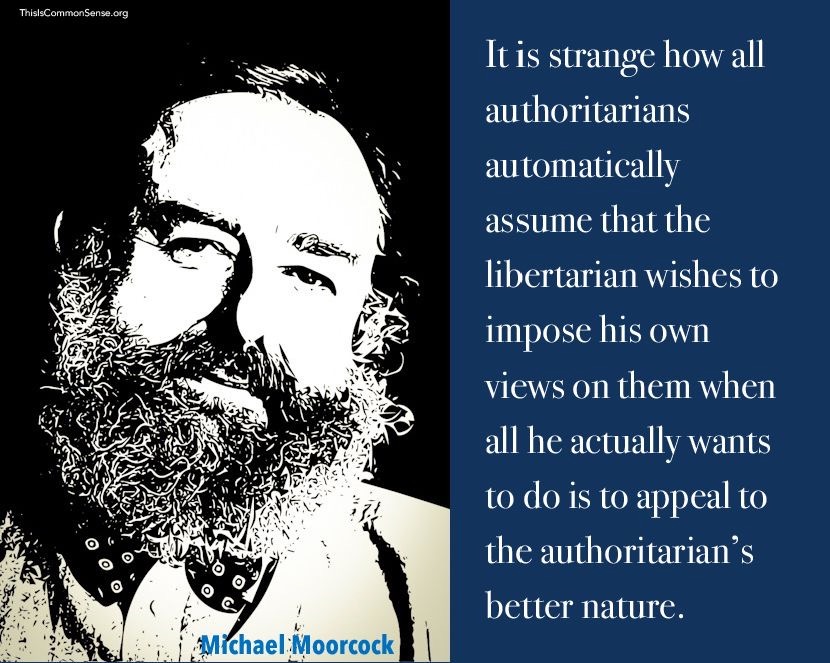
It is strange how all authoritarians automatically assume that the libertarian wishes to impose his own views on them when all he actually wants to do is to appeal to the authoritarian’s better nature. But I suppose you authoritarians can only see things in your own terms.
Count von Bek to the narrator of The Warlord of the Air: A Scientific Romance (1971), the first novel of A Nomad of the Time Streams series by Michael Moorcock (2013 Titan Books edition, p. 149).
[T]here lie before the legislator several open secrets, which yet are so open that they ought not to remain secrets to one who undertakes the vast and terrible responsibility of dealing with millions upon millions of human beings by measures which, if they do not conduce to their happiness, will increase their miseries and accelerate their deaths?
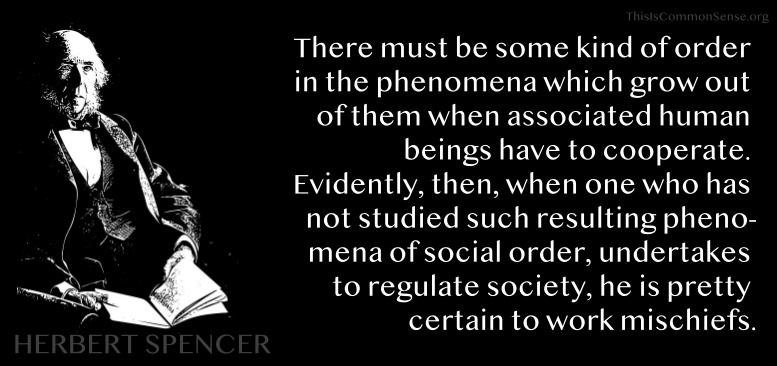
There is first of all the undeniable truth, conspicuous and yet absolutely ignored, that there are no phenomena which a society presents but what have their origins in the phenomena of individual human life, which again have their roots in vital phenomena at large. And there is the inevitable implication that unless these vital phenomena, bodily and mental, are chaotic in their relations (a supposition excluded by the very maintenance of life) the resulting phenomena cannot be wholly chaotic: there must be some kind of order in the phenomena which grow out of them when associated human beings have to cooperate. Evidently, then, when one who has not studied such resulting phenomena of social order, undertakes to regulate society, he is pretty certain to work mischiefs.
Herbert Spencer, “The Sins of Legislators,” in The Man versus the State (1884).
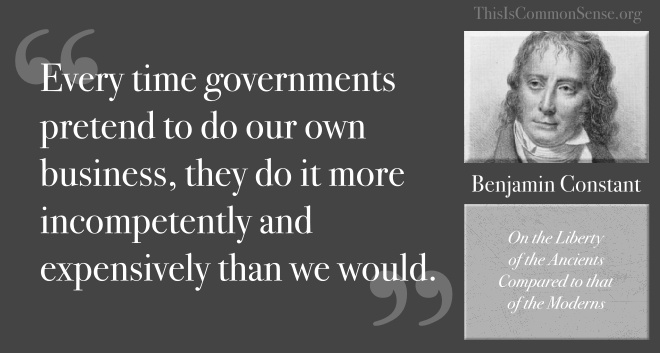
[C]ommerce inspires in men a vivid love of individual independence. Commerce supplies their needs, satisfies their desires, without the intervention of the authorities. This intervention is almost always — and I do not know why I say almost — this intervention is indeed always a trouble and an embarrassment. Every time collective power wishes to meddle with private speculations, it harasses the speculators. Every time governments pretend to do our own business, they do it more incompetently and expensively than we would.
Benjamin Constant, The Liberty of the Ancients Compared with That of the Moderns (1819). See also: https://thisiscommonsense.org/2021/09/15/benjamin-constant-5-2/