Categories
Thought

C.S. Peirce

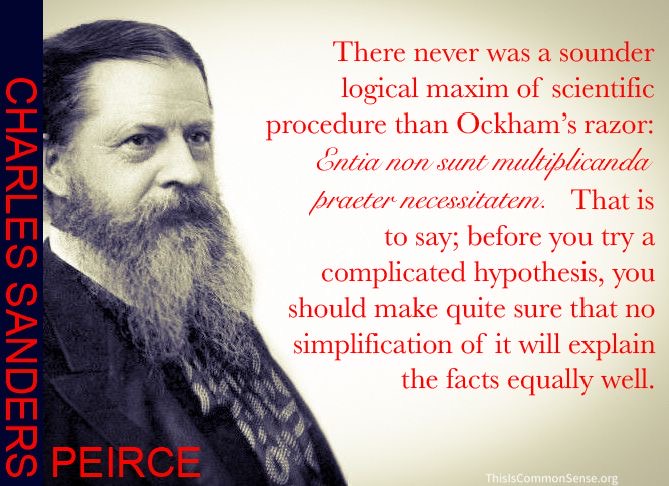
There never was a sounder logical maxim of scientific procedure than Ockham’s razor: Entia non sunt multiplicanda praeter necessitatem. That is to say; before you try a complicated hypothesis, you should make quite sure that no simplification of it will explain the facts equally well.

Charles Sanders Peirce, Lectures on Pragmatism delivered in Cambridge, Massachusetts (March 26 – May 17, 1903).

Categories
Thought

Herbert Spencer

A thing must either exist or not exist — must have a certain attribute or not have it: there is no third possibility. This is a postulate of all thought; and in so far as it is alleged of phenomenal existence, no one calls it in question.

Herbert Spencer, ”Mill versus Hamilton — The Test of Truth,” The Fortnightly Review (July 1865).
Categories
Thought

C.S. Peirce

True science is distinctively the study of useless things. For the useful things will get studied without the aid of scientific men.

Charles Sanders Peirce, The Scientific Attitude and Fallibilism in Philosophical Writings of Peirce, selected and edited with an introducton by Justus Buchler, p. 49.

Categories
Thought

Arthur Latham Perry

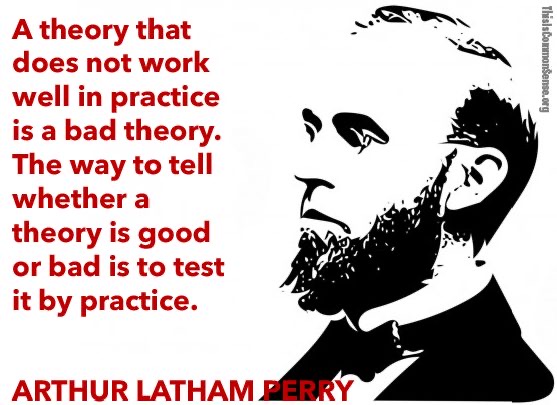
A theory that does not work well in practice is a bad theory. The way to tell whether a theory is good or bad is to test it by practice. Everything that is done at all, unless by mere chance, is done on some theory; and it is certainly better that things should be done on a good theory than on a bad one. What makes a theory good? Simply because it corresponds with and explains the facts.

Arthur Latham Perry, Elements of Political Economy (1869).

Categories
Thought

Popper

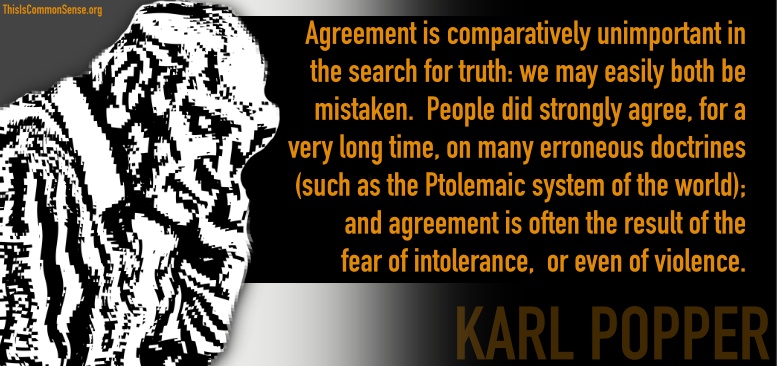
Agreement is comparatively unimportant in the search for truth: we may easily both be mistaken. People did strongly agree, for a very long time, on many erroneous doctrines (such as the Ptolemaic system of the world); and agreement is often the result of the fear of intolerance, or even of violence.

Karl Popper, “Toleration and Intellectual Responsibility,” in Susan Mendus and David Edwards (editors), On Toleration, Clarendon Press, Oxford, 1987, pp. 17–34.
Categories
Thought

H.L. Mencken

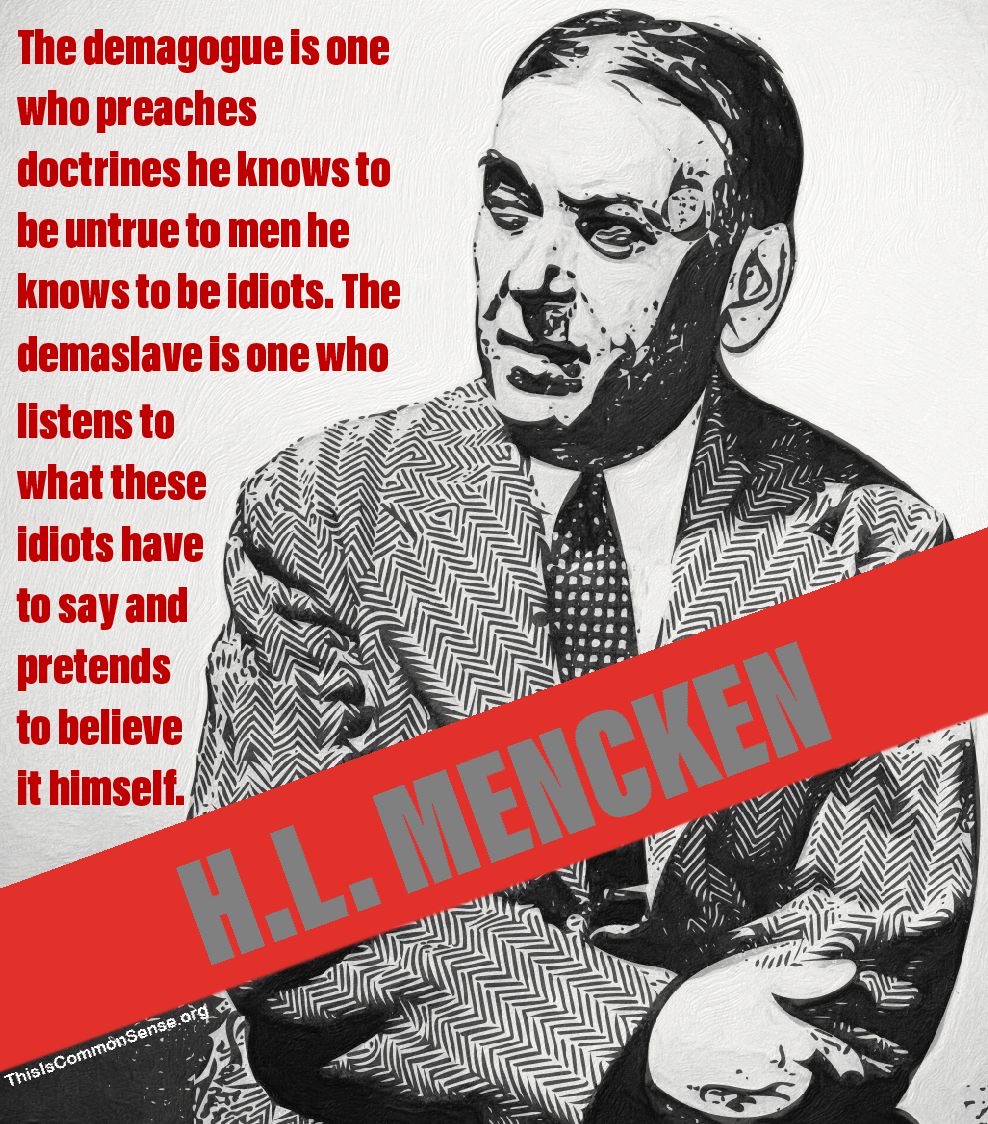
There is the art of the demagogue, and there is the art of what may be called, by a shot-gun marriage of Latin and Greek, the demaslave. They are complementary, and both of them are degrading to their practitioners. The demagogue is one who preaches doctrines he knows to be untrue to men he knows to be idiots. The demaslave is one who listens to what these idiots have to say and then pretends that he believes it himself. 

H.L. Mencken, Notes on Democracy (Knopf, 1926).
Categories
Thought

Einstein

The most incomprehensible thing about the world is that it is comprehensible.

Albert Einstein, as cited in Einstein: A Biography (1954), by Antonina Vallentin, p. 24.
Categories
Thought

Thoreau

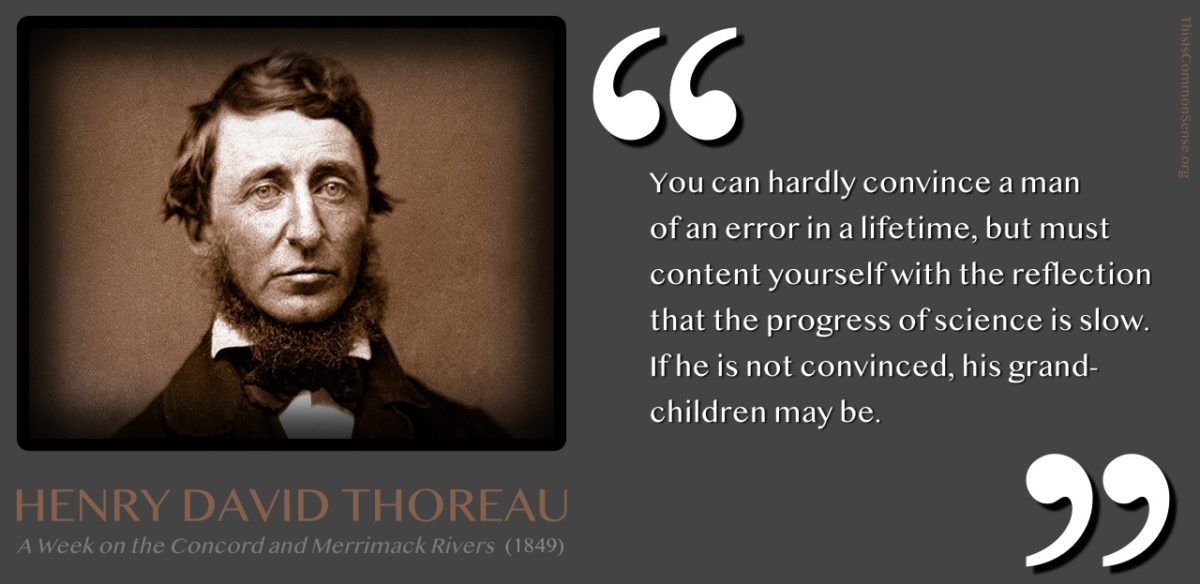
You can hardly convince a man of an error in a lifetime, but must content yourself with the reflection that the progress of science is slow. If he is not convinced, his grandchildren may be.

Henry David Thoreau, A Week on the Concord and Merrimack Rivers (1849).
Categories
Thought

Martial

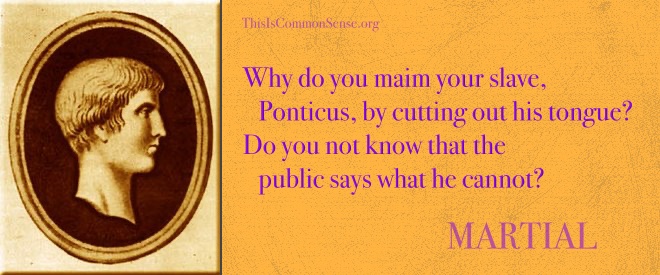
Why do you maim your slave, Ponticus, by cutting out his tongue? Do you not know that the public says what he cannot?

Marcus Valerius Martialis, Epigrammata (80–104 A.D.).
Categories
Thought

Bentham

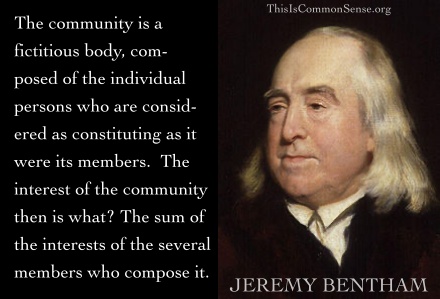
The community is a fictitious body, composed of the individual persons who are considered as constituting as it were its members. The interest of the community then is what? The sum of the interests of the several members who compose it.

Jeremy Bentham, An Introduction to the Principles of Morals and Legislation (1789; 1823), Chapter 1: “Of the Principle of Utility.”