On June 21, 1915, the U.S. Supreme Court struck down an Oklahoma law denying the right to vote to some citizens. In Guinn v. United States, the Supreme Court found “grandfather clauses” in effect in several formerly slave states to be little more than sneaky ways of allowing illiterate white folks to vote while disallowing illiterate black folks.
Author: Redactor
Iris Murdoch
The cry of equality pulls everyone down.
Iris Murdoch, as quoted in The Observer, September 13, 1987
A Federation
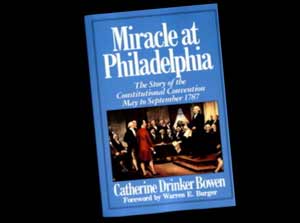
On the 20th of June in 1787, at the Constitutional Convention in Philadelphia, Oliver Ellsworth moved to confine legislative powers to two distinct branches, and to strike the word “national” from the document. Edmund Randolph of Virginia had previously moved successfully to call the government the National Government of United States. Ellsworth moved that the government should continue to be called the United States of America.
The final wording eventually became “All legislative powers herein granted shall be vested in a Congress of the United States, which shall consist of a Senate and House of Representatives.”
And, yes, the word “national” does not occur anywhere in the Constitution.
Happy Birthday, Václav
In 1941, Czech economist and politician Václav Klaus was born; other June 19 births include Salman Rushdie in 1947, Kathleen Turner in 1954, and Laura Ingraham in 1964.
Auberon Herbert
“A man can only learn when he is free to act.”
Auberon Herbert, The Right and Wrong of Compulsion by the State (1885)
Townhall: Black Gun Rights Matter
It is time to get serious about equal rights under the law. And republican policing.
Click on over to Townhall for the timely assessment. Then click back here for full-spectrum perspective.
- YouTube video: Falcon Heights Police Officer Kill Man Reaching for His Wallet in Front of His Girlfriend and Child
- Washington Post: In America, Gun Rights Are for Whites Only
- Star Tribune: Hours after officer Yanez is found not guilty in fatal shooting of Philando Castile, marchers close I-94
- Minneapolis CBS TV: Timeline Of Key Events In Philando Castile Shooting
- Daily Caller: The Only Two Black Jurors Were In Favor Of Acquitting The Cop In The Philando Case
- Star Tribune: Officer who shot Castile attended ‘Bulletproof Warrior’ training
- Washington Post: A day with ‘killology’ police trainer Dave Grossman
- Common Sense: Ferguson Finally Wins
- Washington Post: Charlotte police won’t make shooting video public; chief says footage is not ‘definitive’
- YouTube video: Yanez Trial Day 3: Forensic Evidence In Philando Castile’s Death
- YouTube video: Girlfriend Of Philando Castile Testifies In Trial
- YouTube video: Officer Yanez Takes The Stand In Philando Castile Case
- National Review: Our Dangerous Drift from Reason
- Daily Wire: 5 Statistics You Need To Know About Cops Killing Blacks
Michael Ruhlman
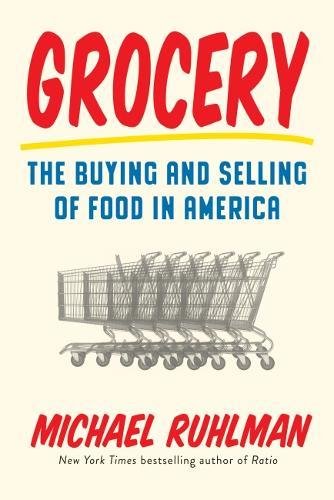
[W]e don’t really have stores that sell only groceries, shelf-stable products, anymore. Most stores sell a variety of shelf-stable and perishable goods. So most stores should be considered, technically, supermarkets. But there is a warmth to the term grocery store that encourages one to embrace it and hold on to it. In large part this is because it sill does connote — in this era of fragmentation and impersonal service and a food world that grows ever more confusing — a place that can be depended upon, day in and day out, where you can get everything you need to nourish your family. We like to think that our grocery store is run by a grocer (not a supermarketer). And we want to believe that there are capable people in charge of our food, people who care for it and ensure that the products are good.
Michael Ruhlman, Grocery: The Buying and Selling of Food in America (New York: Abrams Press, May 16, 2017)
Auberon Herbert
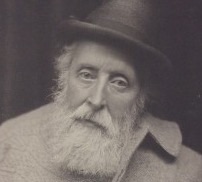
On June 18, 1838, Auberon Edward William Molyneux Herbert was born.
Auberon Herbert was a Liberal Member of Parliament who, after reading the writings of Herbert Spencer, became a radical individualist and author of essays such as “The Ethics of Dynamite,” “A Politician in Trouble About His Soul,” and “The Right and Wrong of Compulsion by the State.”
Capitalism: The Known-and-Loved Ideal
A slightly different take on the subject … than usual:
Jean-Baptiste Say
A tax can never be favorable to the public welfare, except by the good use that is made of its proceeds.
J.-B. Say, A Treatise On Political Economy (Fourth Edition) (1832), Chapter XVII, Section I, p. 168