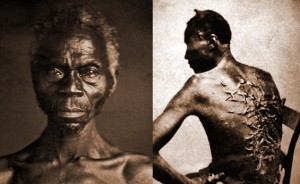
On April 14, 1775, the Society for the Relief of Free Negroes Unlawfully Held in Bondage, the first American organization committed to the abolition of slavery, was formed in Philadelphia.
On April 14, 1818, Noah Webster published his American Dictionary of the English Language, one of the first lexicons to include distinctly American words. The dictionary, which took him more than two decades to complete, introduced more than 10,000 “Americanisms.”
On April 14, 1988, representatives of the Soviet Union, Afghanistan, the United States, and Pakistan signed an agreement calling for the withdrawal of Soviet forces from Afghanistan. In exchange for an end to the disputed Soviet occupation, the United States agreed to end its arms support for the Afghan anti-Soviet factions, and Afghanistan and Pakistan agreed not to interfere in each other’s affairs.
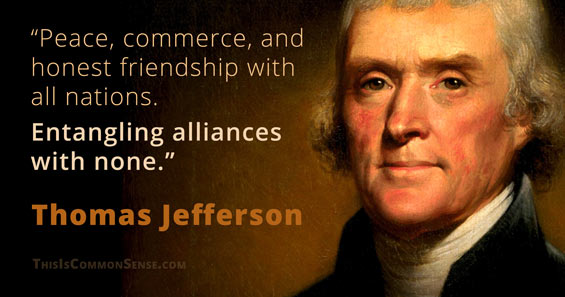
On April 13, 1743, Thomas Jefferson was born. Author of Notes on the State of Virginia and the first draft of the United States’ Declaration of Independence, Jefferson was also a scientist, philosopher, inventor, diplomat, and American politician. He also composed music, designed buildings, and translated works from his favorite French writers, whom he had met in his diplomatic missions to Paris.
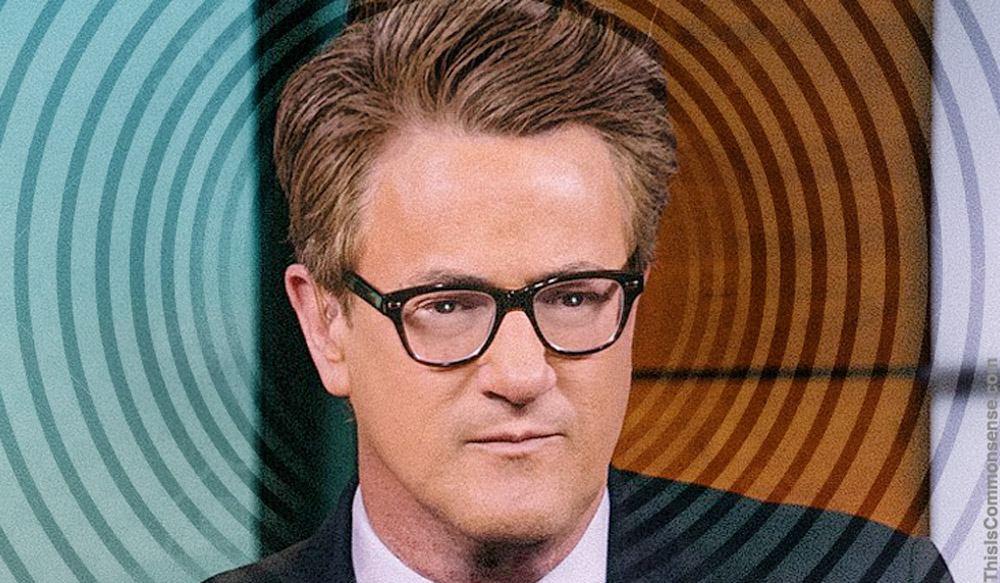
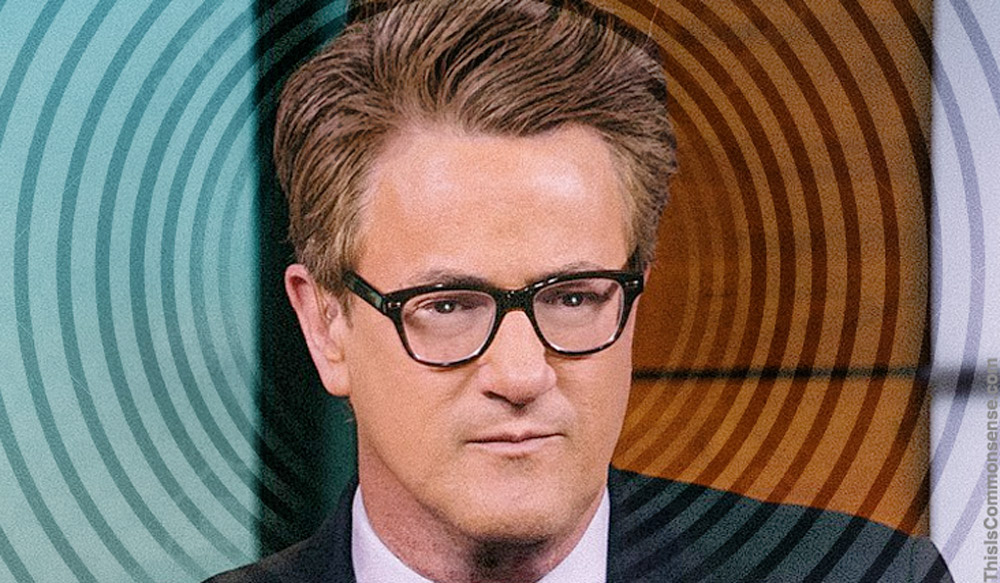
There’s news reporting, done well or not, and opinion, with which one can agree or disagree. But on MSNBC’s Morning Joe you get something even more illuminating: mind-reading.
Yesterday, the show addressed U.S. Attorney General William Barr’s testimony the previous day before a Senate subcommittee. Viewers were shown The Washington Post’s succinct front-page headline: “Barr thinks U.S. spied on Trump.”
And heard the Attorney General tell Senators that he wanted to “explore” and “make sure there was no unauthorized surveillance” of the Donald Trump for President campaign. “I think spying on a political campaign is a big deal,” he added.
“You’re not suggesting that spying occurred?” asked Sen. Jeanne Shaheen (D-N.H.)
“I think spying did occur,” Barr replied, “yes.” Barr defined “spying” as “unauthorized surveillance.”
“Someone’s been Trumped!” co-host Mika Brzezinski exasperatedly declared as the footage ended. Co-host and husband Joe Scarborough then took over, likewise uninterested in any such inquiry.
“[Barr] knows that what he’s saying is unbelievably reckless,” the clairvoyant former congressman informed. “And you can almost see in his mind, Barr going, ‘How do I answer this question so that Trump doesn’t tweet at me, so that I keep my job, but still not make a jackass of myself for lying?’”
As on-set bobbleheads nodded, Mike Barnacle vouched for Joe’s telepathic veracity, sharing a tale that “two people who have known Bill Barr for 30 years” were “stunned.” These unnamed sources are known only to Mr. Barnacle, the disgraced formerBoston Globe columnist, a plagiarist and fabricator of stories, once described accurately as “cynically churning out fiction clothed as journalism.”
“I want to satisfy myself that there were no abuse of law enforcement and intelligence powers,” Barr told the committee. “I think that is one of the principal roles of the attorney general.”
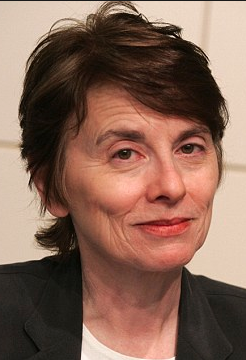
The English language was created by poets, a five-hundred year enterprise of emotion and metaphor, the richest dialogue in world literature. French rhetorical models are too narrow for the English tradition. Most pernicious of French imports is the notion that there is no person behind a text. Is there anything more affected, aggressive, and relentlessly concrete than a Parisian intellectual behind his/her turgid text? The Parisian is a provincial when he pretends to speak for the universe.
Camille Paglia, Sexual Personae: Art and Decadence from Nefertiti to Emily Dickinson, p. 34.
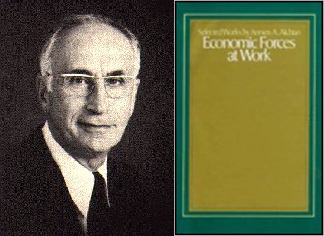
On April 12, 1914, American economist Armen Alchian was born. His contributions to economic theory and teaching were many and varied — his textbook, co-authored with William R. Allen, University Economics (also titled Exchange and Production), was widely considered one of the finest intermediate texts in microeconomics — but he remains perhaps best known for his work on property rights.
Alchian died in 2014, in late February, at the age of 99.
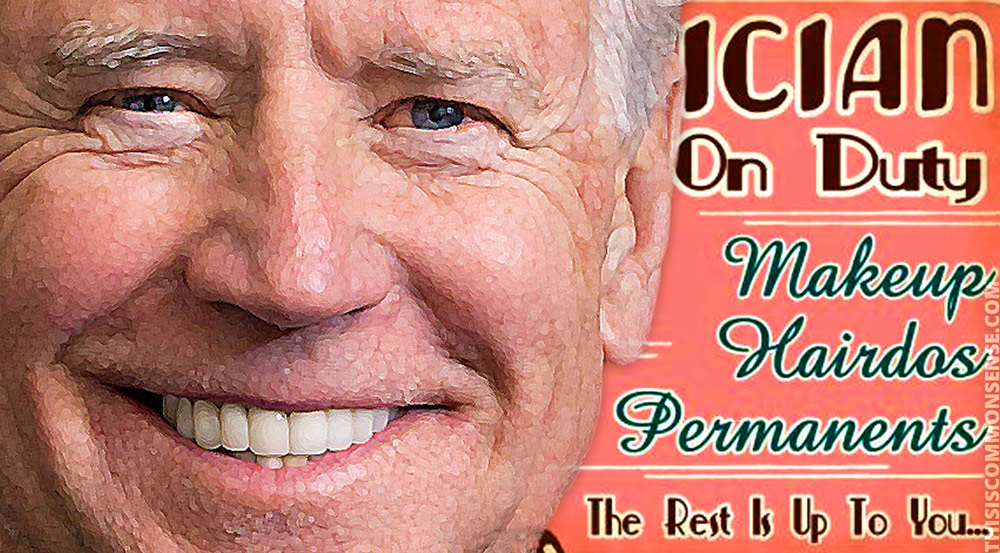
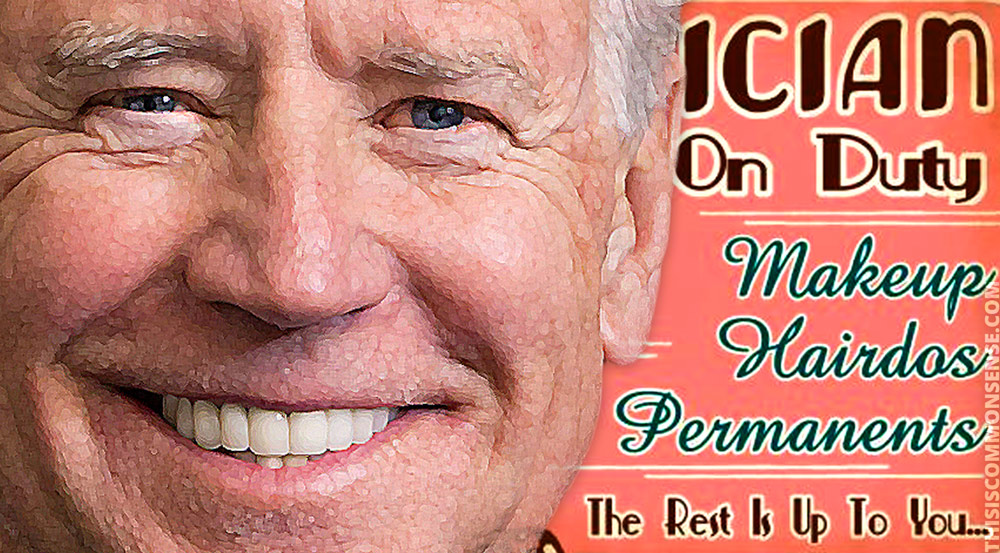
Joe Biden, late of the U.S. Senate and Blair House, is not someone I typically rush to for policy advice. Were I looking for a weather vane to indicate whence bad ideas come a-gusting, in full poisonous gasbaggery, Biden might serve as well as any of the budding socialists now running for the presidency.
But he has a clue about one thing: Occupational licensing.
Last week, Biden came out against the cosmetology licenses so common in states throughout the union. “Joe Biden knocks licensing requirements for hairdressers,” Philip Wegmann summarized on Twitter, “says it’s ridiculous that licenses take ‘400 hours’ of training: ‘It’s all about not helping workers.’”
Now, this is hardly a federal issue for a president to tackle. And Biden sure seems to be itching to run for the top banana position that he was so close to for eight years.
But states can do something — about their own stupid regulations. As Arizona just showed when the legislature passed a bill to acknowledge the occupational licenses from other states when a person moves to Arizona. This allows more freedom of movement among the states, and brings the state back into line with the common market idea of the U.S. Constitution. Governor Doug Ducey is expected to sign (or may already have done so, by the time this is published): it sure fits with the governor’s proclaimed desire to roll back regulations.
And this notion of openness and inclusion could be extended to other issues. You know, like concealed carry permits.
After all, states universally recognize all others’ drivers’ licenses. If you may navigate a metal-and-glass mortician’s little helper based on your state’s licensing, surely you can clip hair safely enough.
In all the works on pedagogy that ever I read — and they have been many, big, and heavy — I don’t remember that any one has advocated a system of teaching by practical jokes, mostly cruel. That, however, describes the method of our great teacher, Experience.
C.S. Peirce, “Pragmatism and Pragmaticism” (1903).
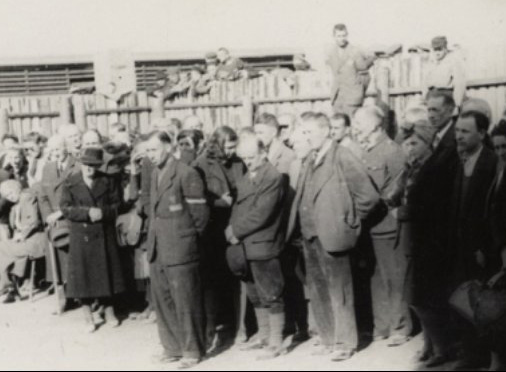
On April 11, 1945, the American Third Army liberated the Buchenwald concentration camp, near Weimar, Germany, a camp that would later be judged second only to Auschwitz in the horrors it imposed on its prisoners.
Among those in the camp saved by the American soldiers was Elie Wiesel, who would go on to win the Nobel Peace Prize in 1986.
Shown in photograph: German citizens ushered to the camp by American soldiers, post-conquest.
Freedom is good, sure . . . for most of us, most of the time.
But the National Commission on Military, National, and Public Service was funded by Congress to study whether perhaps just a smidgen of short-term slavery for young people might be a smart program, a nice change of pace, a big help to all involved — both our nation’s youth and our nation’s government.
Involuntary servitude — a year or two of military service or mandatory civilian national service, i.e. helping this government agency or that one — might force these whipper-snappers to grow up faster, the argument goes. Not to mention assisting them by engineering an enlighteningly involuntary point-of-view from which to better sort out their futures.
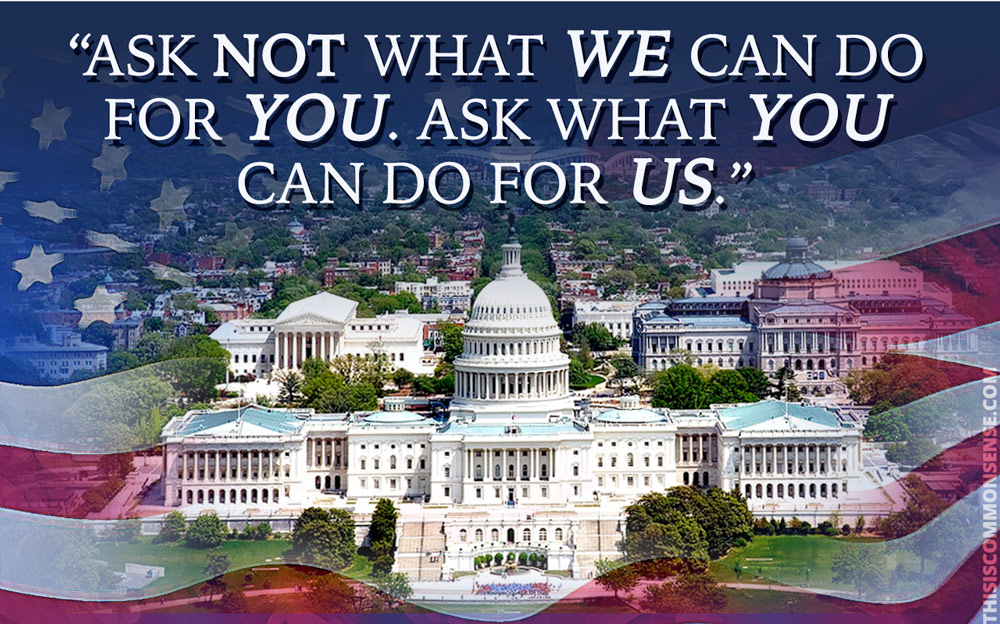
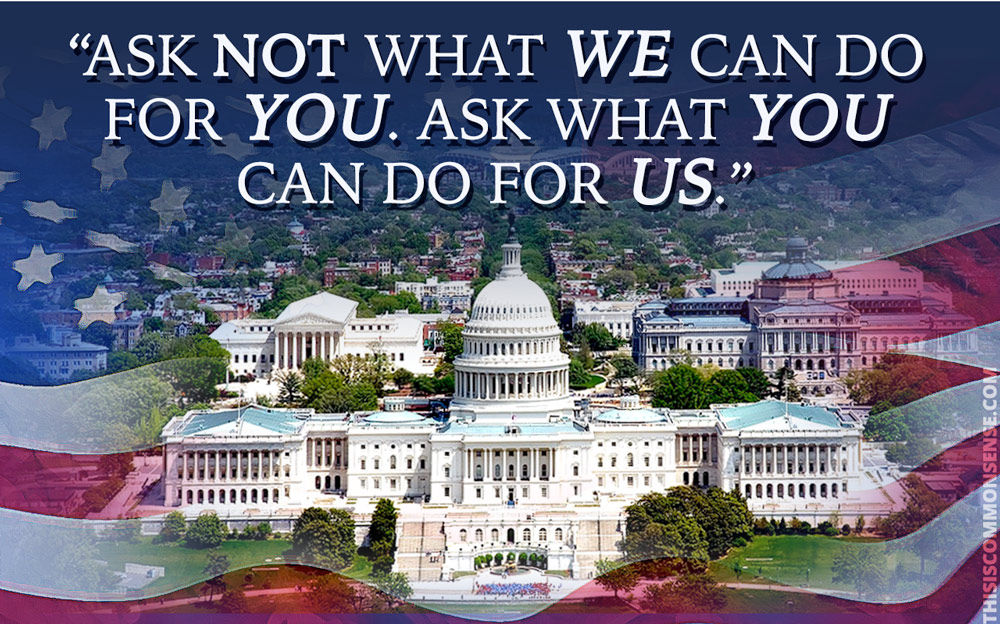
But enough about what’s good for young people. Let them heed the famous words of President John F. Kennedy: “Ask not what we can do for you, ask what you can do for us.”
Consider the awesome benefits we can accrue from an army of four million well-mannered, bright-eyed 18-year-olds, like the kids on The Facts of Life or Saved By the Bell — or whatever newfangled TV show dances in front of today’s youthful eyes.
Imagine, young people solving all our problems: cleaning up the environment, ending illiteracy, reversing global warming, wiping out poverty, curing cancer.
Or at least mopping up the lobby at the EPA, filing documents close to alphabetically at the Department of Education, picking up trash in a park.
All while becoming fully-actualized citizens.
Green energy isn’t the answer, youthful energy is! Remember: It cannot be bottled, but it can be conscripted.
Oh, and actually paying for 4 million make-work jobs?*
Ssshhhh.
This is Common Sense. I’m Paul Jacob.
* At minimum wage, it would cost more than $60 billion a year to hire every 18-year-old American. Oh, well, I guess freedom is much less expensive.