Categories
Thought

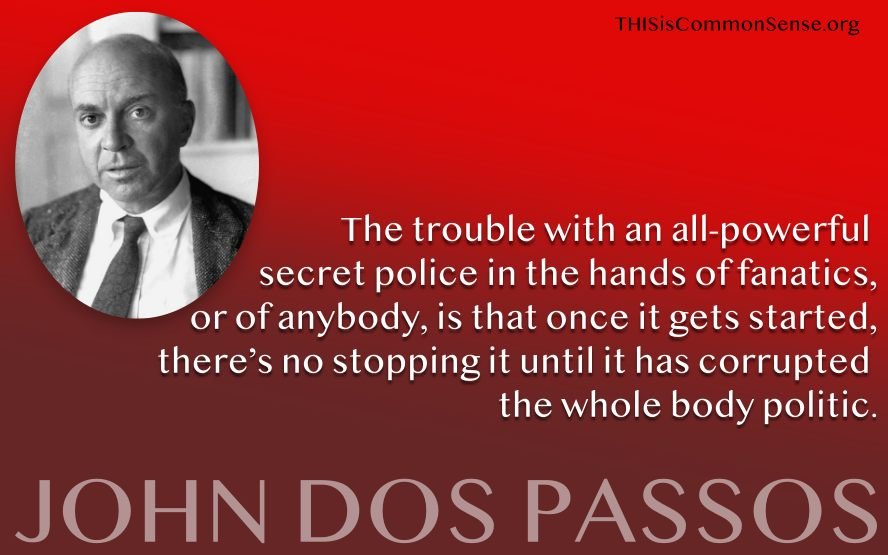
John Dos Passos

I have come to think, especially since my trip to Spain, that civil liberties must be protected at every stage. In Spain, I am sure that the introduction of GPU methods by the Communists did as much harm as their tank men, pilots, and experienced military men did good. The trouble with an all-powerful secret police in the hands of fanatics, or of anybody, is that once it gets started, there’s no stopping it until it has corrupted the whole body politic. I am afraid that’s what’s happening in Russia.

John Roderigo Dos Passos (author of the U.S.A. trilogy), “Statement of Belief,” Bookman, September 1928.
Categories
Today

Car Starts

On August 22, 1902, the Cadillac Motor Company was founded — and on the same day Theodore Roosevelt became the first President of the United States to make a public appearance in an automobile, riding through the streets of Hartford, Connecticut, in a Columbia Victoria electric car. Though TR’s public statement was supportive of the new technology, privately he referred automobiles “a trial” and “as distinct additions to the discomfort of living.”

His predecessor in office, William McKinley, had himself ridden in an automobile, but did not do so in public.

Also in 1902, the federal government bought a Stanley Steamer for presidential outings, the first automobile in general service by what the Founding Fathers referred to as the “general government.”

Categories
election law national politics & policies Voting

Lost Their Bearings

“Washington, D.C. should have every right to set its own rules and policies, just as Vermont does,” argues Sen. Peter Welch (D-VT). “The micromanagement by congressional Republicans and Trump must end.”

First, the District of Columbia is not a state. Vermont is, if you’re playing at home. 

Second, Congress and the President have constitutional authority and responsibility for our nation’s capital. Article 1, Section 8, Clause 17 of the U.S. Constitution specifically empowers Congress “To exercise exclusive Legislation in all Cases whatsoever, over such District (not exceeding ten Miles square) as may, by Cession of particular States, and the Acceptance of Congress, become the Seat of Government of the United States . . .”

Sen. Welch’s comments above, from last week’s Washingtonian magazine article, were in defense of the noncitizen voting law passed by the D.C. City Council, which every Republican in the U.S. House — joined by 56 Democrats — voted to repeal. (Senate action awaits.) The Vermont senator was featured because three Vermont cities also allow noncitizens to vote.

I oppose the laws in those three Vermont cities as well as in our nation’s capital. But Washington, D.C.’s law is the worst. 

Why? It allows noncitizens in the country illegally to vote. It offers the vote even to foreign nationals working in the embassies of hostile powers. For instance, China’s and Russia’s ambassadors could decide who the next mayor is . . . or pass or defeat ballot measures. 

Make any sense? Not a lick.

One new local D.C. officeholder is Mónica López. She is not really a “noncitizen,” just a citizen of Mexico. And one of three non-U.S. citizens who were elected to Washington’s powerless neighborhood advisory council.

“It’s incredibly local,” López offers. “It has no bearing over anything federal.”

Really? None? She’s in a federal enclave, where the feds do their million-billion things, and what she’s up to has no bearing on it?

This is Common Sense. I’m Paul Jacob.


PDF for printing

Illustration created with Krea and Firefly

See all recent commentary
(simplified and organized)
See recent popular posts
Categories
Thought

Dawn Powell

Satire is people as they are; romanticism, people as they would like to be; realism, people as they seem with their insides left out.

Dawn Powell (1896-1965), The Diaries of Dawn Powell: 1931-1965, edited by Tim Page (1998).
Categories
Today

Haitian Revolution

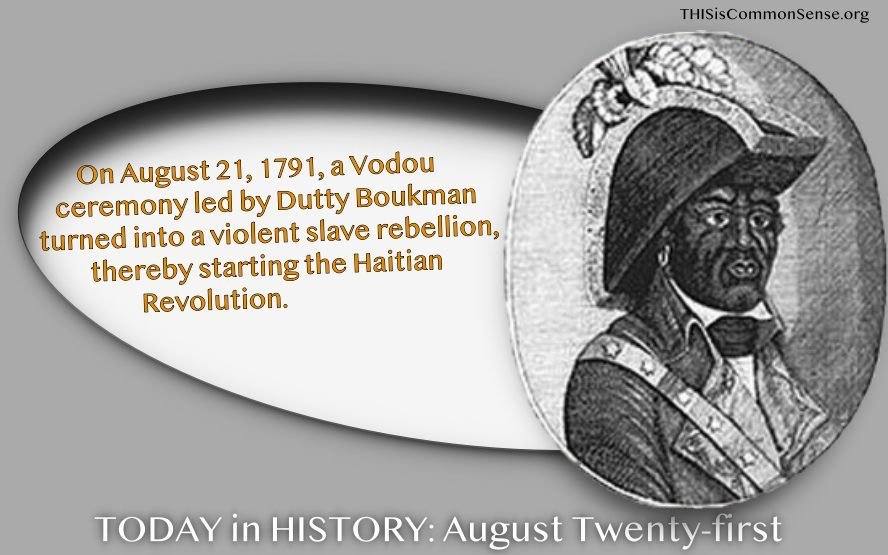
On August 21, 1791, a Vodou ceremony led by Dutty Boukman turned into a violent slave rebellion, thereby starting the Haitian Revolution.

Categories
crime and punishment social media

Talking About Crime in DC

How bad is Washington’s crime problem? Well, that’s hard to know precisely, what with rampant fudging of crime statistics.

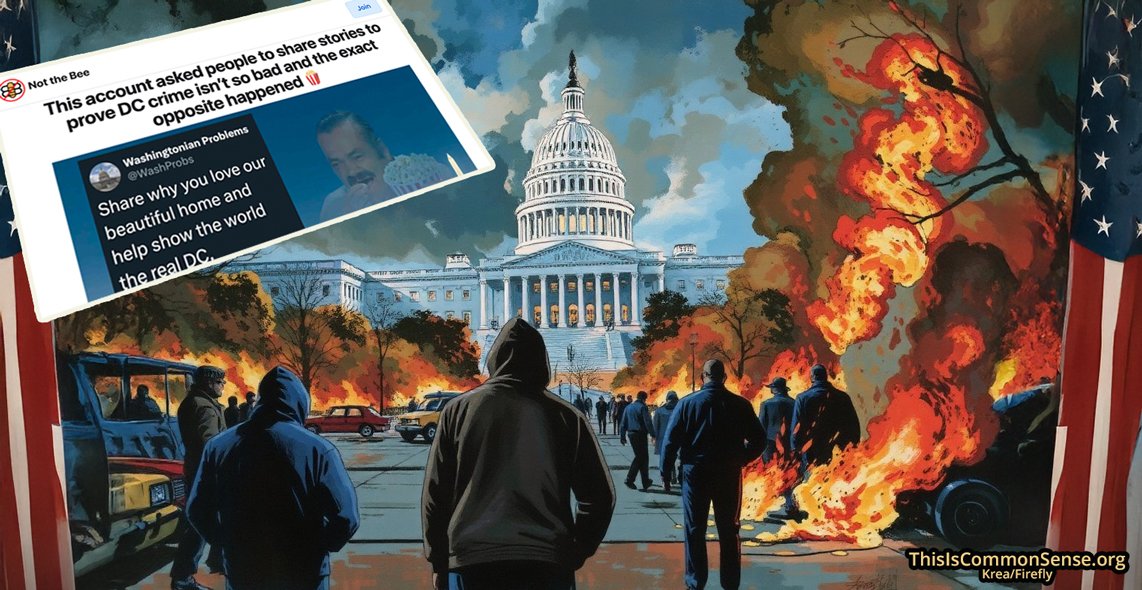
We get anecdotes. For example, via tweeted responses to an invitation by the X account Washingtonian Problems to “push back against the negative narrative about our city. Share why you love our beautiful home and help show the world the real DC.”

Whether the appeal was meant ironically, a possibility suggested by Not the Bee, I don’t know. But a good many reports of non-beauty ensued.

● “I was called into court to give a statement about a man who’d exposed himself to me on the metro. He had over 200 charges to date. Court was delayed four hours for him to ‘calm down’. . . . Once he had, she dismissed the new charges and let him go.”

● “Less than a mile from the Capitol, kids tried to steal my backpack. Punched, for no reason, by a guy on the Metro. . . . Cops recently showed me videos they can’t release. What’s happening out there is more insane than most imagine.”

● “I watched a man kick a plate-glass door in at a 7-Eleven. 911 kept me on hold for almost five minutes before telling me not to call back, it was a property crime.”

Then there’s the news-making disgruntled DoJ employee who threw a Subway sandwich at a Customs and Border Protection officer.

From these reports and plenty others I think we can conclude that yes, crime has been a problem in Washington DC.

As has law enforcement.

This is Common Sense. I’m Paul Jacob.


PDF for printing

Illustration created with Krea and Firefly

See all recent commentary
(simplified and organized)
See recent popular posts

Categories
Thought

James Branch Cabell

Man alone of animals plays the ape to his dreams.

The character “Manuel the Redeemer,” in James Branch Cabell, The Silver Stallion: A Comedy of Redemption (1926), Book Four: “Coth at Porutsa,” Ch. XXV: “Last Obligation upon Manuel.” See also Beyond Life: Dizain des Démiurges (1921), pp. 45.

Categories
Today

The War’s End

On August 20, 1866, President Andrew Johnson formally declared the American Civil War over.

Categories
crime and punishment government transparency

The Case of the Phony Stats

One theme of The Wire, a series about the war on drugs in Baltimore, is the willingness of police department leaders to fake crime statistics.

Despite a few flights of fancy, the drama prided itself on its realism. It turns out that in reality, too, police department bosses may be willing to rewrite crime statistics so things don’t seem as bad as they are.

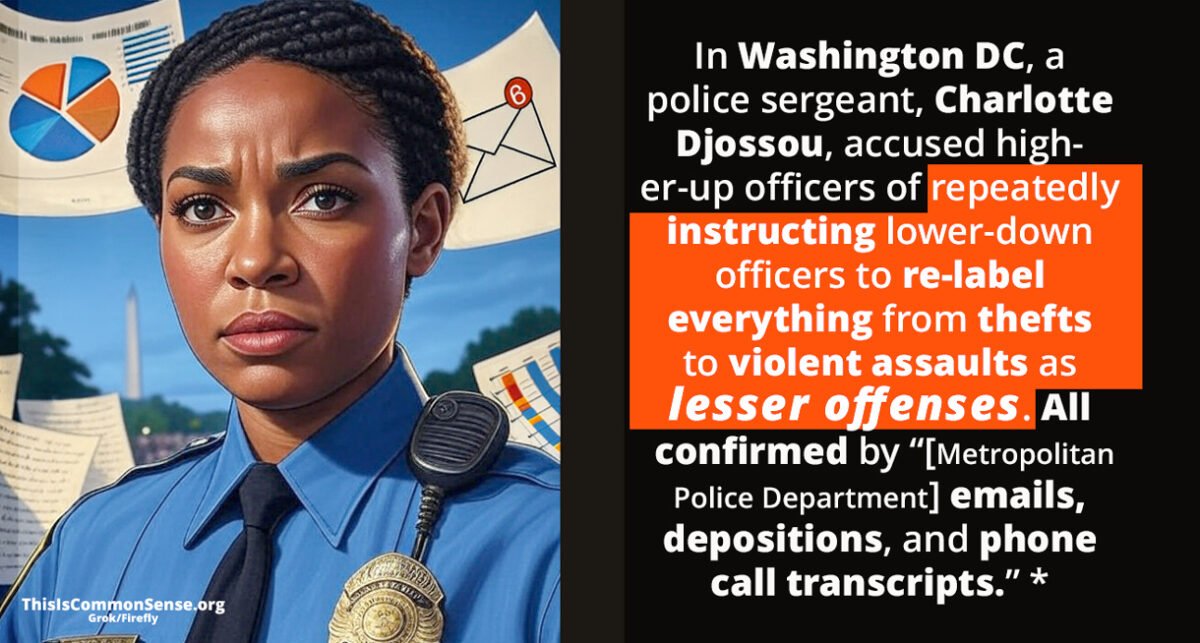
In Washington DC, a police sergeant, Charlotte Djossou, accused higher-up officers of repeatedly instructing lower-down officers to re-label everything from thefts to violent assaults as lesser offenses. All liberally confirmed by “[Metropolitan Police Department] emails, depositions, and phone call transcripts” seen by The Washington Free Beacon.

The MPD has now settled with Djossou, who sued the department in 2020 after it punished her for bringing the matter up.

One example that emerged in the legal proceedings is a 2022 deposition by Randy Griffen, an MPD commander. Griffen admits telling a police captain, Franklin Porter, to find “a solution for the theft problem, which was driving up the district’s statistics.” The solution was to recategorize instances of shoplifting and theft, now calling them “Taking Property Without Right” — “because TPWOR reports are not tracked in the DC Crime Report.”

The Free Beacon quotes extensively from court documents. Tweaking the crime stats was routine in DC for years.

The DC Police are not alone: other fictionalizers of crime statistics are known to have flourished in LA, NYC, New Orleans, and Columbus, Ohio.

This is Common Sense. I’m Paul Jacob.


PDF for printing

Illustration created with Grok and Firefly

See all recent commentary
(simplified and organized)
See recent popular posts

Categories
Thought

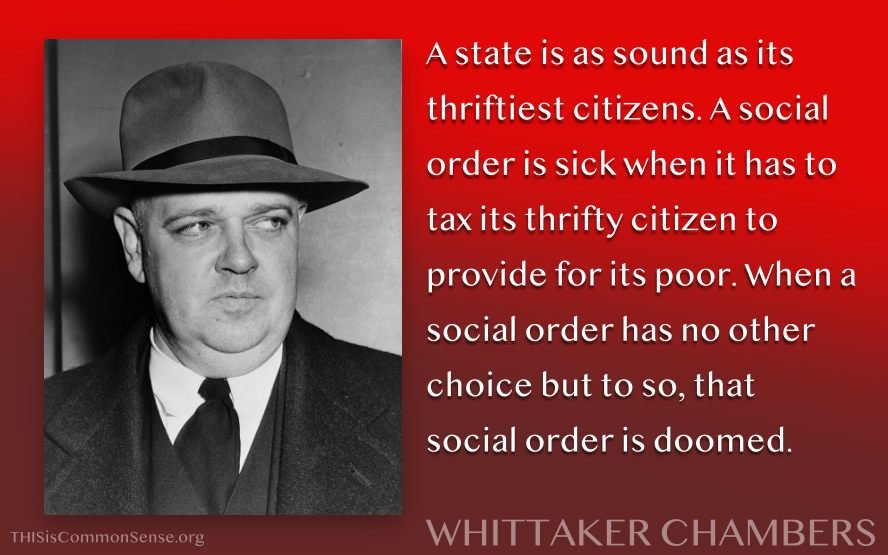
Whittaker Chambers

A state is as sound as its thriftiest citizens. A social order is sick when it has to tax its thrifty citizen to provide for its poor. When a social order has no other choice but to so, that social order is doomed.

Whittaker Chambers, “The Anatomy of Fascism,” The American Mercury (April 1944), p. 94.