When we see that the most ardent advocates of the minimum wage law have been the AFL-CIO, and that the concrete effect of the minimum wage laws has been to cripple the low-wage competition of the marginal workers as against higher-wage workers with union seniority, the true motivation of the agitation for the minimum wage becomes apparent.
Stan Collender, writing last year in Forbes, noted just what a big spender the president really is. Now, an update: fiscal year 2019 sports a deficit of $1.09 trillion, up considerably from the $897 billion projected earlier this year; the next year is expected to nudge the deficit even higher, to $1.1 trillion.
The whys aren’t a mystery: it is politically difficult to cut an expected benefit to any constituency. It looks stingy — though it is the very opposite. Spending other people’s money — including taxpayers’ — is not generosity. For a politician, it is naked self-interest. Buyingvotes.
Worse than merely corrupt, it’s corrupting — since the People are increasingly tempted to look to government to supply special voting bloc advantages rather than the mutual, universal advantage of liberty and justice for all.
Collender speculated that a $2 trillion deficit is “definitely within view” because “Trump is demanding that federal spending and the government’s red ink be increased even further.”
Judd Gregg, writing yesterday for The Hill, summarizes current GOP fiscal policy as “now the most profligate and debt-driving party in the nation’s history.”
He’s not wrong, but I question his next line: “Fiscal restraint is no longer part of the cloth the Republican Party wears.”
Careful wording.
Republicans sometimes talk a good game, but are known to be big spenders when not opposing a Democratic president. The Class of 94 was effective against Bill Clinton. Under unified government in the aughts, though, under George W. Bush, they went on a spree.
Looking for an exemplar of condescending witlessness? Take Steve Benen, producer of MSNBC’s Rachel Maddow Show. Please!
Last week, I praisedDemocratic presidential candidate Tom Steyer for endorsing term limits, while Benen panned him at The Maddow Blog, calling term limits a “gimmick.”
So, when Aristotle argued for mandatory rotation in office, that was just a stunt?
“I imagine most term-limit proponents mean well,” concedes the snooty Benen, about congressional term limits’ whopping 82 percent public support. But, he goes on, “whether they appreciate the details or not, forcing experienced policymakers out of office, even if their constituents want to re-elect them, has an unintended consequence: inexperienced officials inevitably find themselves more dependent on outside groups and lobbyists . . .”
Are we supposed to believe that lobbyists and special interests are being kept at bay by Congress’s current careerists?
Supposedly appealing to an “underlying principle,” Benen then maintains that “there’s simply no reason for the federal government to impose arbitrary constraints on voters’ ability to choose their own members of Congress.”
Oh, that’s really rich — as if “the federal government” is dictatorially cramming term limitation down the throats of poor politician-adoring voters.
Benen notes that Steyer is “not the only Democratic candidate endorsing term limits,” acknowledging that Beto O’Rourke has also proposed the reform. Actually, there are eight more Democratic presidential candidates who have voiced support.*
Mr. Benen’s sophistication boils down to the tired slogan: “We already have term limits; they’re called elections.”
That may fly for the insiders at MSNBC and in Congress, but the vote the American people most want to see is on a constitutional amendment for congressional term limits.
This is Common Sense. I’m Paul Jacob.
* Those candidates are: New Jersey Senator Cory Booker, former HUD Secretary Julian Castro, Maryland Congressman John Delaney, New York City Mayor Bill DiBlasio, New York Senator Kirsten Gillibrand, former Colorado Governor John Hickenlooper, Massachusetts Congressman Seth Moulton, and entrepreneur Andrew Yang.
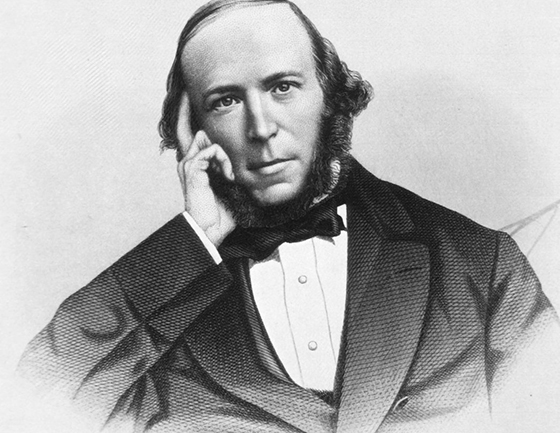
Whoever hesitates to utter that which he thinks the highest truth, lest it should be too much in advance of the time, may reassure himself by looking at his acts from an impersonal point of view. Let him duly realize the fact that opinion is the agency through which character adapts external arrangements to itself—that his opinion rightly forms part of this agency—is a unit of force, constituting, with other such units, the general power which works out social changes; and he will perceive that he may properly give full utterance to his innermost conviction: leaving it to produce what effect it may. It is not for nothing that he has in him these sympathies with some principles and repugnance to others. He, with all his capacities, and aspirations, and beliefs, is not an accident, but a product of the time. He must remember that while he is a descendant of the past, he is a parent of the future; and that his thoughts are as children born to him, which he may not carelessly let die.
Herbert Spencer, from the last page of “The Unknowable,” Part One of First Principles, Second Edition (1867).
Paul tells tales from the early days of the movement — featuring stories about Speaker Tom Foley, Representative Dick Armey, and Senator William Proxmire — and also explaining precisely why people love term limits so much.
Inspiring:
The discussion starts with a famous PSA — used as “an effect” in our previous video.
Attention to advertising, Representative Dick Armey and Senator William Proxmire.
Oh, and Sam Nunn. Heavens, let’s not forget Sam Nunn!
On July 21, 1925, in Dayton, Tennessee, high school biology teacher John T. Scopes was found guilty of teaching evolution in a public school classroom, and fined $100. The ambiguous legacy of the trial would continue — for decades, even to the present — to reveal the tensions inherent within a school system run by government and funded by taxpayers.
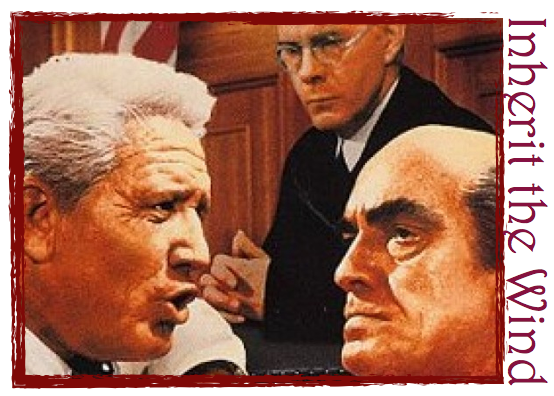
Pictured above, publicity for Inherit the Wind, a 1960 movie about the trial, but with the names changed, fictionalized. The movie starred Spencer Tracy in the Clarence Darrow (lawyer for the defense) role; Frederic March in the prosecutorial part, “Matthew Harrison Brady,” the pseudonymous name for politician William Jennings Bryan; Dick York as the defendant, Mr. Scopes; and Gene Kelly as the Baltimore journalist, a stand-in for H. L. Mencken, whose infamous coverage of the story shocked the nation almost as much as the trial itself. It was Mencken who dubbed the affair “The Scopes ‘Monkey’ Trial.”
At the end of the movie (spoiler alert!) the famous prosecutor dies in the courtroom. In the historical case, Bryan died five days after the verdict. The movie was based on the 1955 play of the same name, written by Jerome Lawrence and Robert Edwin Lee, directed by Stanley Kramer. The script was adapted by Nedrick Young (originally as Nathan E. Douglas) and Harold Jacob Smith.
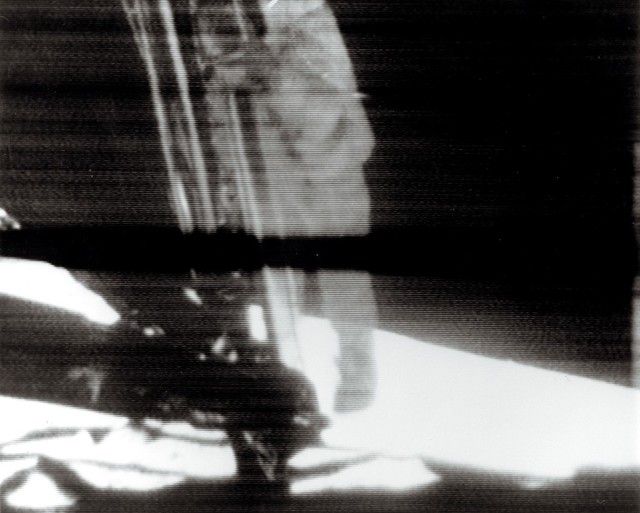
Today is the 50th anniversary of the Apollo 11 mission’s perambulation upon the Moon, on July 21, 1969. Neil Armstrong and Buzz Aldrin walked upon the surface of Mare Tranquillitatis for about two hours and 15 minutes. They spent over 21 hours on the surface, total, most of it inside the Lunar Module, at the site they called Tranquillity Base, before launching to rejoin astronaut Michael Collins in lunar orbit, and returning to Earth on July 24.
A mounted slowscan TV camera shows Apollo 11 space mission US astronaut Neil Armstrong as he climbs down the ladder from the lunar module "Eagle" on July 21, 1969, thus becoming the first man in history to set foot on the moon's surface. AFP PHOTO NASA (Photo by NASA / AFP)
That’s one small step for [a] man, one giant leap for mankind.
What the Apollo 11 astronaut said as he set foot upon the lunar surface on July 21, 1969. The sentence is self-contradictory as CBS news anchor Walter Cronkite heard it and repeated it on air, without the indefinite article — “man,” unmodified, in this context means “mankind” — but Armstrong had indeed intended to say it with the article, so making his announcement sensible and even profound; it is also what he probably did actually say, but was garbled in the transmission to Earth.