Categories
national politics & policies representation

Must the War Go On?

“There is an easy way to end the gerrymandering wars,” a new video by The Recount asserts,and no one is talking about it.”

Except them. And us. And others

“We need more members of Congress,” the anonymous male narrator continues. “This might sound weird, especially since most of us don’t exactly love the ones we have now. But the reality here is simple: the U.S. has the worst ratio of citizens to elected representatives of every developed democracy in the world.”

It’s true. Congressional districts have been capped at 435 since 1929’s Permanent Apportionment Act. That year, the average congressperson represented 243,000 people. That’s too many. But today, the average congressperson represents 761,000 people.

“So uncap the house,” Jeff Mayhugh and A.D. Tippet argue in The Hill, “and rein in gerrymandering at least a bit.

“Our founders believed that smaller congressional districts would lead to a better relationship between citizens and their government,” the authors contend. “Gerrymandering undermines this idea by splitting neighbors from each other or packing them in districts with others from the same party to secure a seat for the political party in control.”

And then there’s this: “Smaller districts are more representative and also harder to manipulate.”

“With more seats, districts can be smaller and more representative of smaller enclaves and communities,” explains the video presentation, “and when that happens, the chances of Republicans winning seats in Massachusetts or Democrats winning seats in South Dakota goes up.”

Entitled “Why Expanding Congress Would End Gerrymandering,” The Recount’s video also correctly points out that creating a smaller representative-to-voter ratio by increasing the size of the House is “fully within Congress’s power” and “doesn’t take a constitutional amendment.”

But it would take a great deal of citizen . . . push.

This is Common Sense. I’m Paul Jacob.


PDF for printing

Illustration created with Krea and Firefly

See all recent commentary
(simplified and organized)
See recent popular posts
Categories
Thought

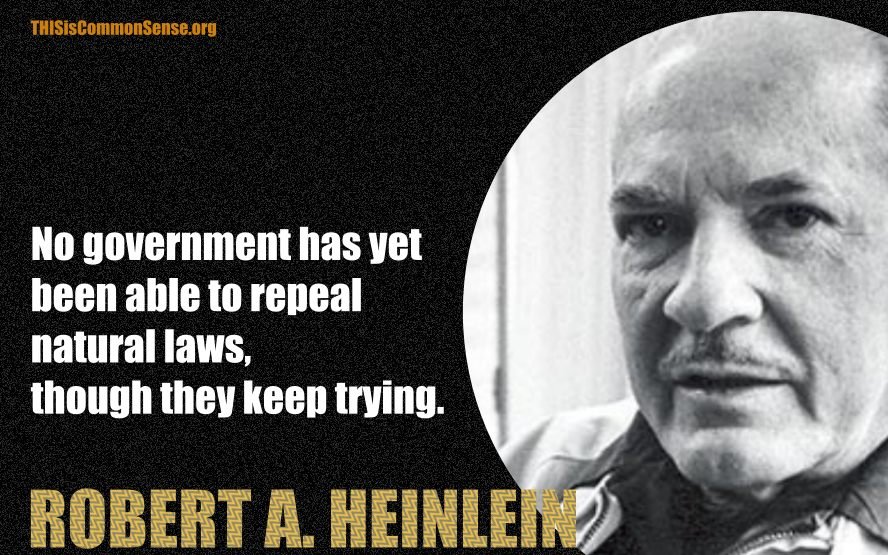
Robert A. Heinlein

No government has yet been able to repeal natural laws, though they keep trying.

Robert A. Heinlein, Farnham’s Freehold (1964).
Categories
Today

Galileo’s Telescope

On August 25, 1609, Galileo Galilei first demonstrated his new invention, the telescope, to Venetian lawmakers. Magnifying distant images by about eight or nine times, it quickly became a profitable sideline for Galileo, who sold his telescopes to merchants who found them useful both at sea and as items of trade. He published his initial telescopic astronomical observations in March of the next year.

Categories
Update

Only One Thing Worse Than Global Warming

The current stretch of history dominated by Trump, war, a reverse in fortunes in the culture war, and AI, have the Greta Thunberg brigades champing at the bit to bring back “climate change” as the main driver of conversation and policy.

So gird up your loins and remember the real big picture in climate change: the regularity of the cycle of glaciation/deglaciation in our current era, the current interglacial of the Ice Age.

And of course there is always John Stossel to throw some cold water on global warming:

Categories
Thought

Doris Lessing

It is our habit to dismiss the Old Testament altogether because Jehovah, or Jahve, does not think or behave like a social worker.

Doris Lessing, Shikasta (1979), p. x.

Categories
Today

The Great Soviet Crackup Begins

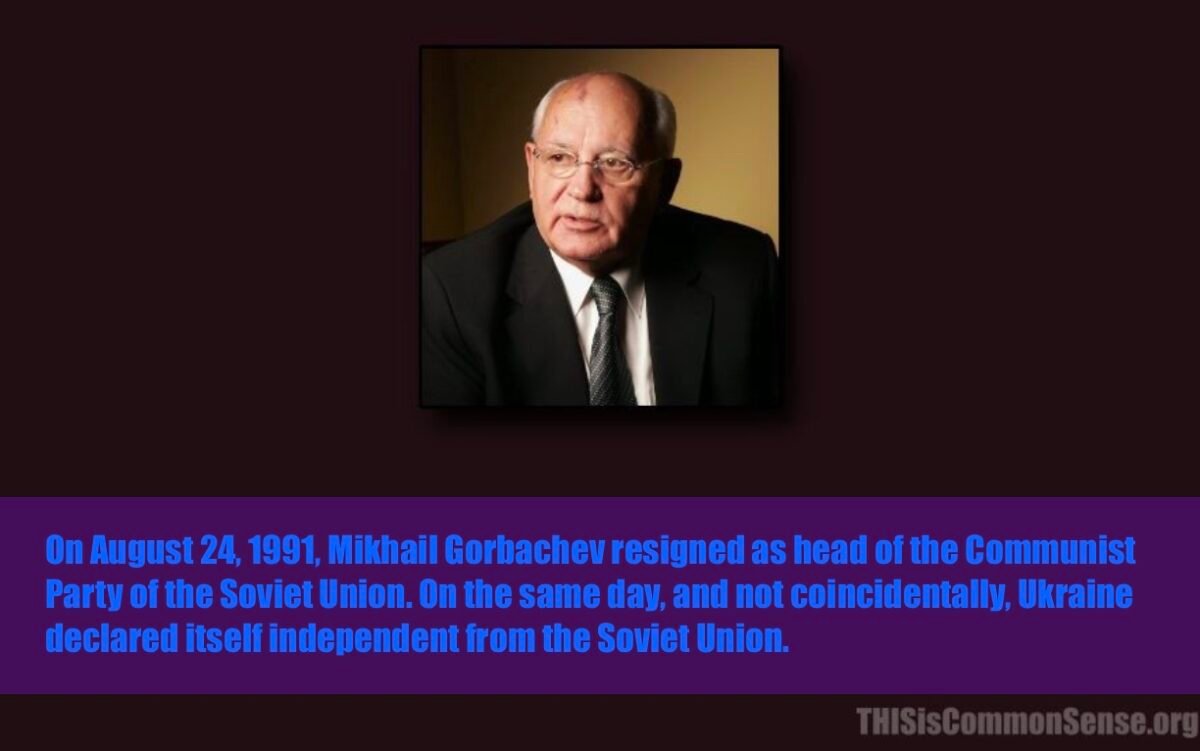
On August 24, 1991, Mikhail Gorbachev resigned as head of the Communist Party of the Soviet Union. On the same day, and not coincidentally, Ukraine declared itself independent from the Soviet Union.

Categories
Update

Socialism Voted Out

South America’s 21st century boom in socialist politics is going bust all over the continent. The latest case? Bolivia. See the terrific article in Reason:

Argentina’s libertarian president, Javier Milei, has turned fiscal shock therapy into a political calling card, and the payoff is visible as inflation cools, poverty falls, and growth returns. In Ecuador, Daniel Noboa secured a second term by blending tough security policies at home with pragmatic economic partnerships abroad, striking new deals with China while maintaining close ties to the U.S. Colombia is poised to move sharply to the right in next year’s election, with one leading contender, the conservative journalist Vicky Dávila, sounding a lot like Milei.

The most recent reversal is happening in Bolivia, where voters just rejected democratic socialism by a lopsided margin. The results mark a sharp turn away from the policies of former President Evo Morales, which have brought immense suffering to the country. In last week’s election, the once-dominant Movement Towards Socialism (MAS) barely cleared 3 percent of the vote.

César Báez, “Socialism Just Imploded in Bolivia,” Reason (August 21, 2025).

Socialism is inherently unstable, contra all the leftists in first world countries who apologize for it. Why is it unstable? Well, the key argument was developed by Ludwig von Mises and F.A. Hayek: complex systems like large societies gain much by distributing responsibility widely, so that diverse knowledge from all sources can be leveraged with minimum of coercion and maximum of efficiency; the industrial society that tries to provide a wide array of consumer goods must fail, because the central planners cannot calculate value without markets in production goods.

Socialism as a universal mode of production is impracticable because it is impossible to make economic calculations within a socialist system. The choice for mankind is not between two economic systems. It is between capitalism and chaos.

Ludwig von Mises, Omnipotent Government: The Rise of the Total State and the Total War (1944).

There are many other arguments as well. Ayn Rand famously said that though one can vote oneself into socialism, one must shoot one’s way out. That appears to be the case in Venezuela, but not, thankfully, Bolivia. “The socialist project ‘imploded by itself,’ Bolivian policy analyst Rolando Schrupp” explained, according to the Reason article, “citing public exhaustion after nearly two decades of rule.”

This is the problem with democratic socialism, as Irving Kristol noted: “Every social-democratic party, once in power, soon finds itself choosing, at one point after another, between the socialist society it aspires to and the liberal society that lathered it.”

Thankfully, Bolivians are choosing democracy by voting out the socialists.

Categories
Thought

Robert A. Heinlein

If you would know a man, observe how he treats a cat.

Robert A. Heinlein, The Door Into Summer (1957)
Categories
Today

Sacco & Vanzetti

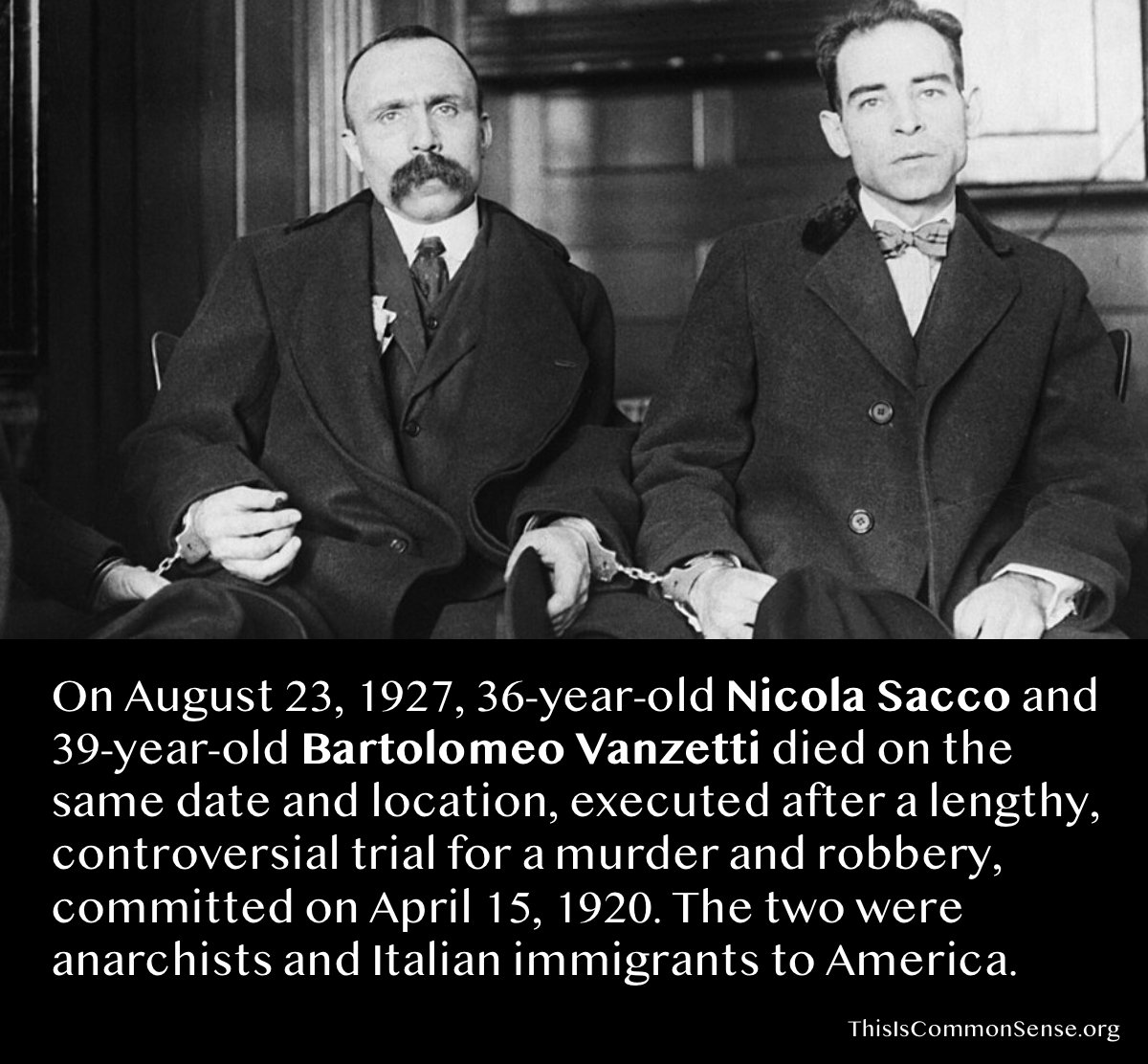
On Tuesday, August 23, 1927, 36-year-old Nicola Sacco and 39-year-old Bartolomeo Vanzetti died on the same date and at the same location, executed after a lengthy, controversial trial for a murder and robbery, committed on April 15, 1920. The two were anarchists and Italian immigrants to America. The means of execution was the electric chair for both; the times of execution were between noon and 12:30 on that Tuesday.

Categories
First Amendment rights international affairs Internet controversy privacy

Apple to Keep Encryption

Thanks, United Kingdom.

Following pressure on UK officials by the Trump administration and some congressmen, British censors have caved — the U.S. Director of National Intelligence confirmed that the UK was abandoning its demand that Apple burn a hole in its iPhone encryption.

So Apple may continue providing its flagship smartphone with robust encryption. Cyberhackers and autocratic regimes (including snoopy British officials) — who’d love a crashable gate into everyone’s private iPhone information — must now endure their extreme disappointment.

Director Tulsi Gabbard reported on X that the UK will “drop its mandate for Apple to provide a ‘back door’ that would have enabled access to the protected encrypted data of American citizens and encroached on our civil liberties.”

Such a back door would have rendered the encryption close to pointless, presenting a vulnerable target to all bad guys in addition to all “good” guys in the UK holding backdoor keys.

Under an agreement in effect since 2019, U.S. companies are obliged to comply with requests from UK officials for data relevant to criminal investigations.

The agreement prohibits surveillance of Americans. But this year British officials secretly demanded that Apple install a back door to enable the UK government to extract data from any iPhone. Yes, that’s any iPhone anywhere in the world. 

The British Government also planned to initiate these back-door intrusions without even needing to show relevance to a UK criminal investigation, let alone provide a warrant.

How long will the reprieve last? Maybe only until we get another U.S. administration as eager to censor everything as the last one was.

This is Common Sense. I’m Paul Jacob.


PDF for printing

Illustration created with Krea and Firefly

See all recent commentary
(simplified and organized)
See recent popular posts