On July 31, 1703, Daniel Defoe — who would later become famous as the author of Robinson Crusoe and other literary works — was placed in a pillory for the crime of seditious libel. The sedition pertained to a satirical pamphlet he had published, “The Shortest-Way with the Dissenters; Or, Proposals for the Establishment of the Church.” The mob pelted him with flowers.
On the same date in 1912, Milton Friedman was born. Friedman became one of the most influential economists of the 20th century, and one of the most effective advocates of free markets, as well. His books include Capitalism and Freedom and two famous collaborations, A Monetary History of the United States (with Anna Schwartz) and Free to Choose (with his wife, Rose Friedman).
There is what I call the American idea. I so name it, because it seems to me to lie at the basis of all our truly original, distinctive, and American institutions. It is itself a complex idea, composed of three subordinate and more simple ideas, namely: The idea that all men have unalienable rights; that in respect thereof, all men are created equal; and that government is to be established and sustained for the purpose of giving every man an opportunity for the enjoyment and development of all these unalienable rights. This idea demands, as the proximate organization thereof, a democracy, that is, a government of all the people, by all the people, for all the people; of course, a government after the principles of eternal justice, the unchanging law of God; for shortness’ sake, I will call it the idea of Freedom.
Theodore Parker, “The American Idea,” a speech at New England Anti-Slavery Convention, Boston (May 29, 1850)
“The idea that negative interest rates will produce loans and generate growth,” concludes Richard Rahn in a Washington Times op-ed, “is not supported by the evidence to date.”
Citing current markets for Danish and Swiss bonds, Rahn states that “approximately 30 percent of the global government bond issues are now trading in negative territory.”
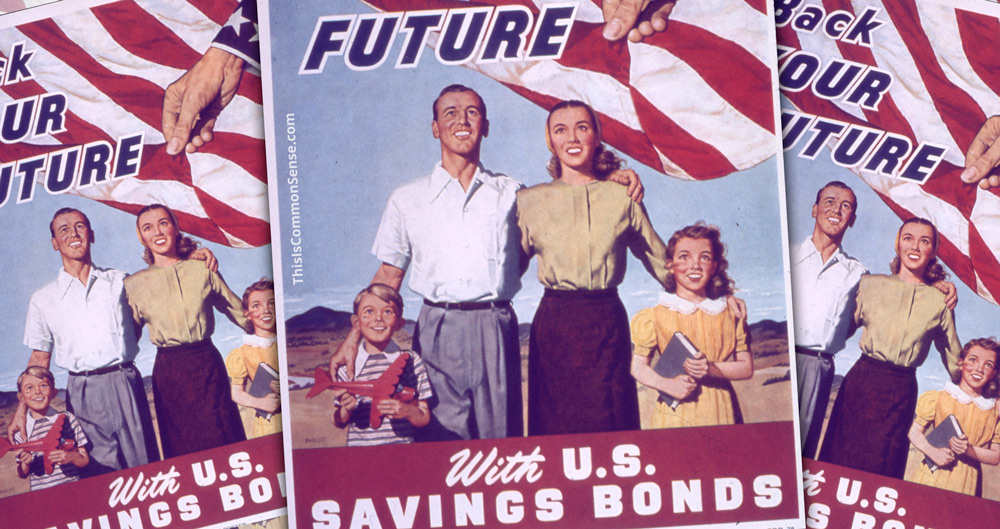
Bonds used to seem the best investment. Government is the biggest, most reliable consumer, as J.B. Say and Destutt de Tracy (the latter being Thomas Jefferson’s favorite economist) argued, making the bond market the surest form of consumer credit. Governments last, weathering storms. So people loan them money not merely to earn interest, but to not risk their principal investment.
Government bonds during America’s Great Depression were about the only form of investing going on: everything else was shaky.
Which seems to be happening again.
“In theory, as the interest rate falls, businesses and individuals should borrow and invest more,” Rahn explains. “In fact, as can be easily seen in Japan, as the interest rate falls, many save more — increasing the supply of savings and putting downward pressure on interest rates — in order to ensure they will have adequate funds for retirement. So, a low or negative interest rate policy becomes self-defeating.”
Could the logic of modern economic policy be . . . illogical?
Keynesian fiscal policy has always struck me as based on . . . evasions, the most obvious being that actual, real-world Keynesian politicians somehow never insist that deficits be turned into surpluses in good times, as John Maynard Keynes’ original program stated.
Modern monetary policy also seems . . . well, if not evasive, at least . . . desperate.
Which I would be, too, were I riding on a growing debt as big as the federal government’s.
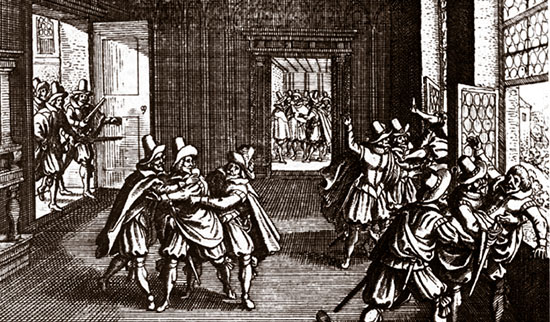
July 30, 1419, the First Defenestration of Prague: Jan Želivský, a Hussite priest at the church of the Virgin Mary of the Snows, led his congregation on a procession through the streets of Prague to the New Town Hall, on Charles Square. While they were marching, a stone was thrown at Želivský from the window of the town hall. The mob, enraged, stormed the hall. Once inside, the group threw the judge, the burgomaster, and some thirteen members of the town council out of the window and into the street, where they were killed by the fall or dispatched by the mob.
King Wenceslaus IV of Bohemia, upon hearing this news, was so stunned, the legend goes, that he died soon after.
On July 30, 1619, the first representative assembly in the Americas, the House of Burgesses, convened for the first time in Jamestown, Virginia. On the same date in 1676, Nathaniel Bacon issued the “Declaration of the People of Virginia,” beginning Bacon’s Rebellion against the rule of Governor William Berkeley.
On this date in 1863, representatives of the United States and tribal leaders (including the Shoshone’s Chief Pocatello) signed the Treaty of Box Elder.
July 30 birthdays include Henry Ford (1863), Gen. Smedley Butler (1881), C. Northcote Parkinson (1909), and former California Governor Arnold Schwarzenegger (1947).
Reason magazine’s Nick Gillespie finds “a lot” to like about Pete Buttigieg. He sees a candidate “who at his best represents a new generation in American politics and a principled unwillingness to go along with the most free-spending plans of his rivals for the Democratic presidential nomination.”
I have so far resisted the charms of the Mayor of South Bend, Indiana.
He seems dangerous to me, in part because he cuts quite a figure while appearing so calm and reasonable.
But Mr. Gillespie is not making a case for Buttigieg. The Reason editor has noticed a growing set of downsides to the pol, writing that as Buttigieg “starts to unveil more and more plans — to pack the Supreme Court, say, and to call for national service — he becomes less appealing,” which, if anything, understates the situation.
You see, Buttigieg “wants to destroy the gig economy in order to save it.”
Gillespie provides that “takeaway” from the campaign’s proposal, “A New Rising Tide: Empowering Workers in a Changing Economy.” Gillespie explains that the plan’s “focus is to force more regulations on employers and increase unionization among workers, neither of which is likely to make it easier for the economy to grow or the workplace to ‘more easily adapt’ to the needs of suppliers, workers, or consumers.”
There is a lot about the current labor markets (at record all-time highs, says the President) that definitely would not be helped by a plan to “organize” labor using the old idea of the strike-threat system.
Like a lot of Buttigieg’s positions, they seem warmed-over yesteryear progressivism.
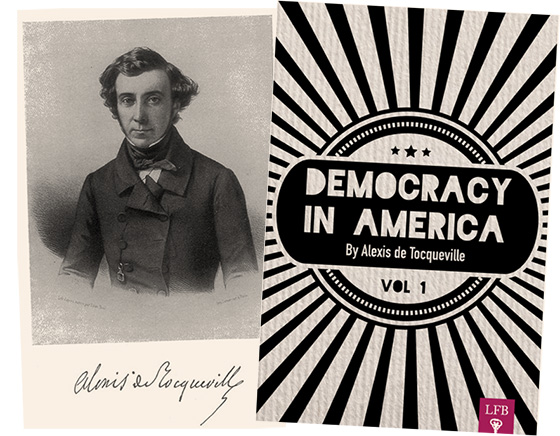
I sought for the greatness and genius of America in her commodious harbors and her ample rivers — and it was not there. . . . . in her fertile fields and boundless forests — and it was not there. . . . . in her rich mines and her vast world commerce — and it was not there. . . . in her democratic Congress and her matchless Constitution—and it was not there. Not until I went into the churches of America and heard her pulpits flame with righteousness did I understand the secret of her genius and power. America is great because she is good, and if America ever ceases to be good, she will cease to be great.
Rev. John McDowell, from a sermon quoted in a 1922 letter to the Herald and Presbyter (vol. 93, no. 36, p. 8). McDowell misattributed it to Alexis de Tocqueville, in Democracy in America, and it has widely been mis-cited since.
On July 29, 1805, Alexis de Tocqueville was born. His most famous book, Democracy in America (two volumes: 1835, 1840), quickly became a classic of social and political research and analysis, and remains the most important early book about the United States of America. He is often referred to as a founder of sociology as well as a major figure in the development of classical liberalism.