Categories
Today

First President of Congress

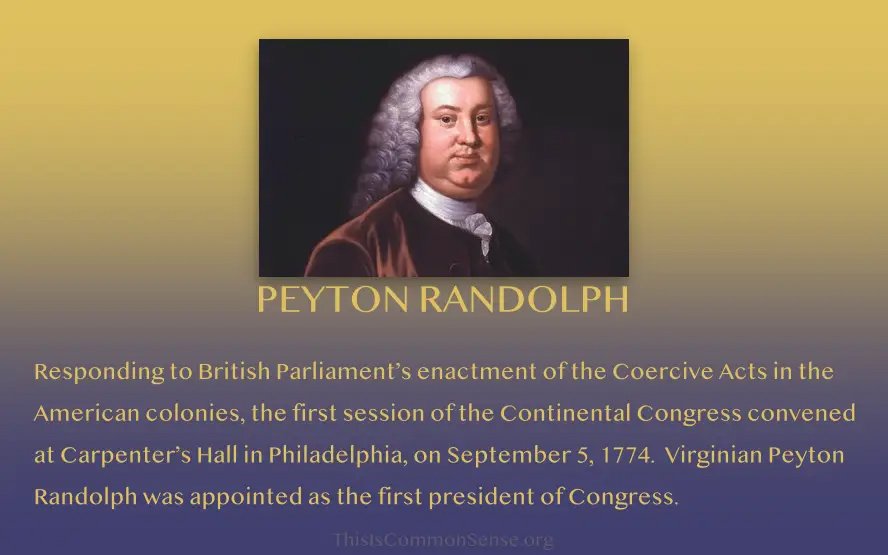
Responding to British Parliament’s enactment of the Coercive Acts in the American colonies, the first session of the Continental Congress convened at Carpenter’s Hall in Philadelphia, on September 5, 1774. Virginian Peyton Randolph (pictured) was appointed as the first president of Congress. John Adams, Patrick Henry, John Jay and George Washington were among the delegates.

Categories
Fifth Amendment rights property rights

The Everest of Theft

Civil forfeiture laws allow officers of the law to commit theft. Sometimes they have to return the money they stole. But they don’t get punished.

Under civil forfeiture, authorities can grab cash or other possessions without proving criminal wrongdoing and without making an arrest. Since 2000, though, a federal law has made the federal government liable for reasonable attorney fees when a victim “substantially prevails” in court.

This law enabled Brian Moore, a rap artist, to eventually obtain compensation for thousands in legal costs after he sued to recover the $8,500 taken from him by federal drug agents.

One day in 2021, Moore took this cash, which he had inherited from his grandfather, to the airport. He hoped to fund production of a music video in Los Angeles, his destination. He was thwarted.

Even after a judge ruled that Moore could get his money back, he had to keep fighting, now with the help of Institute for Justice, to be compensated for legal fees. Eventually, he won that battle too.

But he won only after wasting a lot of time and suffering a lot of anxiety because officers of the law, with no evidence of wrongdoing, treated a person carrying cash as guilty of something just for carrying cash.

It was like Mount Everest. The officers took Moore’s stuff because it was there. 

And they knew what they were doing. Such conduct should be punishable. If it were, it wouldn’t happen so often.

This is Common Sense. I’m Paul Jacob.


PDF for printing

Illustration created with Krea and Firefly

See all recent commentary
(simplified and organized)
See recent popular posts

Categories
Thought

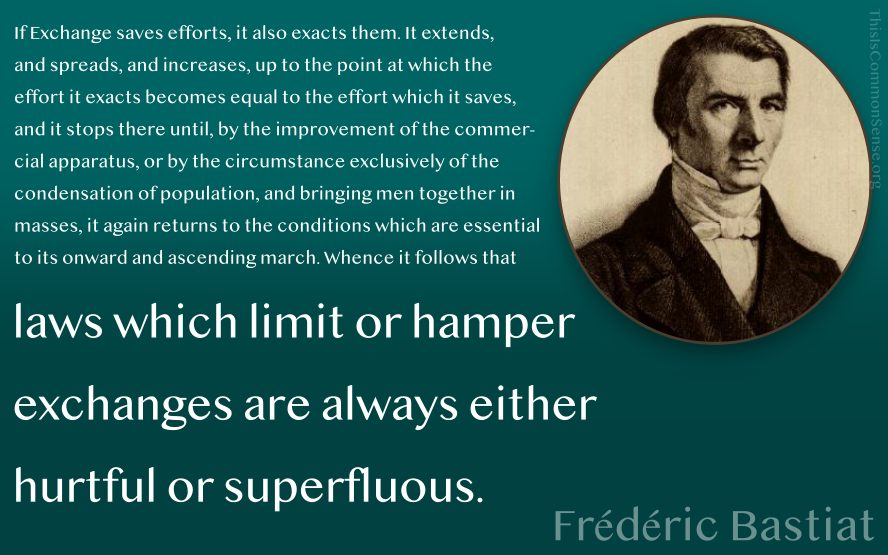
Frédéric Bastiat

If Exchange saves efforts, it also exacts them. It extends, and spreads, and increases, up to the point at which the effort it exacts becomes equal to the effort which it saves, and it stops there until, by the improvement of the commercial apparatus, or by the circumstance exclusively of the condensation of population, and bringing men together in masses, it again returns to the conditions which are essential to its onward and ascending march. Whence it follows that laws which limit or hamper Exchanges are always either hurtful or superfluous.
Governments which persuade themselves that nothing good can be done but through their instrumentality, refuse to acknowledge this harmonic law.
Exchange develops itself NATURALLY until it becomes more onerous than useful, and at that point it NATURALLY stops.
In consequence, we find governments everywhere busying themselves in favouring or restraining trade.
In order to carry it beyond its natural limits, they set to conquering colonies and opening new markets. In order to confine it within its natural bounds, they invent all sorts of restrictions and fetters.

Frédéric Bastiat, Harmonies of Political Economy (from the Third French Edition, Patrick James Stirling, trans.).
Categories
Today

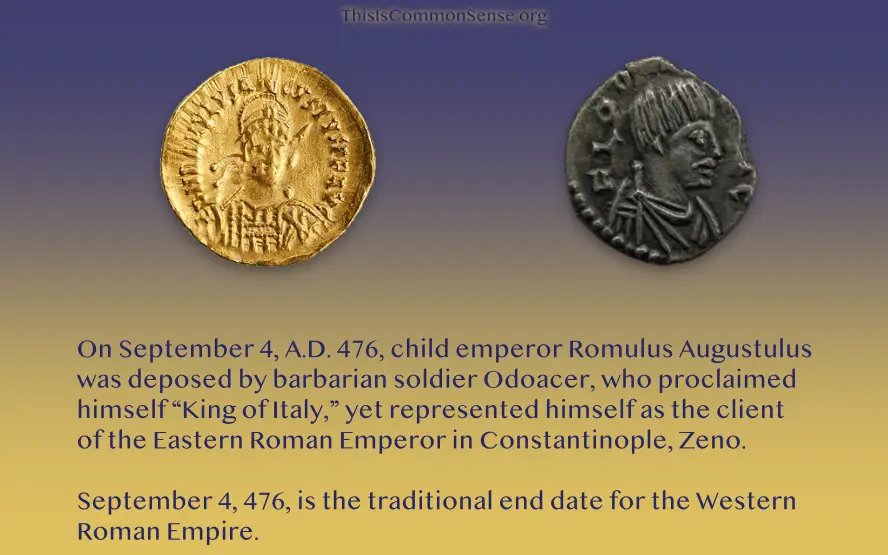
Odoacer Rex

On September 4, A.D. 476, child emperor Romulus Augustulus (Dominus Noster Romulus Augustus Pius Felix Augustus) was deposed by barbarian soldier (and Arian Christian) Odoacer, who proclaimed himself “King of Italy,” yet represented himself as the client of Zeno, the Eastern Roman Emperor in Constantinople.

September 4, 476, is the traditional end date for the Western Roman Empire.

Categories
ideological culture media and media people

Cultural Erasure

Once upon a time, I didn’t think “culture war” issues were important. Give me liberty or — at least lower taxes and allow better representation in Washington.

But in recent years, as the left went woke and the right went MAGA, a number of cultural issues became . . . salient. Unavoidable. Key, even.

In “The Corporate Logo That Broke the Internet,” David French — late editor of National Review and now token rightist for The New York Timesdefends the Cracker Barrel logo rebranding effort, where the image of an old man (Uncle Herschel, in Cracker Barrel lore) leaning against a barrel,” as French describes it, was removed.

Also removed? The tagline on the old logo: “Old Country Store.” All that was left was “Cracker Barrel” on a yellow field.

O, the uproar! And from the right! 

Mr. French thinks it all very stupid. “Right-wing activists did the same thing that they mocked the left for in the [Sydney] Sweeney [American Eagle ad] affair. They looked at a completely normal, innocuous marketing effort, deemed it to be deeply politically coded and then lashed out.”

He contends that the protesting “voices never really explained how a plain logo with the restaurant’s name was woke,” yet the explanation is right before us, staring us in the face everywhere we go.

It was “woke” for corporations to remove beloved commercial icons such as Aunt Jemima, Uncle Ben (now “Ben’s Original”), and “Mia,” the Land O’Lakes Indian maiden. In each of these logos the supposedly “offensive” and “stereotypical” images were removed ostensibly to avoid offending the easily offended. Leaving customers with blank, unoriginal, uninspiring and non-comforting signage.

Exactly what happened when the corporate bigwigs took out the iconography from the Cracker Barrel logo: All nostalgia liquidated.

Cultural erasure used to be a leftist theme, but thanks to today’s enlightened corporations, it has become universal, as the soullessness of modish symbology has become painfully obvious. 

Define woke as erasure in the name of non-erasure. Opposing erasure generally is the defense of culture. That’s not a manufactured “outrage,” or a form of “bullying,” as French asserts.

It’s just Common Sense! I’m Paul Jacob. 


PDF for printing

See all recent commentary
(simplified and organized)
See recent popular posts
Categories
Thought

Frank Herbert

Governments, if they endure, always tend increasingly toward aristocratic forms. No government in history has been known to evade this pattern. And as the aristocracy develops, government tends more and more to act exclusively in the interests of the ruling class — whether that class be hereditary royalty, oligarchs of financial empires, or entrenched bureaucracy.

Frank Herbert, “Politics as Repeat Phenomenon: Bene Gesserit Training Manual,” from Children of Dune (1976).

Categories
Today

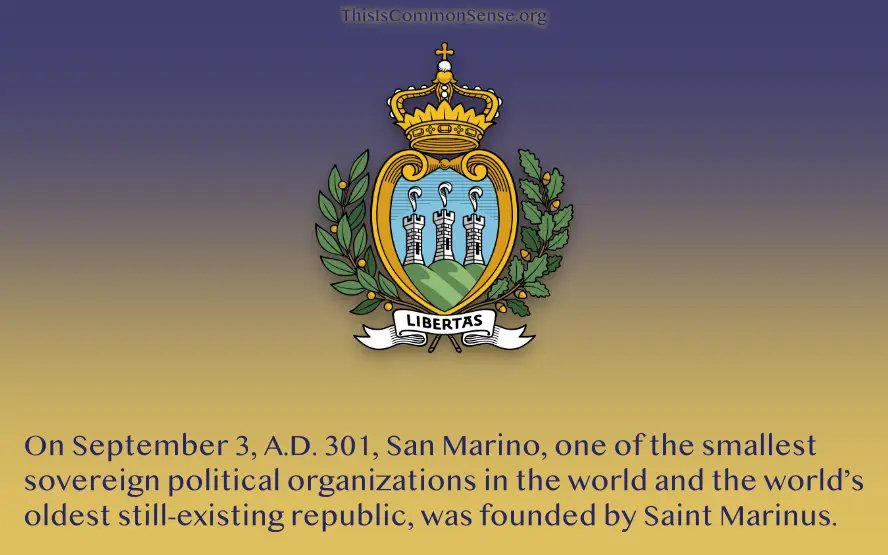
San Marino

On September 3, A.D. 301, San Marino, one of the smallest sovereign political organizations in the world and the world’s oldest still-existing republic, was founded by Saint Marinus.

San Marino is bounded on all sides by northeastern Italy.

Categories
free trade & free markets insider corruption national politics & policies

Protection from Us?

On Labor Day, National Review pointed out that less than 10 percent of all U.S. workers currently belong to unions.

This percentage has been declining for decades. Even during the Biden administration, when the president and his puppeteers did their best to pump up unions, the percentage declined.

In the private sector, only 5.9 percent of workers are union members.

This is great news because unions are typically bad news. By using government-sanctioned force to compel membership and extract wage rates above the market rate, collective bargaining reduces the number of workers who can be employed in a company or industry — thereby distributing wealth from the many to the fewer — and makes firms less efficient.

Only long-run increases in economic productivity enable wage rates to be permanently and generally increased in real terms.

Now, a union devoting itself only to helping workers cope with problems in the workplace problems like an abusive supervisor or gratuitously dangerous working conditions would be fine. But unions as we know them don’t confine themselves to such support and often don’t even offer it. Union bosses prefer to secure above-market wages perhaps because they can then siphon off some of those “rents” (as economists put it).

Meanwhile, unionism is still going strong among public employees. Although government workers constitute only about 15 percent of U.S. workers, these workers “make up about half of the population of union members,”National Review reports.

Who are these government workers protecting themselves from? 

Well, from you and me, basically. 

We might pay them less and we might fire them more often — if we could.

This is Common Sense. I’m Paul Jacob.


PDF for printing

Illustration created with Krea and Firefly

See all recent commentary
(simplified and organized)
See recent popular posts

Categories
Thought

Frédéric Bastiat

Nature has provided, by means as simple as they are infallible, that there should be dispersion, diffusion, coordination, simultaneous progress, all constituting a state of things that your restrictive laws paralyze as much as they can; for the tendency of such laws is, by isolating communities, to render the diversity of condition much more marked, to prevent equalization, hinder integration, neutralize countervailing circumstances, and segregate nations, whether in their superiority or in their inferiority of condition.

Frédéric Bastiat, from Economic Sophisms, “To Equalize the Conditions of Production” — the “such laws” mentioned are protectionist measures, and protectionism was the chief target of Bastiat’s famous book.
Categories
Today

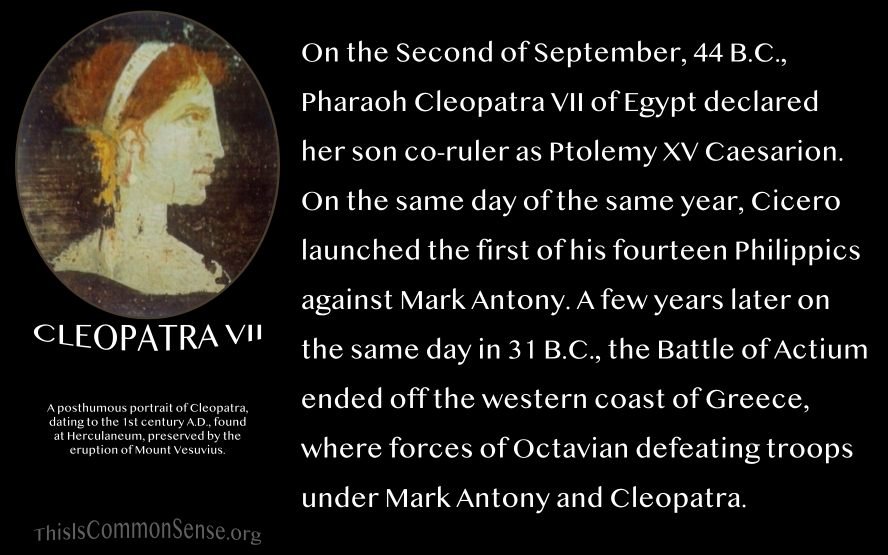
Roman Republic Ends

On September 2, 44 B.C., Pharaoh Cleopatra VII of Egypt declared her son co-ruler as Ptolemy XV Caesarion. On the same day of the same year, Cicero launched the first of his 14 Philippicae (oratorical attacks) on Mark Antony. Just a few years later on the same day, in 31 B.C., the Battle of Actium ended off the western coast of Greece, where forces of Octavian defeating troops under Mark Antony and Cleopatra. Thus ended the Roman Republic, with the consolidation of power by Gaius Octavius (Octavian; Gaius Julius Caesar Octavianus), though he was not renamed “First Citizen” Imperator Caesar divi filius Augustus until January 16, A.D. 27.