A essência do universo é a contradição.
Contradiction is the essence of the universe.
Fernando Pessoa, “A Nova Poesia Portuguesa no Seu Aspecto Psicológico,” A Águia, Porto (September 1912).
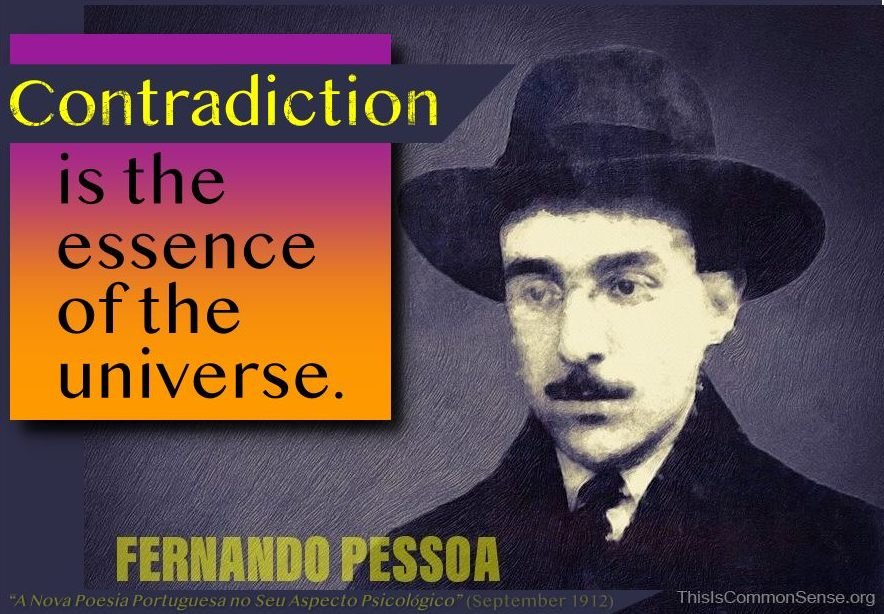
A essência do universo é a contradição.
Contradiction is the essence of the universe.
Fernando Pessoa, “A Nova Poesia Portuguesa no Seu Aspecto Psicológico,” A Águia, Porto (September 1912).
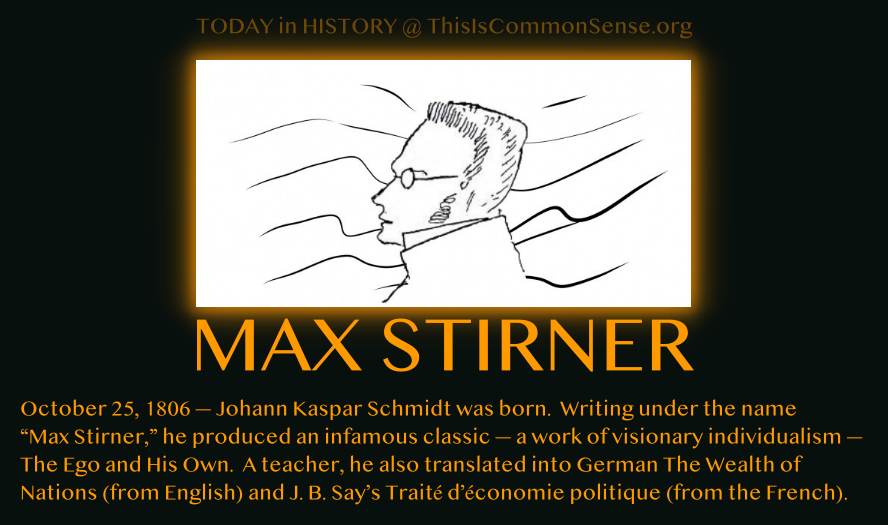
On October 25, 1806, German philosopher Max Stirner was born. Stirner was known for his radical individualism, which under the name of “egoism” became culturally chic in the late 19th and early 20th centuries. In addition to Der Einzige und sein Eigentum, a major work that was famously attacked by Karl Marx, he translated into German Adam Smith’s Wealth of Nations (from its original English) and J.-B. Say’s A Treatise on Political Economy (from its original French).
Der Einzige und sein Eigentum has been translated into English as The Ego and Its Own and The Ego and His Own.
“Max Stirner” is a nom de plume, his birth name being Johann Kaspar Schmidt. He died in 1856, and his biography by John Henry Mackay, Max Stirner — sein Leben und sein Werk, was published in German in 1898 (enlarged 1910, 1914), and finally translated into English in 2005.
The only image we have of him was sketched by Karl Marx’s comrade, benefactor and abuse-buddy, Friedrich Engels. The portrait above has been adapted from that drawing.

It is war that wastes a nation’s wealth, chokes its industries, kills its flower, narrows its sympathies, condemns it to be governed by adventurers, and leaves the puny, deformed, and unmanly to breed the next generation.
George Santayana, The Life of Reason: Reason in Society, (1905), p. 82.
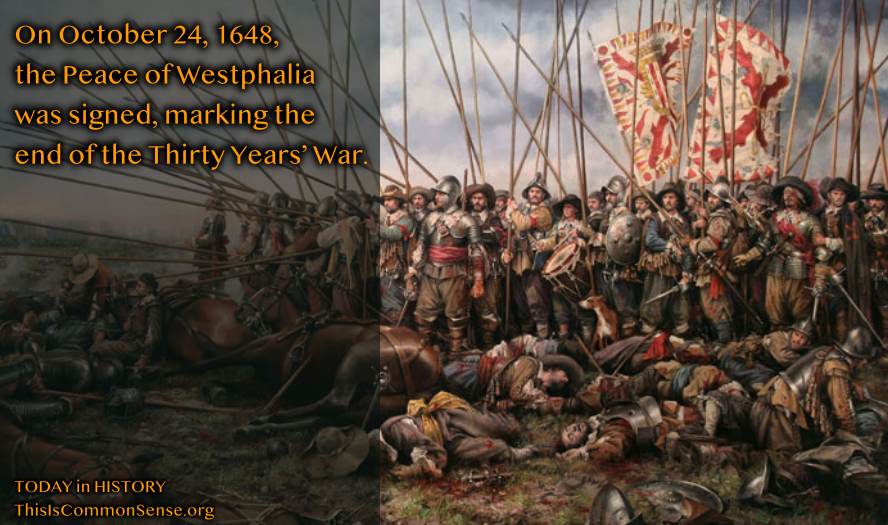
On October 24, 1648, the Peace of Westphalia was signed, marking the end of the Thirty Years’ War.
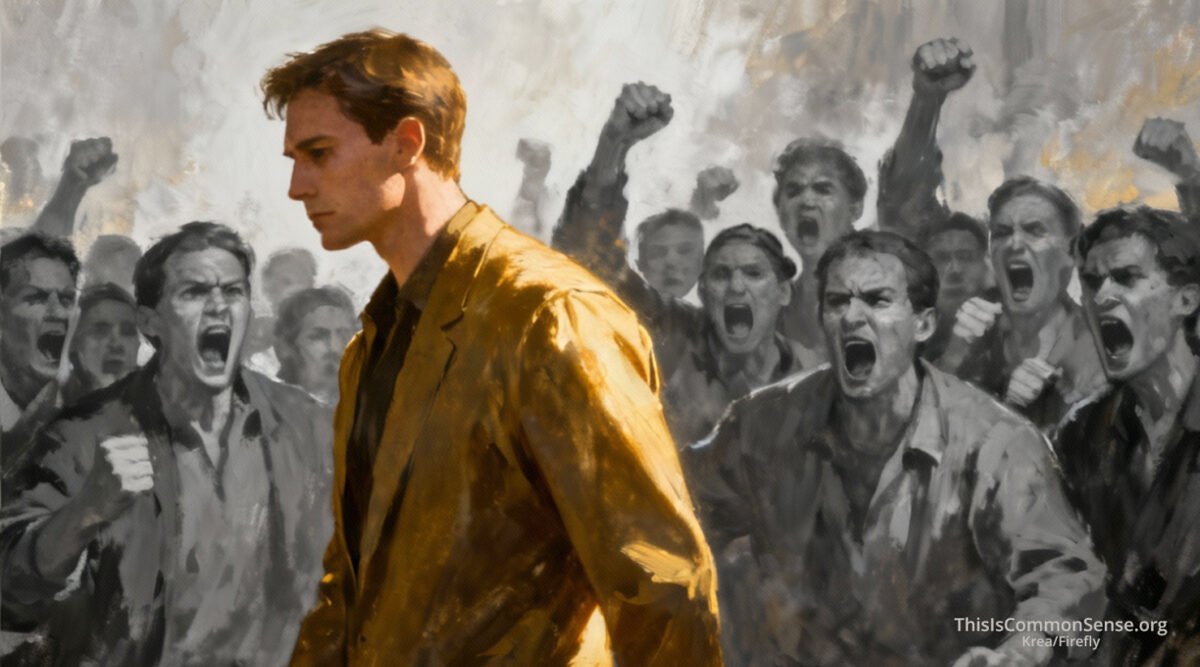
“Free speech doesn’t compel you to listen. You can walk away,” Mr. Reitz goes on to say.
In the piece, reprinted by the Mackinac Center for Public Policy, Reitz wonders, however, whether this “agree to disagree” attitude is enough to keep free speech alive. He believes that “as a society, we show our commitment to free speech through our willingness to listen, discuss and debate. It’s not consistent to say I value another person’s right to speak if I refuse to engage.”
A liberal attitude — in a social, perhaps non-political sense — is what Reitz advises: tolerant of differences; not prone to anger at hearing an opposing view; engaging logically and fairly with differing opinions; but free to take it or leave it without fearing recrimination, retribution or retaliation.
This right to walk away may define free speech, but Reitz argues that we mustn’t all walk to our bubbles in anger.
An old saw, recently popularized, insists that “we have freedom of speech, but we don’t have freedom from the consequences of speech.” In a free society, you may say what you like on your property, on your dime, but some people may shun you. Or fire you. And that’s OK.
What’s not an acceptable “consequence” of freedom of speech? Being silenced by the government, or the mob, either with petty violence or maximum force. Too many people use the “no freedom from consequences” cliché as an excuse to harass people at their work. Or bank. This is where it gets difficult.
Since one neither has a right to a specific job nor to force a bank to accept one’s money on account, purely social pressure to de-bank, de-platform, or get someone fired, fits in a free society. But is Reitz correct that, legality aside, when such social pressure is common, and one-sided, free speech is doomed?
Perhaps society is doomed, in multi-lateral wars of us vs. them.
This is Common Sense. I’m Paul Jacob.
Illustration created with Midjourney and Firefly
See all recent commentary
(simplified and organized)
See recent popular posts
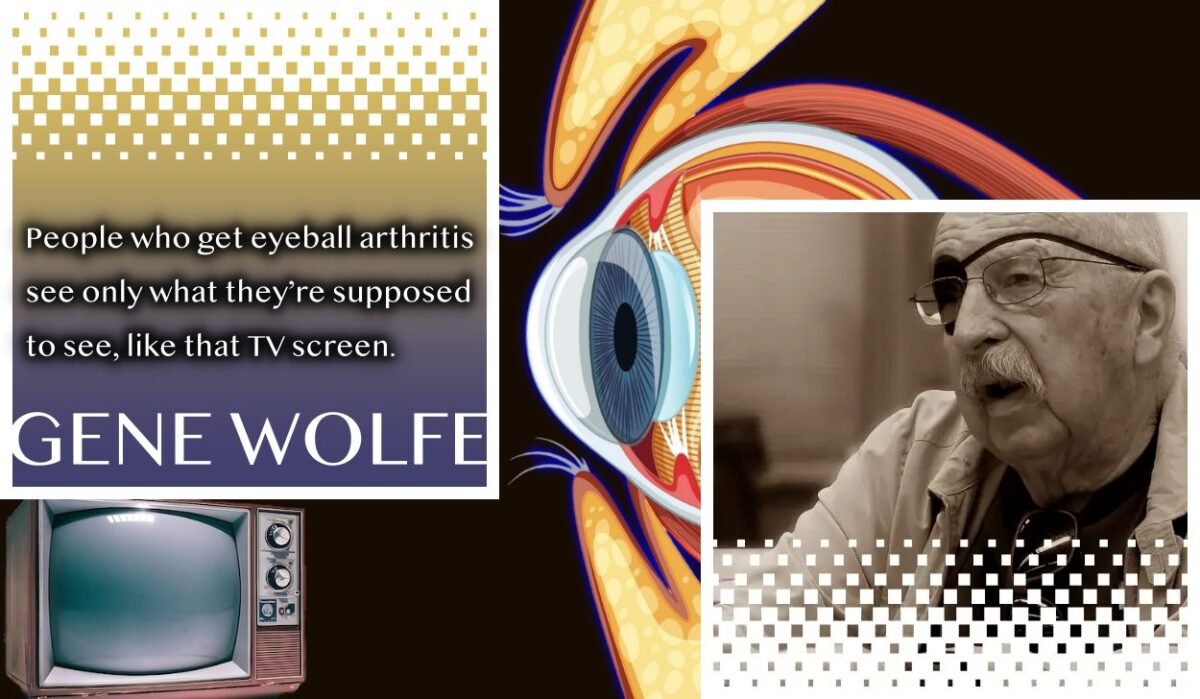
People who get eyeball arthritis see only what they’re supposed to see, like that TV screen.
Gene Wolfe, in ”Hunter Lake,” The Magazine of Fantasy & Science Fiction, October/November 2003; reprinted in Gene Wolfe, Starwater Strains (2005).
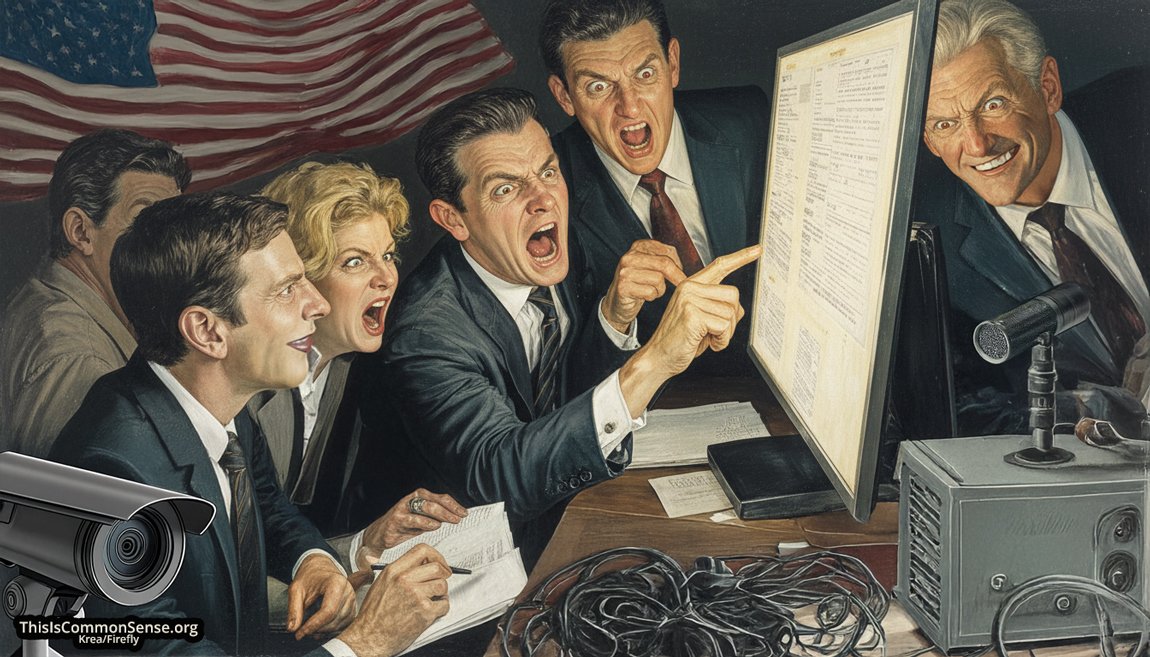
Nancy Brasel, the district judge, has for now blocked Minnesota’s law requiring grassroots advocacy groups to publicly disclose the names and addresses of their vendors because she expects that this requirement will indeed be ultimately thrown out.
Violating, as it does, freedom of speech.
One of the targets of the law is Minnesota Right to Life. One of its vendors dropped MRL with a thud in the middle of a campaign. As MRL’s executive director, Ben Dorr, notes, the challenged law mostly hands “a ready-made ‘enemies list’ to our political opponents.” He counts seven vendors who refused to work with his organization after being harassed by abortion rights proponents.
This harassment is the apparent reason for the disclosure regulation’s existence. When the names and locations of vendors who facilitate spread of political messages is forcibly disclosed, this allows opponents of the message to stoop to any low, such as harassing companies that provide services to organizations trying to get the word out.
What the harassers hope to accomplish, and sometimes do, is frighten vendors into dropping clients who engage in advocacy.
The thugs who would impede speech any way they can sometimes speak of “transparency” as if it were an end in itself. Whether transparency is desirable depends on the context. Citizens have every right to know how much government spends, and on what, and why — transparency is necessary there, because governments belong to citizens. But no crook or bully has an inalienable right to all the information about innocent people that he needs in order to go after them.
This is Common Sense. I’m Paul Jacob.
Illustration created with Krea and Firefly
See all recent commentary
(simplified and organized)
See recent popular posts
It has been said that youngsters go to jail to learn crime as others go to college to learn who won the Peloponnesian wars and the names of the generals, and how to play football.
It’s true. All penitentiaries are crime schools for the young with brilliant professors, empirical professors, doing the pitching. How any criminal could go to such a school and fail to come out a better criminal, I cannot imagine — because the teaching and the ideas are brilliant, even if in most cases the premise stinks, as in paranoia.
It would be hard for a you gster to see wherein the premise is faulty. A class in just this in the educational department would be a very good idea.
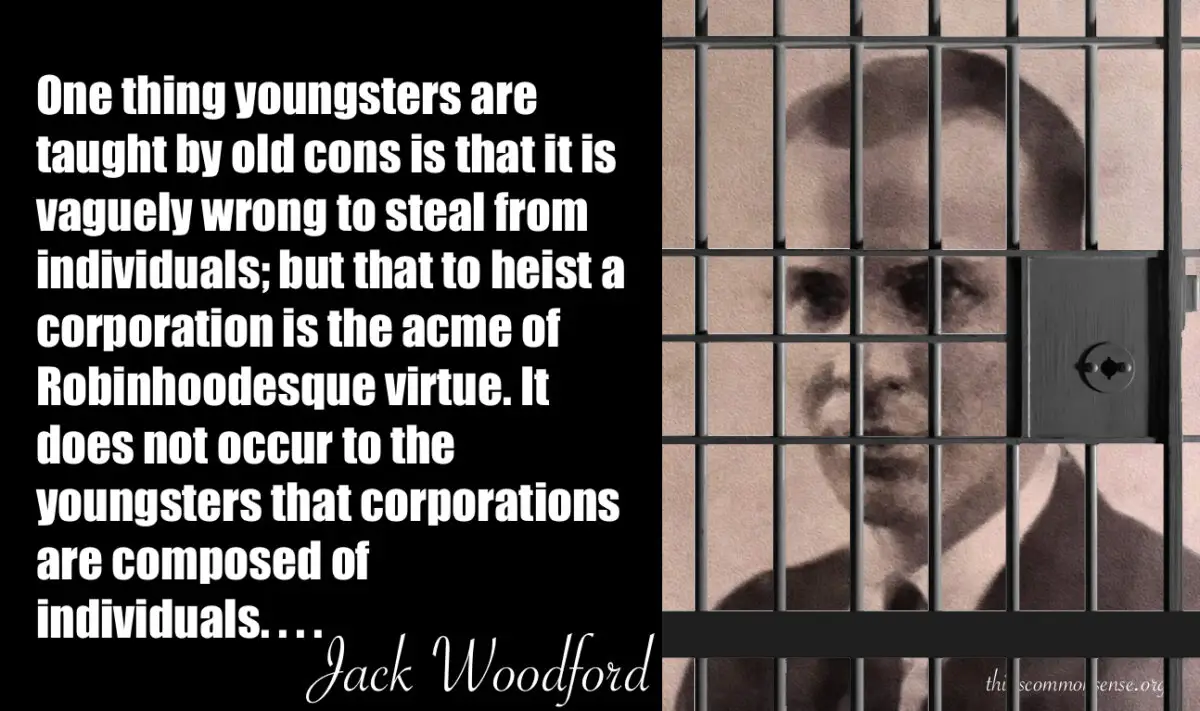
For instance, one thing youngsters are taught by old cons is that it is vaguely wrong to steal from individuals; but that to heist a corporation is the acme of Robinhoodesque virtue. It does not occur to the youngsters that corporations are composed of individuals. . . .
Jack Woodford, on prison life in his personal report on his short time incarcerated, Home Away From Home (1962), p. 194.
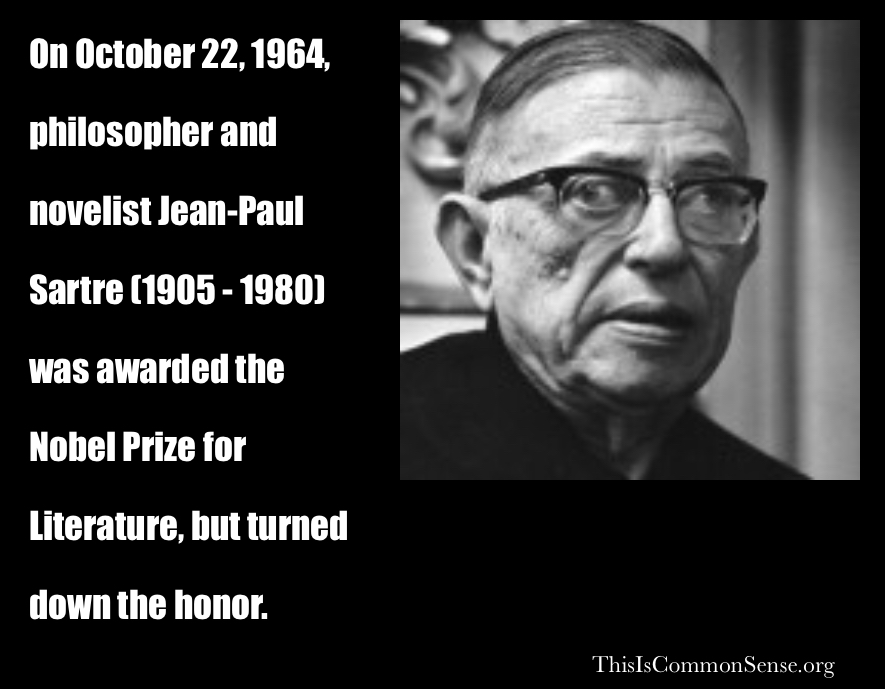
On October 22, 1964, philosopher and novelist Jean-Paul Sartre (1905 – 1980) was awarded the Nobel Prize for Literature, but turned down the honor — establishing a precedent that should have been followed by numerous Peace Prize winners, including Barack Obama and the European Union.
Sartre rejected the award on account of having rejected previous honors. In this he was not dissimilar from philosopher Herbert Spencer (1820-1903) who refused many doctorates late in life, on the grounds that such awards did an old man no good, and perhaps because he was a cantankerous old coot — a judgment that surely applied also to the later French philosopher.
Sartre is best known for his novel Nausea (1938), his play No Exit (1944) and his treatise, Being and Nothingness (1943). One of his main themes was freedom, a concept better explored at the fundamental level of the individual human being than politically, since he become a “Marxist” of sorts . . . the precise nature of which he elaborated in the Critique of Dialectical Reason (1960). He failed to complete his tetralogy of novels, Roads to Freedom, never finishing the final volume.

I write about it now hoping never to have to write about it later. You guessed it: I’m not planning on reading the thing.
I did, however, cover her turn-of-coat re-alignment/what-have-you in June. “I think we need to stop thinking in boxes and think outside of our boxes,” I quoted her in “Rats-a-Jumpin’.”
Whatever else, she had certainly not resisted cliché!
But can we be sure of her sincerity? It’s hard to imagine a paid fibber writing a book and expecting it to be taken at face value. Still, the story is her story, not the full story, so there may be some truth in it.
“The Democratic Party had defined my life, my career,” The Epoch Times quotes her in apparent sincere mode. “Everything I’d done to make people’s lives better had been connected to it. The party was the vehicle that allowed me not just to have a front seat to history, working first on [President Barack] Obama’s presidential campaign then in his administration, but also to make some history of my own as the first Black woman and openly queer person to ever be a White House press secretary. Never had I considered leaving the party until now.”
This may possibly be seen as galling to long-term independents: much ado about a latecomer’s anguish.
Tellingly, there’s no mention, in the pre-publication buzz, of Russiagate or the Epstein case — that is, something that might make the book worthwhile. Only her in-the-box account of Biden’s competence provides any interest at all.
This is Common Sense. I’m Paul Jacob.
Illustration created with Krea and Firefly
See all recent commentary
(simplified and organized)
See recent popular posts