The mind celebrates a little triumph whenever it can formulate a truth.
George Santayana, The Life of Reason: The Phases of Human Progress; Vol. IV, Reason in Art (1906).
George Santayana
The mind celebrates a little triumph whenever it can formulate a truth.
George Santayana, The Life of Reason: The Phases of Human Progress; Vol. IV, Reason in Art (1906).
The classic case is raw, whole milk. I’ve talked about this before. The most recent case is from Amish country, where the State of Pennsylvania raided a farm “on suspicion of selling ‘illegal milk,’ among other products,” explains The Epoch Times, and the farm “is being sued by the Pennsylvania Office of the Attorney General and Pennsylvania Department of Agriculture.”
The Amish farm “has been ordered to halt all sales of its dairy products, inspiring widespread anger over what critics have called a blatant example of government overreach.”
At issue is government interference in farmers and customers freely choosing to skip the major grocery outlets multinational companies and dealing with each other on a local, free-market basis. “Capitalist acts between consenting adults,” as Robert Nozick put it.
But it’s especially galling when placed in the wider context of the FDA’s and USDA’s obvious failure to produce a healthier populace. Though the state’s attorney general insists that “we cannot ignore the illnesses and further potential harm posed by [the] distribution of these unregulated products,” the illnesses caused by what many call the Standard America Diet (SAD) go unnoticed and unregistered as such.
One standard for “the market,” another for the regulators.
Meanwhile, the State of Wisconsin is pushing a new bill to impose a $20,000 annual sales cap on participants in the state’s cottage food industry, “one of the most restrictive in the nation,” explains Suranjan Sen, an attorney at the Institute for Justice — a legal aid outfit often mentioned in these pages.
The very point of the law is to protect brick-and-mortar grocery and baked-goods stores — not the health of consumers. It has the backing of powerful lobbyists.
Looking for healthier foods and healthier economies? Don’t look to government.
This is Common Sense. I’m Paul Jacob.
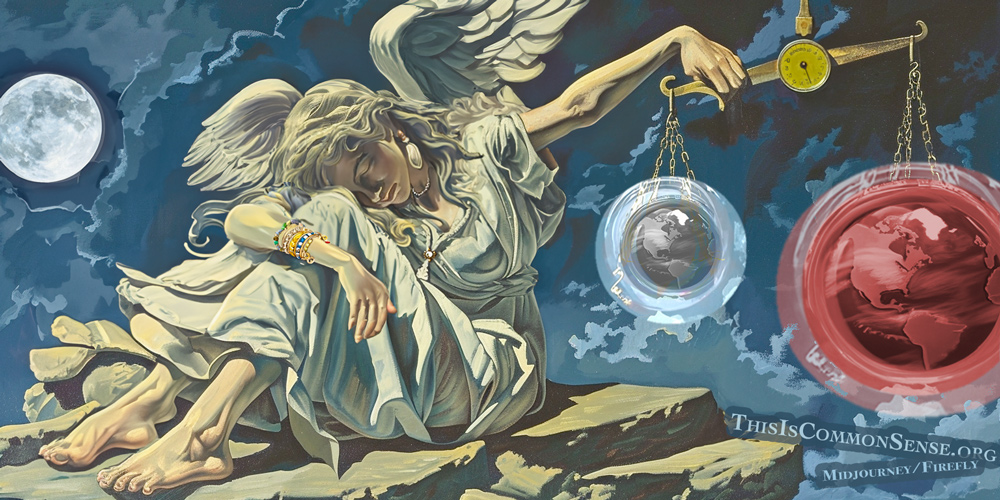
Illustration created with Midjourney
See all recent commentary
(simplified and organized)
See recent popular posts
In yesterday’s update, we directed your attention to a court decision that showed some progress in preventing the federal government from outright theft via the medieval civil asset forfeiture technique. The Epoch Times reported. But there was a passage we did not quote:
“Plaintiffs do have a significant privacy interest in their safe deposit boxes, given that their conduct indicates they intended their items to be ‘preserved . . . as private,’ and society generally views the privacy expectations of items in safe deposit boxes as reasonable,” Judge Smith wrote.
Yes, Judge Smith, we do have “privacy interests” in our . . . private property.
It is right there in the term, private property.
The conceptual fight to reclaim our rights can be a tough slog through the obvious.
Government agencies that “fight crime” too often engage in criminal behavior to do so.
In June of 2021, Common Sense with Paul Jacob reported on an FBI operation that raided safe deposit boxes.
In March, the federal government conducted a raid of a safe deposit box company called U.S. Privacy Vaults. The government accuses the company of abetting drug dealers.
The government accuses the box renters of . . . nothing. But DOJ is trying to use civil forfeiture laws to retain most of what it seized during the raid: some $85 million in cash and valuables.
In August of 2022 Paul returned to the case, wondering whether FBI agents would themselves see justice:
The plot’s been foiled, it appears, but will the culprits within the FBI be prosecuted?
Seems unlikely.
Truth is, the culture at the FBI has never been good. Barring defunding (which would be politically difficult) perhaps FBI agents should be restricted to just investigation, stripped of their weaponry, forced to rely on state and local lawmen — and perhaps the U.S. Marshals — to make any searches and arrests at all.
In October, the courts failed to back up the Constitution regarding searches and seizures in this case.
Now, according to The Epoch Times, a federal court has indeed found cause to reprimand the FBI and the lawyers that defended the agents who had — without cause — searched all of the safety deposit boxes:
“We note that it is particularly troubling that the government has failed to provide a limiting principle to how far a hypothetical ‘inventory search’ conducted pursuant to customized instructions can go,” Judge Smith said.
Many of the plaintiffs have already had their belongings returned by the FBI but pressed forward with the case for an opinion in their favor.
The ruling remanded the case back to U.S. District Judge Robert Klausner, who previously dismissed the case, for a ruling that directs the FBI to destroy records the bureau collected on the box renters who are members of the class-action case.
The opinion “draws a line in the sand, to ensure something like this never happens again,” Rob Johnson, a senior attorney with the Institute for Justice, which was representing the plaintiffs, said in a statement. “If this had come out the other way, the government could have exported this raid as a model across the country. Now, the government is on notice its actions violated the Fourth Amendment.”
It took several years, but apparently justice in this case is finally approaching, and the Federal Bureau of Investigations has been reminded that its powers are limited. By our rights.
It would be different if the government were a team, but in fact they’re a loose confederation of warring tribes.
Sir Ian Whitworth, Permanent Secretary for Health, Yes, Prime Minister, “The Smoke Screen” (S1; E3: Thu, Jan 23, 1986), as performed by John Barron; written by Antony Jay and Jonathan Lynn.
The federal government, it seems, had instituted a policy of “cover-up.”
This has changed in the last few years, after a military investigation into UFOs went public, and as Congress began making public and confidential inquiries.
What do we really know?
Not much.
Still, that startling 1952 UFO wave appears to have received some additional evidence . . . from an unexpected quarter.
A team of astronomers compared old sky plates from the Palomar Observatory —photographed in the 1950s — to modern digitized pictures of the heavens, searching for “vanishing stars.” Appearing and disappearing stars are a fascinating study, in this research the aim being to detect “instances where a star directly collapses into a black hole.” The scientists found none of these “failed supernova” events.
But what they found surprised them: “several images where multiple star-like objects appear in a single snapshot of the sky, never to be seen again.”
They tested many possible explanations for the mysterious data, and then an automated search coughed up a doozy: “The image showed three bright and beautiful objects looking just like stars in a POSS-I image from the 19th of July 1952 that appeared and vanished within a plate exposure. . . . The three bright objects seemed as real as Betelgeuse itself.”
These were not single bright dots on photographic plates, but multiple simultaneous dots.
As scientist Beatriz Villarroel writes, “our two most prominent and brightest cases of multiple transients coincided in time with the two weekends of the renowned Washington UFO flyovers.”
One wonders whether later mass-sighting events, such as the “Belgian Wave” (November 1989–April 1990) and Arizona’s “Phoenix Lights” (March 13, 1997), might have recorded similar transients above, ready for study.
Thankfully, we do not need to rely directly upon government agents to do the research.
This is Common Sense. I’m Paul Jacob.
Illustration created with Midjourney and Fireflly
See all recent commentary
(simplified and organized)
See recent popular posts
Behavior is imitated, then abstracted into play, formalized into drama and story, crystallized into myth and codified into religion — and only then criticized in philosophy, and provided, post-hoc, with rational underpinnings.
Jordan Peterson, Maps of Meaning (1999), p. 78.
On January 26, 1992, Boris Yeltsin announced that Russia would stop targeting United States cities with nuclear weapons.
In the case commanding our attention today, the meta-investigating organization is the Select Subcommittee on the Weaponization of the Federal Government. It is investigating the Financial Crimes Enforcement Network (FinCEN).
Who does FinCEN pursue? True scoundrels? Hapless executives caught in a regulatory net?
Nope. FinCEN has been on fishing expeditions. It hasn’t been going after persons suspected of either willfully committing crimes or even tripping over regulations accidentally, or at least not only such types.
It has been going after anybody whose purchasing history puts them in the category of wrong-thinking rightists — hence, I guess, crypto-terrorists.
FinCEN has been instructing banks to scan customer records for evidence of suspect purchases. Not illegal purchases. Just “suspicious” in light of an ideological filter, unconstitutionally applied.
On Twitter, Representative Jim Jordan reported recently that the subcommittee now knows that FinCEN required financial institutions to screen transactions in which terms like “MAGA,” “Trump,” “Bible,” and “Bass Pro Shop” popped up.
Apparently, if you’re fishing while wearing a MAGA cap and quoting Genesis, you just might be on the verge of shooting up your local post office.
Please don’t ask me to explain what anybody involved with FinCEN could possibly be thinking by engaging in this illegal spying. Or whether they have even a glancing acquaintance with constitutional protections against unreasonable searches and seizures.
I’m just glad Jordan and his Weaponization Subcommittee are on the job, “watching the watchers.”
This is Common Sense. I’m Paul Jacob.
Illustration created with PicFinder and Firefly
See all recent commentary
(simplified and organized)
See recent popular posts

On January 25, 1787, Shays’ Rebellion experienced its largest confrontation, outside the Springfield Armory, with four of the rebels dead, 20 wounded.
The rebellion was a key moment in United States history. Daniel Shays and his followers objected to Massachussetts’s high taxes and rampant cronyism. The revolt, which was completely suppressed, led to the adoption of the U.S. Constitution, drawing George Washington from his retirement to serve as the new union’s president.