When a prisoner of style escapes it’s called an evasion.
Mark Twain, The Adventures of Huckleberry Finn (1884), Chapter 39.
Categories
Mark Twain
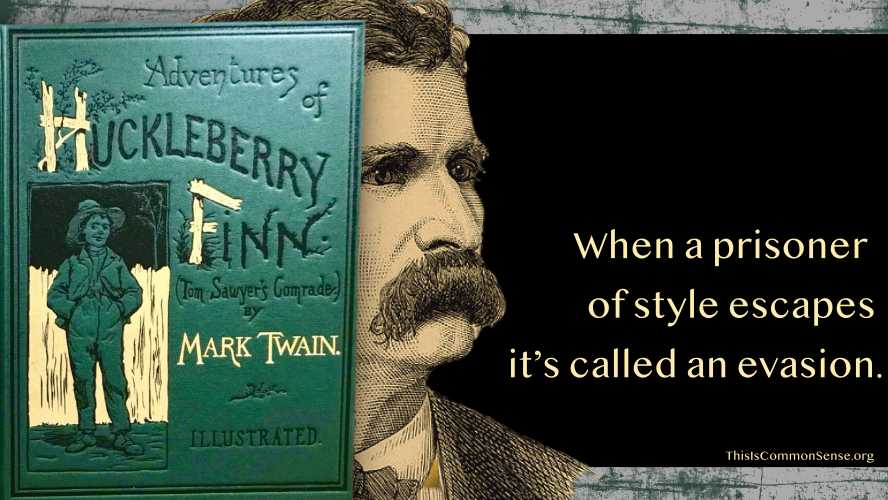
When a prisoner of style escapes it’s called an evasion.
Mark Twain, The Adventures of Huckleberry Finn (1884), Chapter 39.
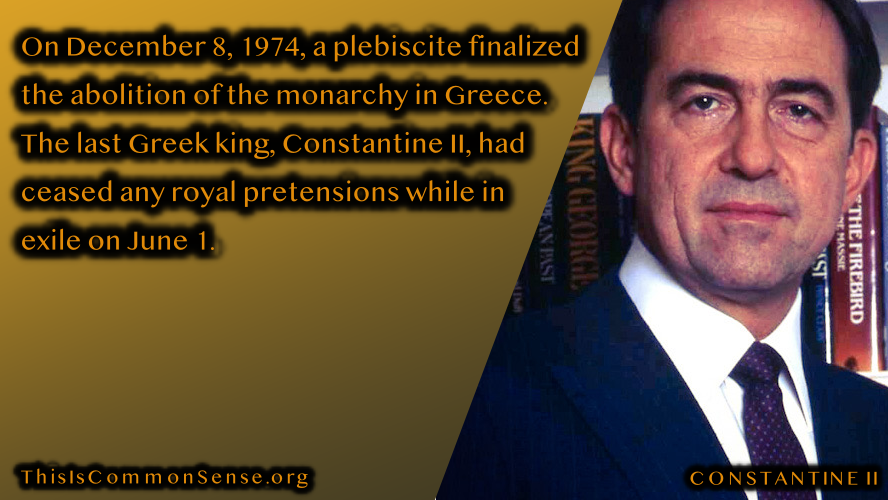
On December 8, 1974, a plebiscite finalized the abolition of the monarchy in Greece. The last Greek king, Constantine II, had ceased any royal pretensions while in exile on June 1. The December referendum was something of a formality.

“In October 2022, Chinese leader Xi Jinping held a secret meeting instructing top state officials — overseeing political, intelligence, and influence operations — on a new strategy to target the Falun Gong religious group internationally,” reports The Epoch Times in a new 2000+ word report.
“At the core of the Chinese Communist Party (CCP)’s new anti-Falun Gong strategy is launching disinformation campaigns via social media influencers and Western media outlets; and using the American legal system to go after companies started by Falun Gong practitioners.”
The report concludes by quoting Rep. Scott Perry (R-Pa.) on the need to counter-act the CCP’s anti-Falun Gong initiative. “‘The Communist Party of China is essentially a criminal organization running a country,’ Perry said, adding that since the United States doesn’t allow criminal organizations to use government systems to persecute adversaries or violate basic human rights, ‘we certainly shouldn’t let the CCP do it either.’”

If our government knows anything about these devices, the people should be told at once. A lot of people out here are very much disturbed. Some think these things may be from another planet. But they aren’t harming anyone and I think it would be the wrong thing to shoot one of them down — even if it can be done. Their high speed would completely wreck them.
Kenneth Arnold, as quoted in “‘Flying discs’ called real by 2 air veterans,” Chicago Times (July 7, 1947). Businessman and aviator Arnold had reported seeing nine mysterious flying objects speeding by Mount Rainier in Washington State, on June 24, and thereby starting the modern UFO craze.

Well, when the job that Musk is doing is not a government job and a company’s internal process of determining the compensation is voluntary and aboveboard . . . no.
But according to a Delaware judge, Chancellor Kathaleen McCormic, who last January rescinded Tesla’s compensation package then worth $56 billion, now worth more than $100 billion, Musk is not entitled to this compensation. And she has just affirmed her ruling.
Musk says that “shareholders should control company votes, not judges.”
Tesla says: “The ruling is wrong, and we’re going to appeal.”
The appeal could take a year or more.
There’s nothing in the U.S. Constitution authorizing judges to run private companies or decide how much their most valuable personnel may be paid. The judge has no constitutional warrant. And no moral warrant.
Not her business.
Ignoring the enormous success of Tesla, McCormic is simply deciding that Musk’s pay is way too much with respect to some arbitrary personal criterion that is irrelevant to the decisions that companies must make to attract and keep their greatest entrepreneurial talents, the ones who do the most to make it all go.
Still, maybe we should give the judge a break — I mean, just a tad?
Remember, it was Chancellor McCormic who forced Musk to go through with his Twitter purchase — which turned out to be the most consequentially favorable free-speech/-free-press event of our time.
Sure, then too she was grinding a personal or ideological animus against the magnate.
But credit where credit’s due!
This is Common Sense. I’m Paul Jacob.
Illustration created with …
See all recent commentary
(simplified and organized)
See recent popular posts

There is no passion so contagious as that of fear.
Michel de Montaigne, Essais, Book III, Ch. 13 (1595).
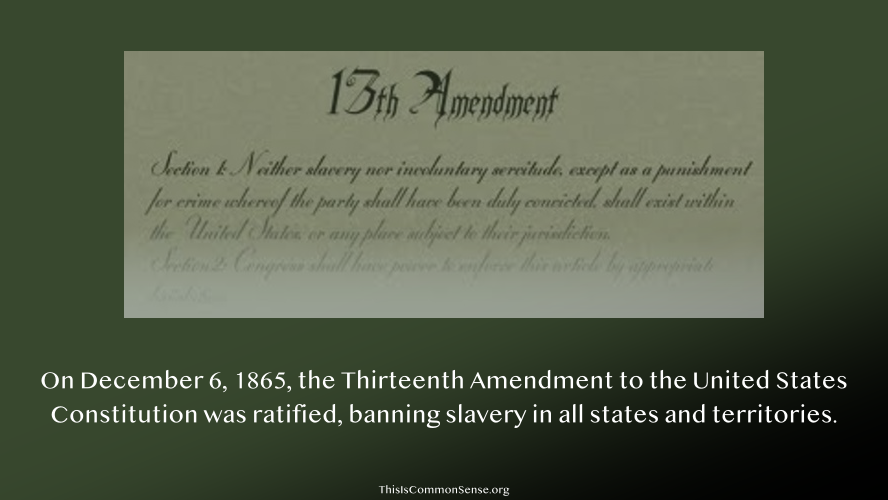
On December 6, 1865, the Thirteenth Amendment to the United States Constitution was ratified, banning slavery in all states and territories.
One-hundred-and-nineteen years later, to the day, in 1984, Paul Jacob (of ThisIsCommonSense.org, LibertyiFund.org, and the Citizens in Charge Foundation) was arrested by the FBI for his refusal to register with Selective Service System (the draft people). The Government was probably not attempting to make a commemorative point about involuntary servitude.

But we’re not on safe ground yet. One example of rearguard action by the proponents of these lunacies is the willingness of major publications to hide evidence of harm caused by DEI.
Colin Wright reports that both The New York Times and Bloomberg have “shelved coverage of a groundbreaking study that raises serious concerns about the psychological impacts of diversity, equity, and inclusion pedagogy.”
The Network Contagion Research Institute finds that DEI ideology incites hostility (between members of favored and disfavored groups, you see) and authoritarianism (by bullies eager for new weapons to intimidate and control others).
When presented with various scenarios, participants in the study who had first been exposed to DEI propaganda were much more likely than participants who hadn’t been thus exposed to impute racism to agents in the scenario — even when no evidence to justify the accusation was also presented in the scenario.
Wright suggests that at both the Times and Bloomberg, reports-in-progress about the research were killed outright by editors whose decisions to spike the story “align conspicuously with the ideological leanings” of those editors.
NCRI’s work confirms what we know about the dishonesty, injustice, and destructiveness of the DEI enterprise.
As does the conduct of certain gatekeepers.
This is Common Sense. I’m Paul Jacob.
Illustration created with Flux-Realtime/Firefly
See all recent commentary
(simplified and organized)
See recent popular posts

The sad truth of the matter is that most evil is done by people who never made up their minds to be or do either evil or good.
Hannah Arendt, The Life of the Mind (1978).

On December 5, 1933, nationwide alcohol Prohibition in the United States ended after Utah became the 36th U.S. state to ratify the 21st Amendment to the United States Constitution, thus establishing the required 75 percent of states needed to enact the amendment that overturned the 18th.