Categories
Today

Seventh of July

In 1456, a retrial verdict acquitted Joan of Arc of heresy 25 years after her execution.

In 1928 on July 7, sliced bread was sold for the first time by the Chillicothe Baking Company of Chillicothe, Missouri.

On this date in 1958, U.S. President Dwight D. Eisenhower signed the Alaska Statehood Act into law.

Categories
FYI

Sotomayor’s Quackery?

“Justice Sotomayor’s dissent was one of the most impressive pieces of progressive quackery ever produced by SCOTUS,” tweeted historian Brion McClanahan.

Jonah Goldberg, on the other hand, wrote that “I think that while Sotomayor’s dissent is a bit over the top, her concerns are more well-founded than I would have thought.” But a day later he took it back: “Having read more, and having talked to a half dozen legal beagles I trust, I’m less dismayed than I was yesterday. I do think the ‘Absolute Immunity’ stuff is unnecessary. I also think ACB’s concurrence is better than Roberts’ opinion.”

They were discussing the Supreme Court’s ruling in Trump v. the United States.

“The chief justice insisted that the president ‘is not above the law,’” explains the Associated Press. “‘But in a fiery dissent for the court’s three liberals,’ Justice Sonia Sotomayor wrote, ‘In every use of official power, the President is now a king above the law.’

Reading from her opinion in the courtroom, Sotomayor said, “Because our Constitution does not shield a former president from answering for criminal and treasonous acts, I dissent.” Sotomayor said the decision “makes a mockery of the principle, foundational to our Constitution and system of government, that no man is above the law.”

The protection afforded presidents by the court, she said, “is just as bad as it sounds, and it is baseless.”

Sotomayor’s case against an imperial, unaccountable president seems quite reasonable at first blush, but Glenn Greenwald devoted a huge chunk of an episode of his System Update (Rumble) to mocking it. 

“The narrative that we were fed” about the Trump v; U.S. ruling and the doctrine of presidential immunity generally, Greenwald said, “was an absolute fairy tale about American history and political life. To listen to Democrats and their media allies tell it, you would think that presidents have a long history in the United States of being criminally accountable for the illegal acts they undertook in office; that it has always been the case that presidents enjoy no immunity that any other citizen of the United States doesn’t enjoy; and that all of a sudden, out of the blue, a conservative, fanatical court driven by ideological and political considerations to protect Donald Trump, invented out of whole cloth some kind of new immunity that never previously existed.” 

Greenwald, who has been fighting the notions of executive immunity for decades now, in his journalistic work, expressed his incredulity over the Sotomayor reaction, and reaction of most media Democrats. They seem to be burying their past commitments to a notion they now say they find abhorrent.

But Greenwald does not call Sotomayor’s dissent “progressive quackery,” though.

Categories
Thought

Thomas Jefferson

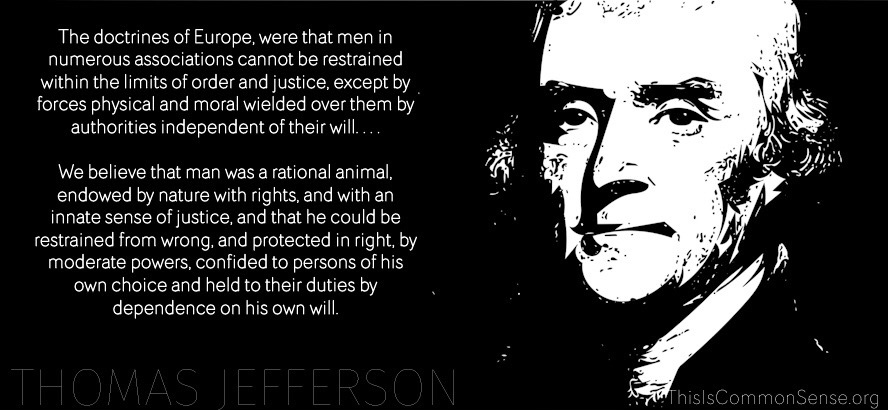
The doctrines of Europe were, that men in numerous associations cannot be restrained within the limits of order and justice, but by forces physical and moral, wielded over them by authorities independent of their will. Hence their organization of kings, hereditary nobles, and priests. Still further to constrain the brute force of the people, they deem it necessary to keep them down by hard labor, poverty and ignorance, and to take from them, as from bees, so much of their earnings, as that unremitting labor shall be necessary to obtain a sufficient surplus barely to sustain a scanty and miserable life. And these earnings they apply to maintain their privileged orders in splendor and idleness, to fascinate the eyes of the people, and excite in them an humble adoration and submission, as to an order of superior beings. Although few among us had gone all these lengths of opinion, yet many had advanced, some more, some less, on the way. And in the convention which formed our government, they endeavored to draw the cords of power as tight as they could obtain them, to lessen the dependence of the general functionaries on their constituents, to subject to them those of the States, and to weaken their means of maintaining the steady equilibrium which the majority of the convention had deemed salutary for both branches, general and local. To recover, therefore, in practice the powers which the nation had refused, and to warp to their own wishes those actually given, was the steady object of the federal party. Ours, on the contrary, was to maintain the will of the majority of the convention, and of the people themselves. We believed, with them, that man was a rational animal, endowed by nature with rights, and with an innate sense of justice; and that he could be restrained from wrong and protected in right by moderate powers, confided to persons of his own choice, and held to their duties by dependence on his own will. We believed that the complicated organization of kings, nobles, and priests, was not the wisest nor best to effect the happiness of associated man; that wisdom and virtue were not hereditary, that the trappings of such a machinery, consumed by their expense, those earnings of industry, they were meant to protect, and, by the inequalities they produced, exposed liberty to sufferance. We believed that men, enjoying in ease and security the full fruits of their own industry, enlisted by all their interests on the side of law and order, habituated to think for themselves, and to follow their reason as their guide, would be more easily and safely governed, than with minds nourished in error, and vitiated and debased, as in Europe, by ignorance, indigence and oppression. The cherishment of the people then was our principle, the fear and distrust of them, that of the other party.

Thomas Jefferson, Letter to William Johnson (1823).
Categories
Today

Tyranny?

July 6 serves better as a “Today in Tyranny” marker than anything positive, at least when you consider these events:

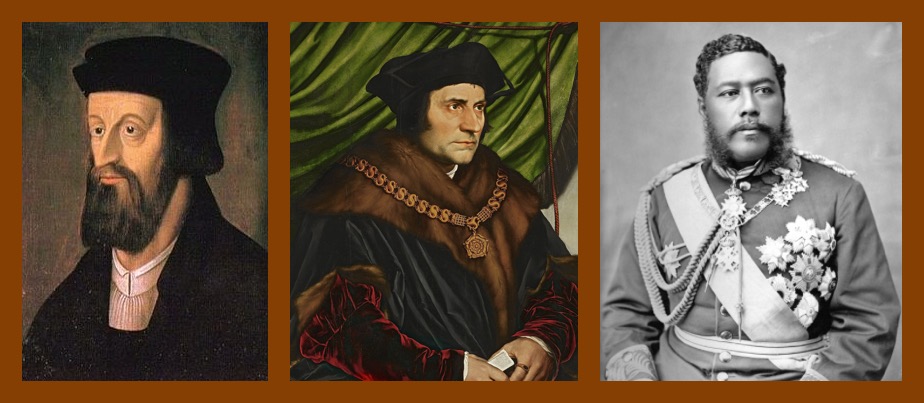
  • 1415 – Jan Hus was burnt at the stake.
  • 1535 – Sir Thomas More was executed for treason against King Henry VIII of England.
  • 1887 – David Kalakaua, monarch of the Kingdom of Hawaii, was forced at gunpoint by Americans to sign the Bayonet Constitution giving Americans more power in Hawaii while stripping Hawaiian citizens of their rights.
  • 1939 – The Nazi “Third Reich” closed the last remaining Jewish enterprises in Germany.
Categories
crime and punishment ideological culture

Noncriminal Advice Not a Crime

I have now learned, or relearned, that doing legal things may well be illegal.

A recent example of the legal-is-illegal syndrome is the apparent criminalization, ex post facto, of helping your clients legally promote their legally vendible wares.

According to an April 2024 Wall Street Journal report, the consulting firm McKinsey is in trouble with the Justice Department for advising Purdue on how to sell more of its drug OxyContin, which is legal to sell. The Department has criminally opened a criminal investigation into McKinsey’s “role in advising” opioid manufacturers like Purdue “on how to boost sales.”

McKinsey consultants suggested pitching more to doctors who prescribe OxyContin the most, pitching less to docs who don’t prescribe it.

Which part of this shockingly standard advice is the criminal activity?

As economists David Henderson and Charles Hooper note, there is “nothing mysterious or nefarious” about going where the sales are. It’s “economically rational. To do otherwise would be inefficient and wasteful.”

But there’s an Opioid Crisis. 

And whenever there’s a Crisis, lawmakers and launchers of criminal investigations hurtle to ignore subtle distinctions about legal, illegal, etc.

I’m not quite sure what we do in light of this information, that all the legal-to-do things are now subject to senseless investigations by Justice Department hacks, bored or maniacal.

I guess the safest thing would be to stop doing things. All the things. Well, you can’t really live by pursuing safety — or a mirage of safety — at all costs.

This is Common Sense. I’m Paul Jacob.


PDF for printing

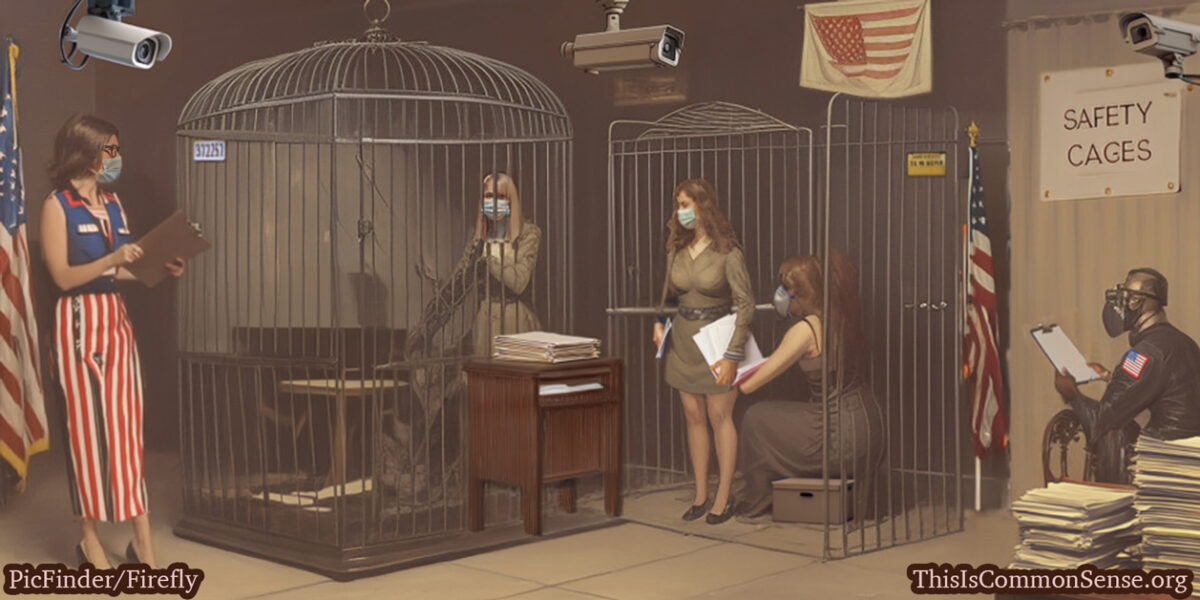
Illustration created with PicFinder and Firefly

See all recent commentary
(simplified and organized)
See recent popular posts

Categories
Thought

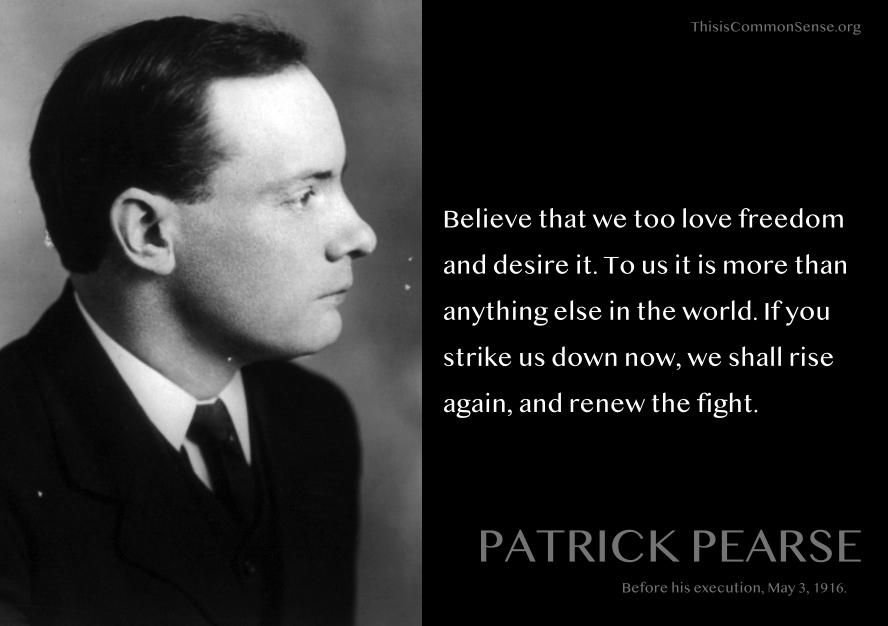
Patrick Pearse

Believe that we too love freedom and desire it. To us it is more than anything else in the world. If you strike us down now, we shall rise again, and renew the fight. You cannot conquer Ireland; you cannot extinguish the Irish passion for freedom. If our deed has not been sufficient to win freedom, then our children will win it by a better deed.

Patrick Pearse, at his 1916 court-martial, prior to his execution.
Categories
Today

July Fifth

The Liberty Bell left Philadelphia by special train on its way to the Panama–Pacific International Exposition, on July 5, 1915 — the last trip outside Philadelphia that the custodians of the bell intend to permit.

In 1937 on this date, Spam, the luncheon meat, was introduced into the market by the Hormel Foods Corporation.

The Twenty-sixth Amendment to the United States Constitution, lowering the voting age from 21 to 18 years, was formally certified by President Richard Nixon on July 5, 1971.

On July 5, 1995, Armenia (flag, above) adopted its constitution, four years after the country’s independence from the Soviet Union.

Categories
Common Sense general freedom

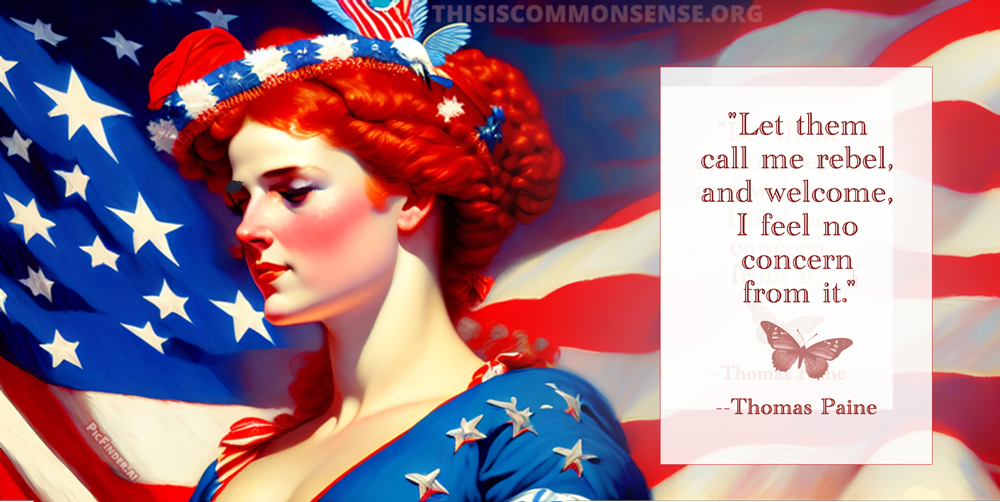
A Declaration

When in the Course of human events, it becomes necessary for one people to dissolve the political bands which have connected them with another, and to assume among the powers of the earth, the separate and equal station to which the Laws of Nature and of Nature’s God entitle them, a decent respect to the opinions of mankind requires that they should declare the causes which impel them to the separation.

We hold these truths to be self-evident, that all men are created equal, that they are endowed by their Creator with certain unalienable Rights, that among these are Life, Liberty and the pursuit of Happiness. — That to secure these rights, Governments are instituted among Men, deriving their just powers from the consent of the governed, — That whenever any Form of Government becomes destructive of these ends, it is the Right of the People to alter or to abolish it, and to institute new Government, laying its foundation on such principles and organizing its powers in such form, as to them shall seem most likely to effect their Safety and Happiness.

Prudence, indeed, will dictate that Governments long established should not be changed for light and transient causes; and accordingly all experience hath shewn, that mankind are more disposed to suffer, while evils are sufferable, than to right themselves by abolishing the forms to which they are accustomed.

But when a long train of abuses and usurpations, pursuing invariably the same Object evinces a design to reduce them under absolute Despotism, it is their right, it is their duty, to throw off such Government, and to provide new Guards for their future security.

This is Common Sense. I’m Paul Jacob.


PDF for printing

Illustration created with PicFinder.ai

See all recent commentary
(simplified and organized)
See recent popular posts

Categories
Thought

United States in General Congress, Assembled

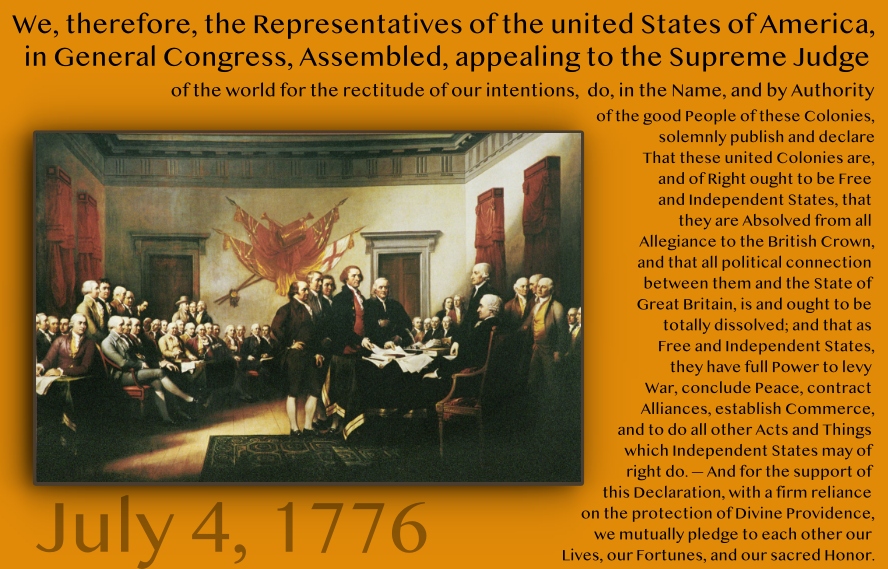
IN CONGRESS, JULY 4, 1776

The unanimous Declaration of the thirteen united States of America

When in the Course of human events it becomes necessary for one people to dissolve the political bands which have connected them with another and to assume among the powers of the earth, the separate and equal station to which the Laws of Nature and of Nature’s God entitle them, a decent respect to the opinions of mankind requires that they should declare the causes which impel them to the separation.

We hold these truths to be self-evident, that all men are created equal, that they are endowed by their Creator with certain unalienable Rights, that among these are Life, Liberty and the pursuit of Happiness. — That to secure these rights, Governments are instituted among Men, deriving their just powers from the consent of the governed, — That whenever any Form of Government becomes destructive of these ends, it is the Right of the People to alter or to abolish it, and to institute new Government, laying its foundation on such principles and organizing its powers in such form, as to them shall seem most likely to effect their Safety and Happiness. Prudence, indeed, will dictate that Governments long established should not be changed for light and transient causes; and accordingly all experience hath shewn that mankind are more disposed to suffer, while evils are sufferable than to right themselves by abolishing the forms to which they are accustomed. But when a long train of abuses and usurpations, pursuing invariably the same Object evinces a design to reduce them under absolute Despotism, it is their right, it is their duty, to throw off such Government, and to provide new Guards for their future security. — Such has been the patient sufferance of these Colonies; and such is now the necessity which constrains them to alter their former Systems of Government. The history of the present King of Great Britain is a history of repeated injuries and usurpations, all having in direct object the establishment of an absolute Tyranny over these States. To prove this, let Facts be submitted to a candid world.

He has refused his Assent to Laws, the most wholesome and necessary for the public good.

He has forbidden his Governors to pass Laws of immediate and pressing importance, unless suspended in their operation till his Assent should be obtained; and when so suspended, he has utterly neglected to attend to them.

He has refused to pass other Laws for the accommodation of large districts of people, unless those people would relinquish the right of Representation in the Legislature, a right inestimable to them and formidable to tyrants only.

He has called together legislative bodies at places unusual, uncomfortable, and distant from the depository of their Public Records, for the sole purpose of fatiguing them into compliance with his measures.

He has dissolved Representative Houses repeatedly, for opposing with manly firmness his invasions on the rights of the people.

He has refused for a long time, after such dissolutions, to cause others to be elected, whereby the Legislative Powers, incapable of Annihilation, have returned to the People at large for their exercise; the State remaining in the mean time exposed to all the dangers of invasion from without, and convulsions within.

He has endeavoured to prevent the population of these States; for that purpose obstructing the Laws for Naturalization of Foreigners; refusing to pass others to encourage their migrations hither, and raising the conditions of new Appropriations of Lands.

He has obstructed the Administration of Justice by refusing his Assent to Laws for establishing Judiciary Powers.

He has made Judges dependent on his Will alone for the tenure of their offices, and the amount and payment of their salaries.

He has erected a multitude of New Offices, and sent hither swarms of Officers to harass our people and eat out their substance.

He has kept among us, in times of peace, Standing Armies without the Consent of our legislatures.

He has affected to render the Military independent of and superior to the Civil Power.

He has combined with others to subject us to a jurisdiction foreign to our constitution, and unacknowledged by our laws; giving his Assent to their Acts of pretended Legislation:

For quartering large bodies of armed troops among us:

For protecting them, by a mock Trial from punishment for any Murders which they should commit on the Inhabitants of these States:

For cutting off our Trade with all parts of the world:

For imposing Taxes on us without our Consent:

For depriving us in many cases, of the benefit of Trial by Jury:

For transporting us beyond Seas to be tried for pretended offences:

For abolishing the free System of English Laws in a neighbouring Province, establishing therein an Arbitrary government, and enlarging its Boundaries so as to render it at once an example and fit instrument for introducing the same absolute rule into these Colonies

For taking away our Charters, abolishing our most valuable Laws and altering fundamentally the Forms of our Governments:

For suspending our own Legislatures, and declaring themselves invested with power to legislate for us in all cases whatsoever.

He has abdicated Government here, by declaring us out of his Protection and waging War against us.

He has plundered our seas, ravaged our coasts, burnt our towns, and destroyed the lives of our people.

He is at this time transporting large Armies of foreign Mercenaries to compleat the works of death, desolation, and tyranny, already begun with circumstances of Cruelty & Perfidy scarcely paralleled in the most barbarous ages, and totally unworthy the Head of a civilized nation.

He has constrained our fellow Citizens taken Captive on the high Seas to bear Arms against their Country, to become the executioners of their friends and Brethren, or to fall themselves by their Hands.

He has excited domestic insurrections amongst us, and has endeavoured to bring on the inhabitants of our frontiers, the merciless Indian Savages whose known rule of warfare, is an undistinguished destruction of all ages, sexes and conditions.

In every stage of these Oppressions We have Petitioned for Redress in the most humble terms: Our repeated Petitions have been answered only by repeated injury. A Prince, whose character is thus marked by every act which may define a Tyrant, is unfit to be the ruler of a free people.

Nor have We been wanting in attentions to our British brethren. We have warned them from time to time of attempts by their legislature to extend an unwarrantable jurisdiction over us. We have reminded them of the circumstances of our emigration and settlement here. We have appealed to their native justice and magnanimity, and we have conjured them by the ties of our common kindred to disavow these usurpations, which would inevitably interrupt our connections and correspondence. They too have been deaf to the voice of justice and of consanguinity. We must, therefore, acquiesce in the necessity, which denounces our Separation, and hold them, as we hold the rest of mankind, Enemies in War, in Peace Friends.

We, therefore, the Representatives of the united States of America, in General Congress, Assembled, appealing to the Supreme Judge of the world for the rectitude of our intentions, do, in the Name, and by Authority of the good People of these Colonies, solemnly publish and declare, That these united Colonies are, and of Right ought to be Free and Independent States, that they are Absolved from all Allegiance to the British Crown, and that all political connection between them and the State of Great Britain, is and ought to be totally dissolved; and that as Free and Independent States, they have full Power to levy War, conclude Peace, contract Alliances, establish Commerce, and to do all other Acts and Things which Independent States may of right do. — And for the support of this Declaration, with a firm reliance on the protection of Divine Providence, we mutually pledge to each other our Lives, our Fortunes, and our sacred Honor.

SECOND CONTINENTAL CONGRESS —
New Hampshire:
Josiah Bartlett, William Whipple, Matthew Thornton
Massachusetts:
John Hancock, Samuel Adams, John Adams, Robert Treat Paine, Elbridge Gerry
Rhode Island:
Stephen Hopkins, William Ellery
Connecticut:
Roger Sherman, Samuel Huntington, William Williams, Oliver Wolcott
New York:
William Floyd, Philip Livingston, Francis Lewis, Lewis Morris
New Jersey:
Richard Stockton, John Witherspoon, Francis Hopkinson, John Hart, Abraham Clark
Pennsylvania:
Robert Morris, Benjamin Rush, Benjamin Franklin, John Morton, George Clymer, James Smith, George Taylor, James Wilson, George Ross
Delaware:
Caesar Rodney, George Read, Thomas McKean
Maryland:
Samuel Chase, William Paca, Thomas Stone, Charles Carroll of Carrollton
Virginia:
George Wythe, Richard Henry Lee, Thomas Jefferson, Benjamin Harrison, Thomas Nelson, Jr., Francis Lightfoot Lee, Carter Braxton
North Carolina:
William Hooper, Joseph Hewes, John Penn
South Carolina:
Edward Rutledge, Thomas Heyward, Jr., Thomas Lynch, Jr., Arthur Middleton
Georgia:
Button Gwinnett, Lyman Hall, George Walton
DECLARATION SIGNED on AUGUST 2, 1776.

Categories
Today

Supernovae

July Fourth events include:

1054 – A supernova was spotted by Chinese, Arab, and possibly Amerindian observers. The celestial event occurred near the star Zeta Tauri, remaining, for several months, bright enough to be seen during the day. Its remnants form the Crab Nebula.

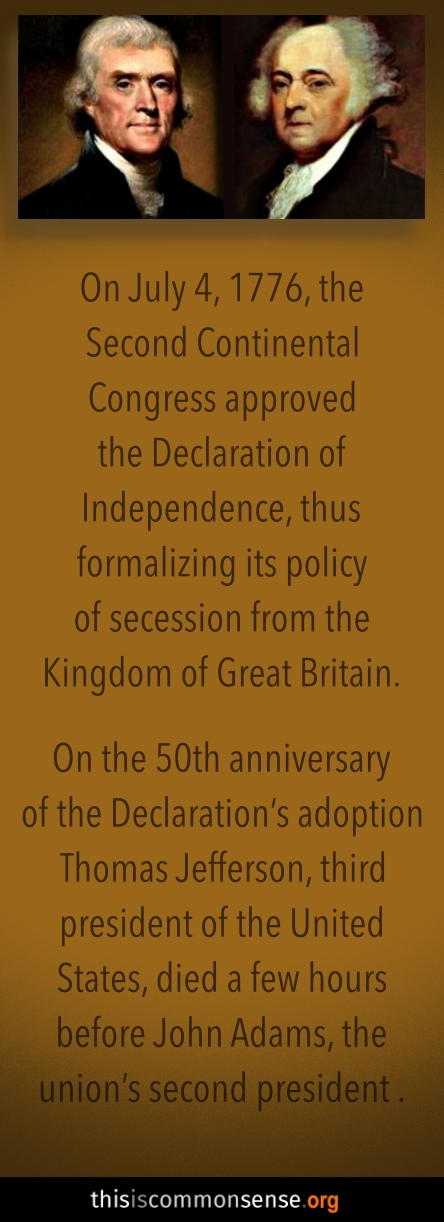
1776 — The Second Continental Congress approved the Declaration of Independence, thus formalizing its policy of secession from the empire of the Kingdom of Great Britain.

1803 — The Louisiana Purchase was announced to the American people.

1804 – Nathaniel Hawthorne, American author of The Scarlet Letter, House of Seven Gables, The Blithesdale Romance, and other classics, was born. Hawthorne became part of the Young America literary movement spawned by Loco-Foco political activism in New England.

1826 – Thomas Jefferson, third president of the United States, died a few hours before John Adams, second president of the United States, on the fiftieth anniversary of the adoption of the United States’ Declaration of Independence.

1826 – Stephen Foster, composer of “Old Black Joe,” “Beautiful Dreamer,” and many other classic American songs, was born.

1827 – Slavery was abolished in New York State.

1831 – Samuel Francis Smith wrote “My Country, ’Tis of Thee” for Boston’s July 4th festivities, set to the tune of Great Britain’s national anthem, “God Save the King/Queen.”

2009 – The Statue of Liberty’s crown re-opened to the public after eight years of closure that resulted from security concerns following the September 11, 2001, attacks.