Categories
national politics & policies regulation

If This Be Price Control

In the recent pandemic, we learned that government and pharmaceutical companies do not have the least bit of an antagonistic relationship. It’s all buddy-buddy, a Big Gov/Big Pharma partnership.

And an expensive mess, sadly, in which Americans routinely pay prescription prices many times higher than folks around the world.

Now that President Donald Trump has signed an executive order aimed at “Delivering Most-Favored Nation Prescription Pricing to American Patients,” you have probably heard complaints that Trump’s plan amounts to “price controls,” which Republicans say they are against, and Trump, too, says he adamantly opposes. 

But the The Wall Street Journal editorial that mounted this case, and Joe Lancaster’s argument in Reason, assume that the current order makes sense. The present system is in no way a free market in drugs. It’s the result of patent policy, massive subsidies to consumers, an insane approach to insurance regulation, and abridgements to free trade.

“There are many good reasons why we should pay more for earlier access to new medications than our trading partners,” write Darius Lakdawalla and Dana Goldman, quoted in Lancaster’s Reason article.  

And then they go on to recommend an elaborate government scheme that itself is more a form of price controls than Trump’s workaround.

While I doubt that all of Trump’s boasted benefits will pan out, the status quo is a rigged market, and Congress — which could debate and fix it, theoretically — does nothing to restore a free market, thereby earning its low ratings from the public.

Leaving it to the executive branch. 

Which is not supposed to legislate this sort of thing at all.

This is Common Sense. I’m Paul Jacob.


NOTE: Jeffrey Tucker wrote a much longer piece defending Trump’s plan — arguing that in a rigged system such as ours, calling Trump’s most-favored-nation policy a form of price regulation, and the status quo not, is witless.

PDF for printing

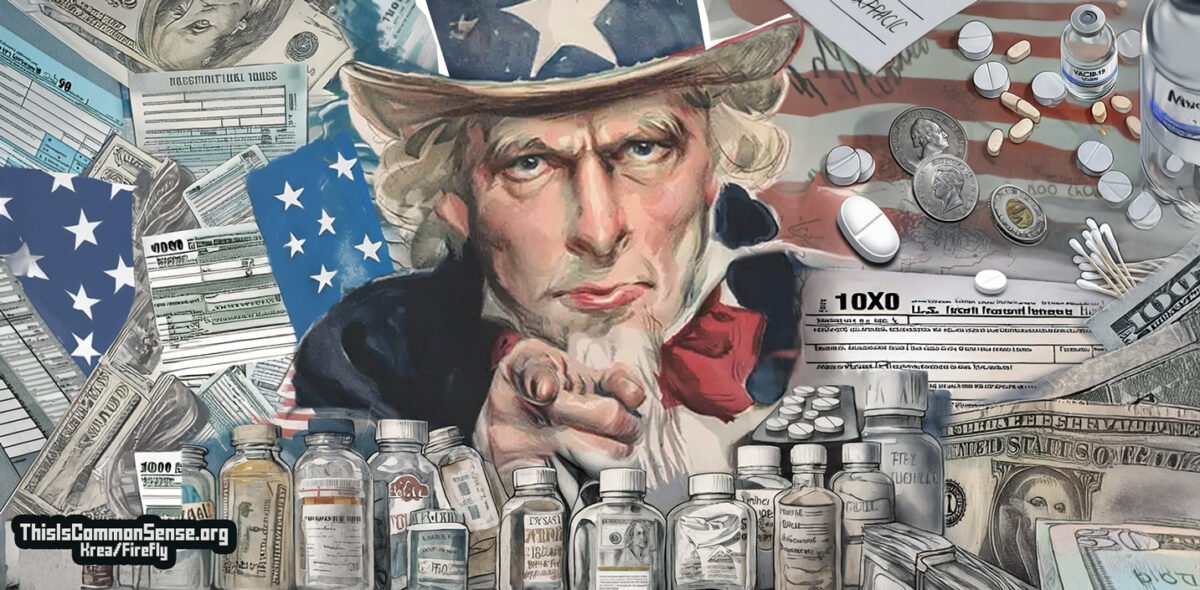
Illustration created with Krea and Firefly

See all recent commentary
(simplified and organized)
See recent popular posts

Categories
Thought

Florence King

We wallow in nostalgia but manage to get it all wrong. True nostalgia is an ephemeral composition of disjointed memories […] but American-style nostalgia is about as ephemeral as copyrighted déjà vu.

Florence King, “Déjà Views,” in Reflections in a Jaundiced Eye (1989), p. 112.
Categories
Today

Constitutional Convention

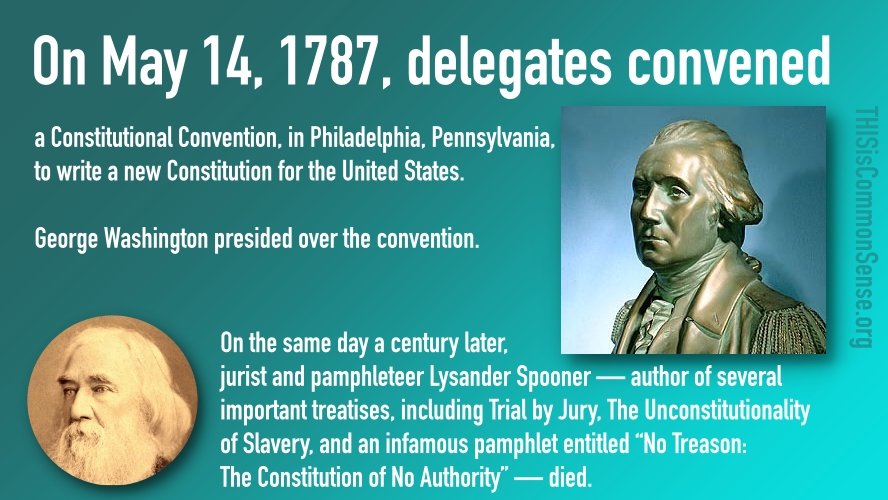
On May 14, 1787, delegates convened a Constitutional Convention, in Philadelphia, Pennsylvania, to write a new Constitution for the United States. George Washington presided over the convention.

On the same day a century later, jurist and pamphleteer Lysander Spooner — author of several important treatises, including Trial by Jury, The Unconstitutionality of Slavery, and an infamous pamphlet entitled “No Treason: The Constitution of No Authority” — died.

Categories
government transparency international affairs media and media people national politics & policies

Lying About Killing for Votes

Some foreign policy issues, such as regarding Israel and Palestine, are confusing enough that many of us tend to be wary of sharing our opinions. 

But no matter how reticent we may be, we can agree on this: there should be no outright lying about our positions. 

Mitchell Plitnick is a progressive who is willing to confront this prevarication problem forthrightly. Of the many “disheartening moments” during the last presidential campaign, “few,” he admits, “were quite as deflating as that moment when the ostensibly progressive, leading member of The Squad, Alexandria Ocasio-Cortez stood at the podium at the Democratic National Convention and told the audience that then-Vice President Kamala Harris was ‘working tirelessly to secure a ceasefire in Gaza and bring the hostages home.’

“We knew she was lying,” Plitnick confesses. “AOC herself knew she was lying. But it was just the message that the crowd — who were more than eager to show their support for the Democrats despite the party’s utter refusal to allow even the most conciliatory and moderate Palestinian voice to be heard — wanted to hear, and they ate it up.”

This willingness of the few to promote a blatant lie, and of the masses to believe it, might be the most disheartening thing about modern politics.

And as for the truth, how do we know Plitnick is right about the prevarications? “The utterly shameless nature of the lie has now been confirmed by no less than nine officials from Joe Biden’s administration and reported on by Israel’s own Channel 13 news program, Hamakor. . . .”

We, the people — pro-Israel and pro-Palestinian and otherwise — may all wish for a ceasefire.

But it’s clear that the last administration wanted nothing to do with it.

And lied about it. For votes.

This is Common Sense. I’m Paul Jacob.


PDF for printing

Illustration created with Krea and Firefly

See all recent commentary
(simplified and organized)
See recent popular posts
Categories
Thought

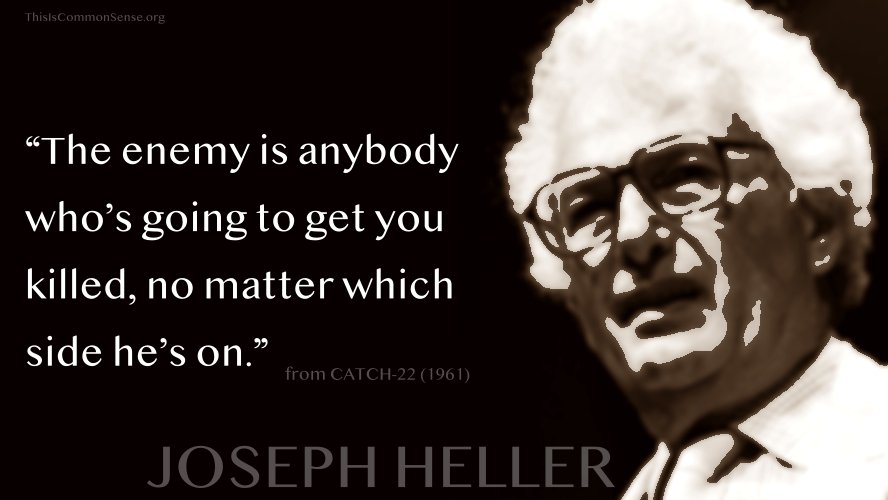
Joseph Heller

“The enemy is anybody who’s going to get you killed, no matter which side he’s on.”

Joseph Heller, Catch-22 (1961).
Categories
Today

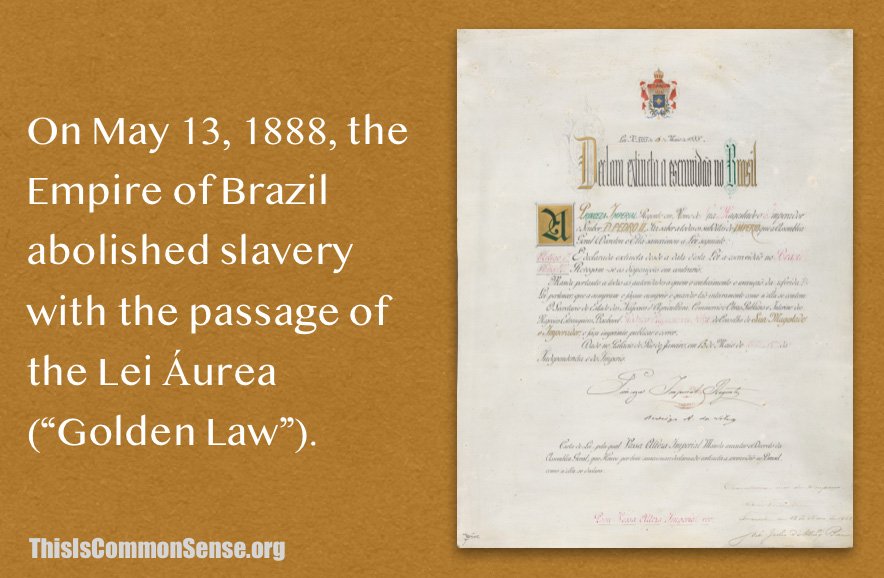
Lei Áurea

On May 13, 1888, the Empire of Brazil abolished slavery with the passage of the Lei Áurea (“Golden Law”).

Categories
Thought

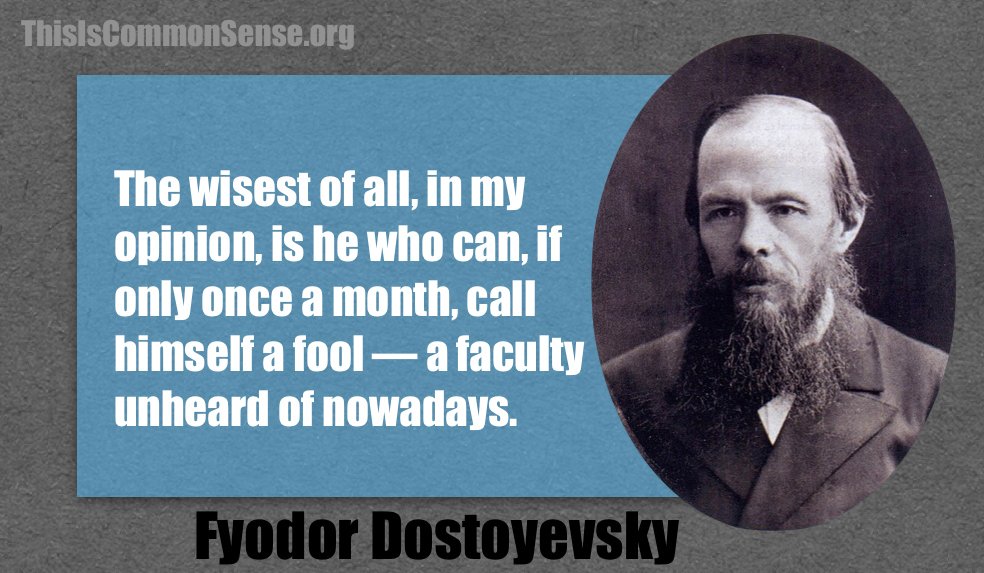
Fyodor Dostoyevsky

The wisest of all, in my opinion, is he who can, if only once a month, call himself a fool — a faculty unheard of nowadays.

Fyodor Dostoyevsky, “Bobok : From Somebody’s Diary,” as translated by Constance Garnett in Short Stories (1900).

Categories
Today

Axis in Africa

On May 12, 1943, Axis forces in North Africa surrendered.

Categories
Update

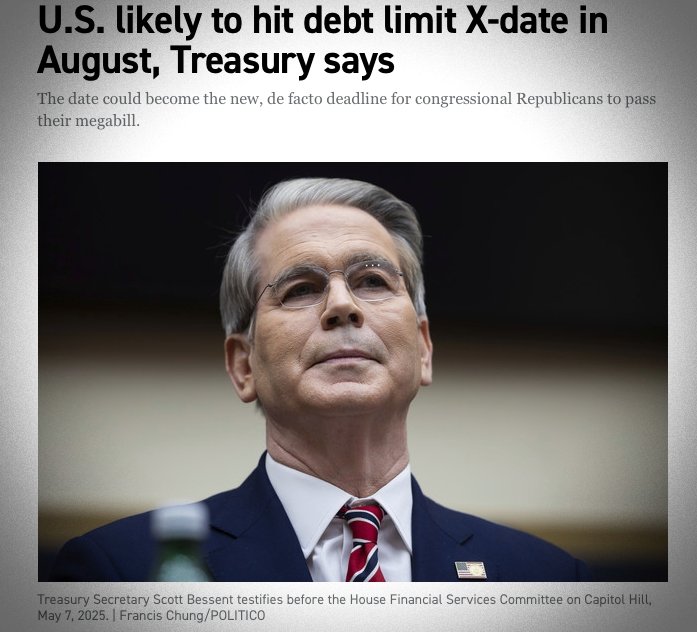
A New Deadline

“The Treasury Department said Friday it would likely run out of cash to pay the nation’s bills by August,” Politico tells us, “setting a new, firmer deadline for Congress to act to avoid a catastrophic default on the United States’ more-than $36 trillion debt.”

“Because there is significant uncertainty in projecting cash flows months into the future,” Secretary of Treasury Scott K.H. Bessent wrote Speaker of the House Mike Johnson, on Friday, “it is impossible to identify precisely how long cash and extraordinary measures will last.” Bessent went on to surmise that funds “will be exhausted in August while Congress is scheuled to be in recess.”

The Secretary urged “Congress to increase or suspend the debt limit by mid-July,” to prevent another scurrying chaos about government operations, like we’re used to, and “to protect the full faith and credit of the United States.”

Not doing so, the Secretary informed the Speaker, “would wreak havoc on our financial system and diminish America’s security and global leadership position.”

Michael Stratford and Jennifer Scholtes at Politico draw the obvious extrapolation: “If congressional Republicans don’t get their party-line bill to President Donald Trump’s desk before Treasury exhausts its borrowing power, GOP leaders will likely be forced to seek votes from Democrats to head off the fiscal cliff — an exercise that would likely require making major policy concessions to the minority party and risk alienating fiscal hawks.”

“GOP Lawmakers are hashing out the details of what will be in the sweeping package,” explains USA Today, “which is expected to boost funding for border security and defense while cutting taxes and possibly cutting social programs such as Medicaid.”

What are the odds that Republicans will work together to reduce government in their promised megabill before this new “deadline”?

Odds are that they will only increase spending. No?


Paul Jacob writes about the budgeting process, debt crises, and allied subjects with some regularity. “The Continuing Crisis,” from March, gives a good idea of his general tenor.

Categories
Thought

John Wilkes

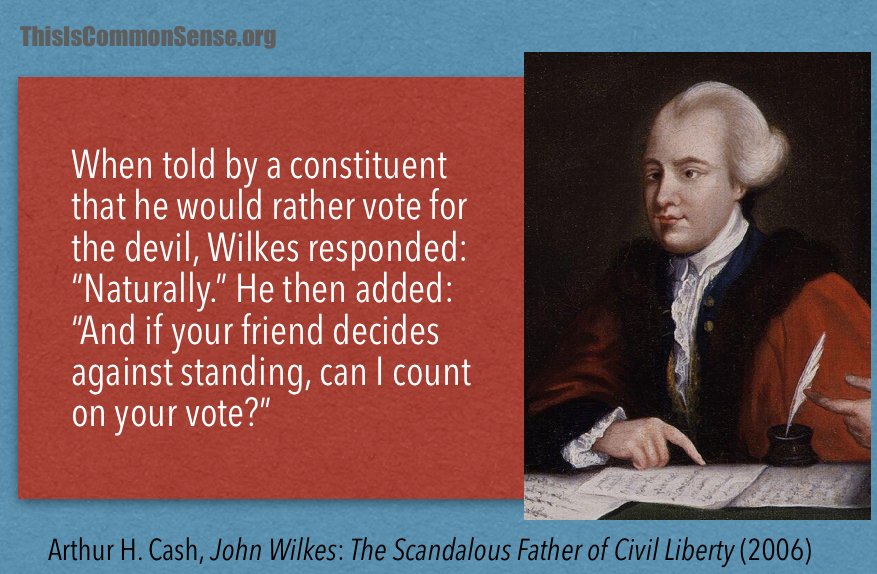
When told by a constituent that he would rather vote for the devil, Wilkes responded: “Naturally.” He then added: “And if your friend decides against standing, can I count on your vote?”

Arthur H. Cash, John Wilkes: The Scandalous Father of Civil Liberty (2006).