Categories
general freedom ideological culture

Greatest Man in the World

Today, while we prepare our family’s feast or exchange our fastidiously purchased Presidents’ Day gifts or even find ourselves kissing under the cherry tree, let us take just a moment to consider the history of this momentous day.

When I was a kid, we celebrated Washington’s Birthday on February 22nd, each year. That officially recognized day honored George Washington, first president and the ‘father of our country,’ began in the 1880s (even before I was born). Then in 1968, someone discovered that Abraham Lincoln also had a February birthday and was apparently feeling slighted. 

So, what could we do but get the two big guys together for a mega national holiday? Lincoln was a pretty consequential president, after all.

But the holiday came to be known as Presidents’ Day . . . and as the Encyclopedia Brittanica notes, “is sometimes understood as a celebration of the birthdays and lives of all U.S. presidents.”

Is this some sort of “everyone gets a trophy” thing?

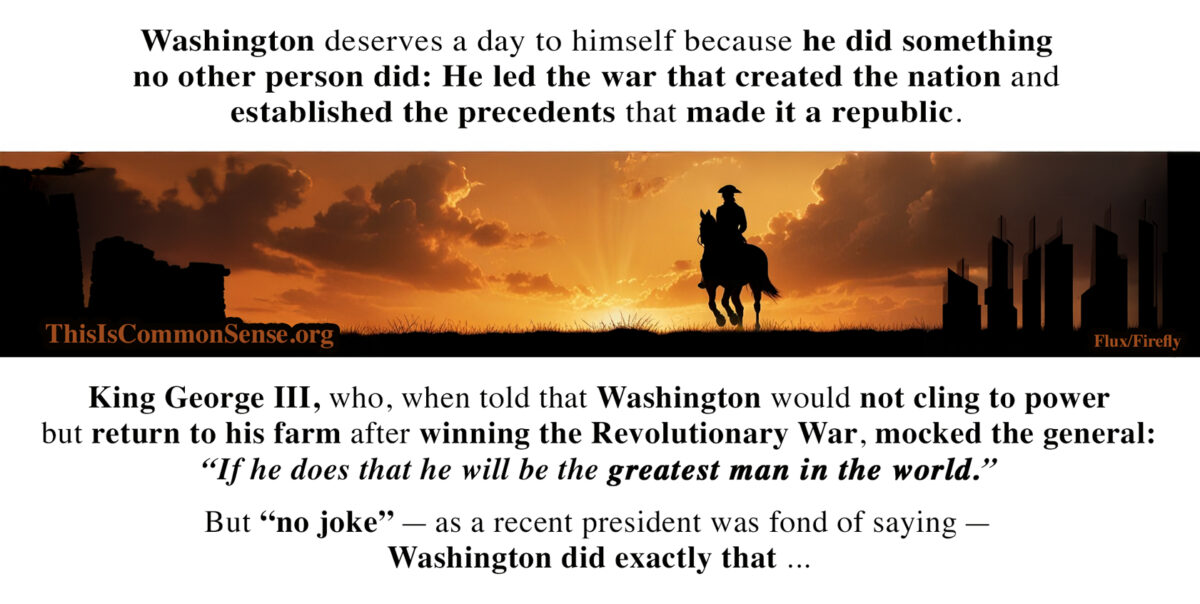
No. “Washington deserves a day to himself,” wrote David Boaz years ago, “because he did something no other person did: He led the war that created the nation and established the precedents that made it a republic.”

Boaz also wrote of King George III, who, when told that Washington would not cling to power but return to his farm after winning the Revolutionary War, mocked the general. “If he does that he will be the greatest man in the world.”

But “no joke” — as a recent president was fond of saying — Washington did exactly that, handing back his commission as commander of the army. 

Just as years later he stepped down after two terms as president, setting the tradition that ultimately led to the Constitution’s 22nd Amendment: presidential term limits.

So, Happy Washington’s Birthday!

This is Common Sense. I’m Paul Jacob. 


PDF for printing

Illustration created with Flux and Firefly

See all recent commentary
(simplified and organized)
See recent popular posts

Categories
Common Sense

Henry Adams

Knowledge of human nature is the beginning and end of political education.

Henry Adams, The Education of Henry Adams (1907), Vol. XII, “Eccentricity.”

Categories
Today

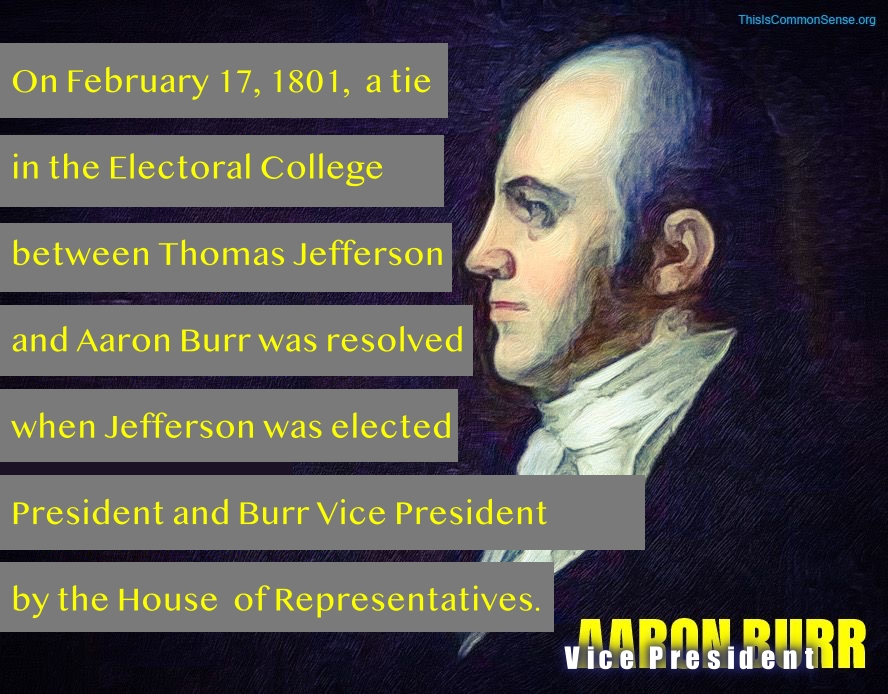
Jefferson vs. Burr

On February 17, 1801, a tie in the Electoral College between Thomas Jefferson and Aaron Burr was resolved when Jefferson was elected President and Burr Vice President by the House of Representatives.

Categories
Update

Doing Something About the Debt?

There used to be comity in Washington, D.C., because there was a system in place that allowed the two vying parties to fleece the public while “justifying” the fleecing. Paul Jacob wrote about this over a decade ago:

[H]ere was the genius of the system: The slight cuts in growth rates allowed left-leaning Democrats to hysterically decry the cruelty of the “cuts” that Reagan was “imposing” — courtesy of the accounting tricks allowed by the post-Nixon Budget Control Act — despite the illusory nature of those cuts.

Republican politicians, meanwhile, could go home to boast of those “cuts.”

Meanwhile, deficits ballooned under Ronald Reagan, and Republican voters came to accept deficit financing (growth in debt) as a natural thing, almost good. With the ascension of George W. Bush to the presidency, and a post-Clintonian reaction giving majorities in both houses to Republicans, this trend solidified.

Paul Jacob, “Dumbline Democracy,” Townhall (July 8, 2012).

The comity ended as increasing numbers of Americans came to disbelieve in the confidence game the two parties engaged in. This led to the selection by one of the parties of a candidate enough outside the con artists’ guild to upset the out-of-control order. Trump, that is.

So now that key bit of legislation, the Congressional Budget and Impoundment Control Act of 1974, is finally under serious targeting:

In a move that could give President Donald Trump more freedom to enact his agenda, Republicans are attempting to repeal a law which ties the hands of presidents who don’t want to spend particular funding appropriated by Congress.

Known as impoundment, the practice of declining to spend funds provided by Congress dates back to President Thomas Jefferson.

Since 1974, however, it has been tempered by the Impoundment Control Act (ICA).

Nathan Worcester, “Republicans Seek to Unleash President’s Power to Not Spend,” The Epoch Times (February 16, 2025).

The constitutionality of impoundment has never reached the Supreme Court. The practice was started by Jefferson, who used it to stop Congress from unconstitutional spending — but because impoundment was not in the Constitution itself, it’s open to obvious challenge, and to the argument that it is an example of executive overreach.

The whole issue comes down to the fact that the Constitution provides inadequate means of the executive to stop Congress from unconstitutional acts, as well as the states to stop the federal government as a whole from the same. The constitutional crises associated with slavery expansion in the mid-century are now endlessly discussed. But current dysfunctional partisan over-spending is at least as serious a problem.

Thankfully, we have an easier marker for a constitutional crisis now:

See also “The Fourteenth Amendment Escape Clause,” July 8, 2011.

Categories
Thought

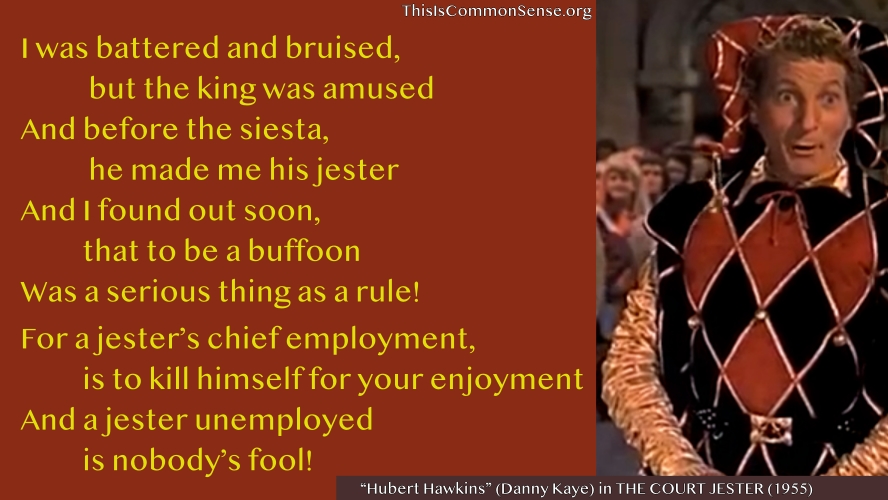
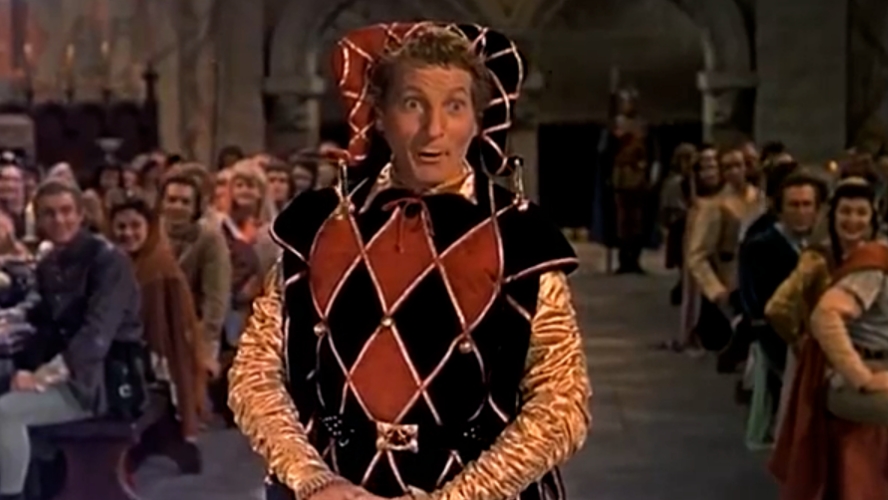
Hubert Hawkins

I was battered and bruised, but the king was amused
And before the siesta, he made me his jester
And I found out soon, that to be a buffoon
Was a serious thing as a rule!
For a jester’s chief employment,
is to kill himself for your enjoyment
And a jester unemployed is nobody’s fool!

Sung by Danny Kaye, playing Hubert Hawkins, in The Court Jester (1955), movie writing credits to Norman Panama and Melvin Frank but lyrics credited to Sammy Cahn.
Categories
Today

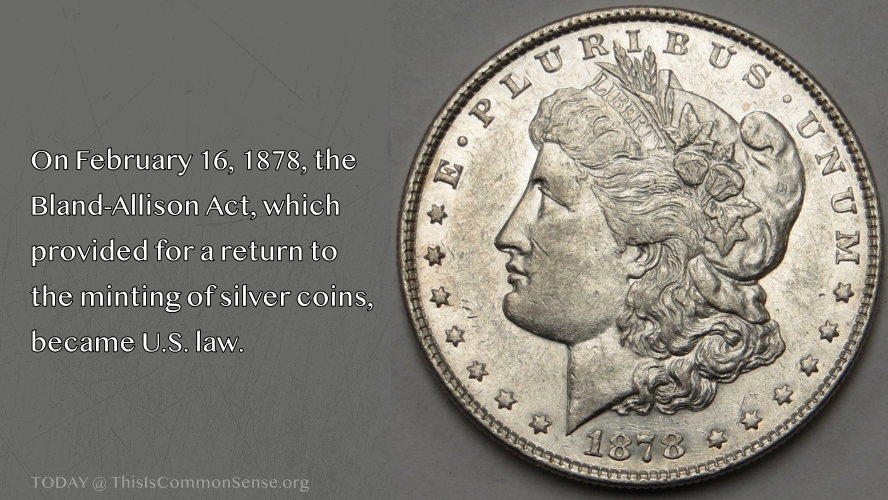
Silver Coinage

On February 16, 1878, the Bland-Allison Act, which provided for a return to the minting of silver coins, became U.S. law.

Categories
FYI

How the DOGE Do

“DOGE is a temporary organization repurposed from U.S. Digital Services,” explains The Epoch Times. “Trump and Musk previewed the idea to prospective voters on the campaign trail.”

The new “department” was not created ex nihilo, but, instead, fashioned out of an existing outfit that had been established by the Obama Administration. It was actually a “Reorganization and Renaming of the United States Digital Service. The United States Digital Service is hereby publicly renamed,” the January 20, 2025, executive order put it, “as the United States DOGE Service (USDS) and shall be established in the Executive Office of the President.”

Establishment of a Temporary Organization.  There shall be a USDS Administrator established in the Executive Office of the President who shall report to the White House Chief of Staff. There is further established within USDS, in accordance with section 3161 of title 5, United States Code, a temporary organization known as “the U.S. DOGE Service Temporary Organization”.  The U.S. DOGE Service Temporary Organization shall be headed by the USDS Administrator and shall be dedicated to advancing the President’s 18-month DOGE agenda. The U.S. DOGE Service Temporary Organization shall terminate on July 4, 2026. The termination of the U.S. DOGE Service Temporary Organization shall not be interpreted to imply the termination, attenuation, or amendment of any other authority or provision of this order.

Notice that this is a sunsetting operation, of limited duration. And also notice how the “Department of Government Efficiency” is contracted to DOGE (with its own history in the crypto space), which is then subsumed under the initialism of an existing organization, “United States Digital Services,” and note that many of the members of the DOGE team are proficient masters of modern technology and organizational methods — or, as The Epoch Times puts it, “Many individuals publicly associated with DOGE are very young and highly technically accomplished.”

“Doge” was also the title of rulers of several renaissance era Italian city states, perhaps made most recently memorable in the banter of Danny Kaye in the 1955 film The Court Jester:

King Roderick: The Duke. What did the Duke do?
Hubert Hawkins: Eh . . . the Duke do?
Roderick: Yes. And what about the Doge?
Hawkins: Oh, the Doge! King Roderick: Eh. Well what did the Doge do?
Hawkins: The Doge do?
Roderick: Yes, the Doge do.
Hawkins: Well, uh, the Doge did what the Doge does. Eh, uh, when the Doge does his duty to the Duke, that is.
Roderick: What? What’s that?
Hawkins: Oh, it’s very simple, sire. When the Doge did his duty and the Duke didn’t, that’s when the Duchess did the dirt to the Duke with the Doge.
Roderick: Who did what to what?
Hawkins: Oh, they all did, sire. There they were in the dark; the Duke with his dagger, the Doge with his dart, Duchess with her dirk.
Roderick: Duchess with her dirk?
Hawkins: Yes! The Duchess dove at the Duke just when the Duke dove at the Doge. Now the Duke ducked, the Doge dodged, and the Duchess didn’t. So the Duke got the Duchess, the Duchess got the Doge, and the Doge got the Duke!

Extremely clever. The legal creation of the DOGE, we mean. Much more clever than renaming the Gulf of Mexico to the “Gulf of America.” And to much more pointed effect.

Categories
Thought

Ayanna Pressley

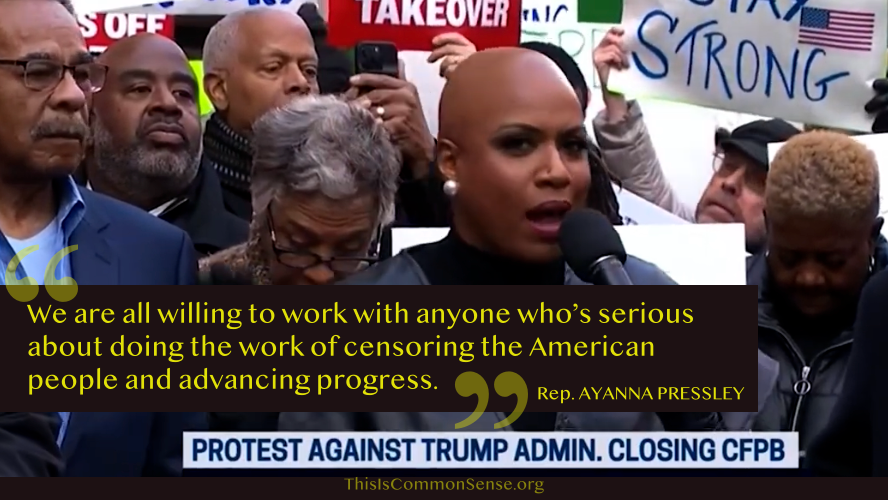
We are all willing to work with anyone who’s serious about doing the work of censoring the American people and advancing progress.

Representative Ayanna Pressley (D-Mass.), taking “a bit of umbrage” and speaking “on behalf of my colleagues.” Best guess as to what she meant to say is “centering the American people,” whatever that means. But she did not say that. She said “censoring.” She is talking about the Department of Government Efficiency and the closing of the rogue agency the CFPB. She concludes this statement with “But they are not serious,” referring to the people she opposes: the Republicans and President Trump’s team constituting the DOGE.
Categories
Thought

Ayn Rand

A genius is a genius, regardless of the number of morons who belong to the same race — and a moron is a moron, regardless of the number of geniuses who share his racial origin.

Ayn Rand, The Virtue of Selfishness (1964).

Categories
Today

Remember the Maine

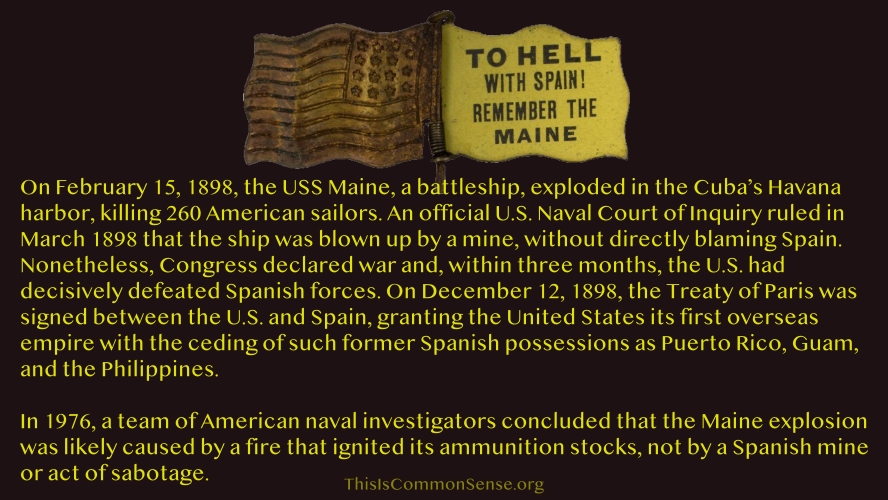
On February 15, 1898, the USS Maine, a battleship, exploded in the Cuba’s Havana harbor, killing 260 American sailors. An official U.S. Naval Court of Inquiry ruled in March 1898 that the ship was blown up by a mine, without directly blaming Spain. Nonetheless, Congress declared war and, within three months, the U.S. had decisively defeated Spanish forces. On December 12, 1898, the Treaty of Paris was signed between the U.S. and Spain, granting the United States its first overseas empire with the ceding of such former Spanish possessions as Puerto Rico, Guam, and the Philippines.

In 1976, a team of American naval investigators concluded that the Maine explosion was likely caused by a fire that ignited its ammunition stocks, not by a Spanish mine or act of sabotage.