Tuesday is Election Day for Wisconsin’s gubernatorial recall, pitting Republican Gov. Scott Walker against Democratic Milwaukee Mayor Tom Barrett in a rematch of their 2010 contest, won by Walker. Polls show Walker leading, and likely to become the first “recalled” governor to ultimately defeat his recall and retain his office.
In fact, after all the massive protests and the recall campaign, Walker’s popularity has increased.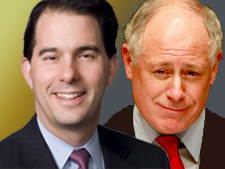
Why?
Mr. Walker has done what he said he would. He hasn’t raised taxes. He staked out his position on ending collective bargaining for most public employees as well as requiring them to pay something toward healthcare and pension benefits, and, against a flurry of opposition, stuck to his guns.
Now the Badger State’s unemployment rate is down below the national average and economic prospects are up.
For a very different story, look south, to Illinois.
Gov. Patrick Quinn supports initiative, referendum and recall, but gets demerits for his response to the current economic difficulties. In 2010, Illinois raised the state income tax by 66 percent. But the $7 billion in extra revenue has done little to solve the state’s chief budget woe — Illinois was $8 billion in the hole when the income tax was hiked, and somehow faces that same $8 billion shortfall today.
So, just a week ago, lawmakers slapped a $1-per-pack tax on cigarettes.
If a state could tax itself out of trouble, Illinois would be a near paradise today.
Walker took on the government employee unions; Quinn took on the taxpayers. That’s why Wisconsin — including their embattled governor — is on the upswing and Illinois is not.
This is Common Sense. I’m Paul Jacob.
 Harriett Beecher Stowe’s “Uncle Tom’s Cabin” begins its ten-month serialization in the National Era, an abolitionist publication, on this date in 1851.
 [T]he most important change which extensive government control produces is a psychological change, an alteration of the character of the people. This is necessarily a slow affair, a process which extends not over a few years but perhaps one or two generations. The important point is that the political ideals of a people and its attitude toward authority are as much the effect as the cause of the political institutions under which it lives. This means that . . . even a strong tradition of political liberty is no safeguard if the danger is precisely that new institutions and policies will gradually undermine and destroy that spirit.
  Henry Ford puts his first “quadricycle” through a test run on June 4, 1896. Ford would go on to transform transportation by applying the principles of the assembly line to automobile production, which would transform American life . . . and the world.
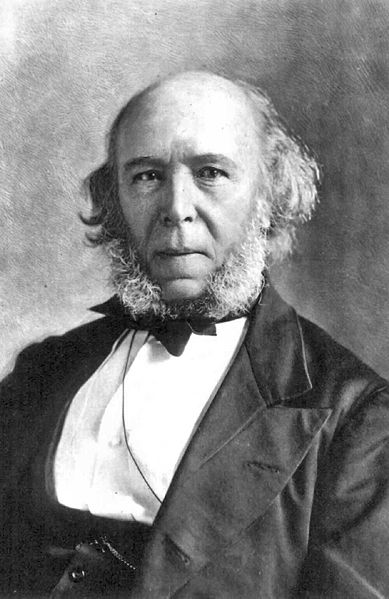 The essential trait in the moral consciousness, is the control of some feeling or feelings by some other feeling or feelings.
 Born on this date in 1821, Edward Livingston Youmans, American science writer and editor. In 1871 he started publication of the International Scientific Series of then-modern classics of scientific literature (published simultaneously first in New York, London, Paris, and Leipzig, later also in St. Petersburg and Milan), and the next year started the magazine Popular Science Monthly. In these and other venues he promoted the work of British philosopher Herbert Spencer, instigating Spencer to write the popular “The Study of Sociology,” and arranging publication of all of Spencer’s books with D. Appleton & Co., as well as many other international authors – with royalties on the sales (which in Spencer’s case reached 132,000 copies by 1890) going to the authors, despite the lack of an international copyright.
 On June 2, 1774, the Quartering Acts were passed by British Parliament, part of a package of punitive acts devised as a response to colonial unrest. The acts did not have the desired effect; they did not quell resistence. Instead, they became known as the “Intolerable Acts,” and helped fuel the fires of secession, leading to the American Revolution.
 The only guarantee of the Bill of Rights which continues to have any force and effect is the one prohibiting quartering troops on citizens in time of peace. All the rest have been disposed of by judicial interpretation and legislative whittling. Probably the worst thing that has happened in America in my time is the decay of confidence in the courts. No one can be sure any more that in a given case they will uphold the plainest mandate of the Constitution. On the contrary, everyone begins to be more or less convinced in advance that they won’t. Judges are chosen not because they know the Constitution and are in favor of it, but precisely because they appear to be against it.