“It is good to be without vices, but it is not good to be without temptations.”
—Walter Bagehot

To download the full-size version of this image, click above.
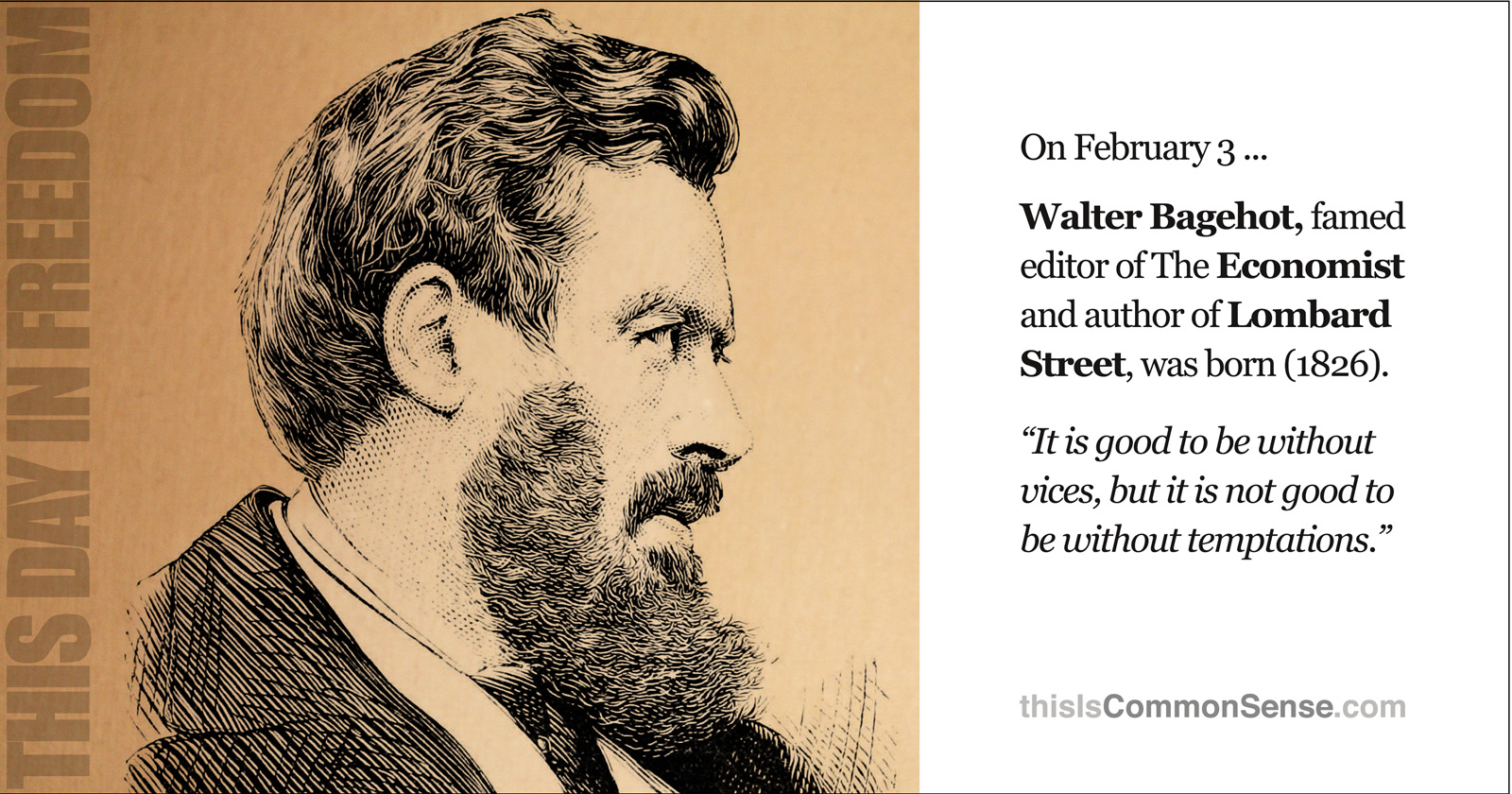
“It is good to be without vices, but it is not good to be without temptations.”
—Walter Bagehot
To download the full-size version of this image, click above.
On February 2, 1887, Punxsutawney, Pennsylvania celebrated the first Groundhog Day. On the same day in 1976, the Groundhog Day gale hit the north-eastern United States and south-eastern Canada.
In 2009, the Reserve Bank of Zimbabwe officially devalued the Zimbabwean dollar for the third and final time, making Z$1 trillion now only Z$1 of the new currency, equivalent to Z$10 septillion before the first devaluation. Politicians in Zimbabwe looked up, saw their shadow, and realized that they had only a couple months more of their inflation binge. Indeed, the legalization of trading currencies, the previous month, had sealed the fate of Zimbabwe’s independent dollar. The Zimbabwean dollar was abandoned officially on the 9th of April, 2009.
“I should have been an engineer,” climatologist Dr. Roy Spencer laments. “I went into science with the misguided belief that science provides answers. Too often, it doesn’t. Some physical problems are simply too difficult. Two scientists can examine the same data and come to exactly opposite conclusions about causation.”
In other words, it’s like all sciences of complex phenomena. Like social science — economics, for instance.
But he’s not complaining that it’s hard. He’s complaining that it’s been taken over.
By ideologues.
 When it comes to “climate change,” scientific nuance is gone:
We still don’t understand what causes natural climate change to occur, so we simply assume it doesn’t exist. This despite abundant evidence that it was just as warm 1,000 and 2,000 years ago as it is today. Forty years ago, “climate change” necessarily implied natural causation; now it only implies human causation.
This unscientific leap to the now-de rigueur “anthropogenic” conclusion depresses him.
Understandably. Take the latest news pitch, the NOAA and NASA reports that last year, 2014, stands as “the hottest on human record.”
No, it isn’t, Spencer says.
Such claims are based on compromised data that most respectable climate scientists now avoid: surface temperature recordings, not satellite data. Such “hottest ever” reports “feed the insatiable appetite the public has for definitive, alarming headlines. It doesn’t matter that even in the thermometer record, 2014 wasn’t the warmest within the margin of error.”
But journalists, often moonlighting as lazy political activists, “went into journalism so they wouldn’t have to deal with such technical mumbo-jumbo” as “margins of error.”
And politicians are worse.
I guess that leaves the job of common-sense skeptic to you and me.
This is Common Sense. I’m Paul Jacob.
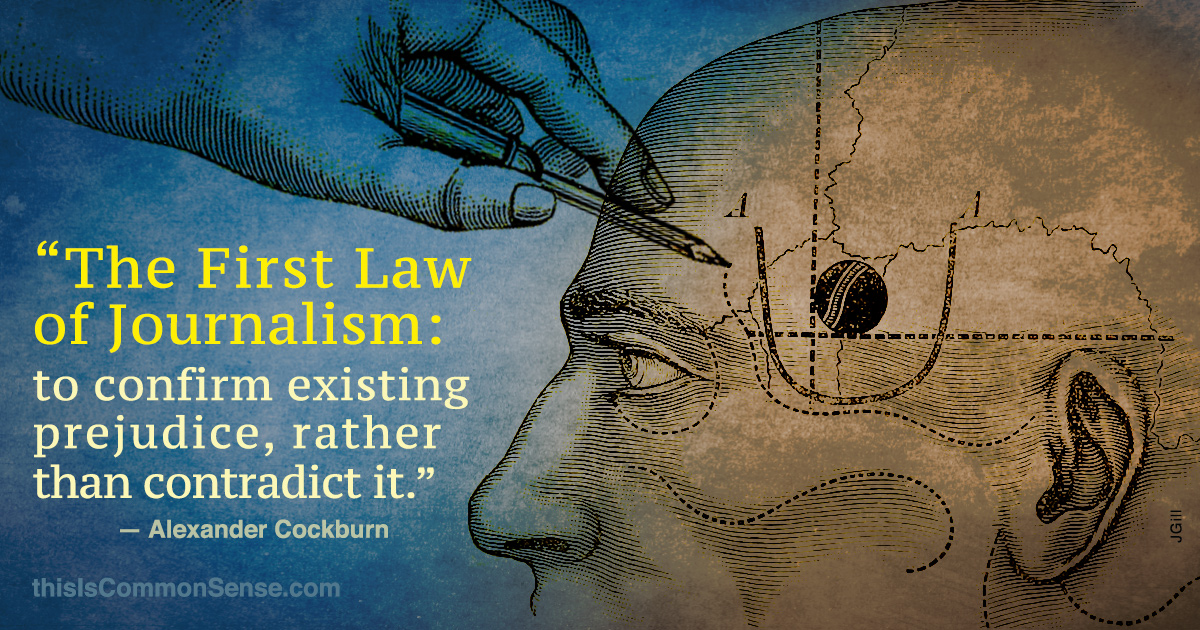
“The First Rule of Journalism: to confirm existing prejudice, rather than contradict it.”
—Alexander Cockburn
To download the full-size version of this image, click above.
 The great difficulty which history records is not that of the first step, but that of the second step. What is most evident is not the difficulty of getting a fixed law, but getting out of a fixed law; not of cementing . . . a cake of custom, but of breaking the cake of custom; not of making the first preservative habit, but of breaking through it, and reaching something better.
It is one thing to be alert to possible catastrophe. Quite another to yearn for it. Yes, it’s time again for the end of the world! Read all about it at Townhall. Click on over, then come back here for further reading. If you have time.
I am in a meeting all day. The video I have been meaning to record is still unrecorded. So, maybe all I need is a #lastminute link. Or a hashtag:
Yes, this is satire. A satire, I like to think, on all the superficial, nonsensical activism out there.
But by the way, thanks for your all your super and sensible activism in recent years. #doitright
 On January 31, 1849, the Corn Laws were abolished in the United Kingdom, one of the most impressive and far-reaching anti-protectionist moves of all time. “Corn” stood for all grains, including wheat, oats, barley, etc., and the free-trade agitation by John Bright and Richard Cobden (pictured) was one of the main impetuses for the reform.
On Jan. 31, 1865, the United States Congress proposed the Thirteenth Amendment to the U.S. Constitution, submitting it to the states for ratification. The Amendment’s main section reads: “Neither slavery nor involuntary servitude, except as a punishment for crime whereof the party shall have been duly convicted, shall exist within the United States, or any place subject to their jurisdiction.”
On Jan. 31, 1990, the first McDonald’s fast food restaurant opens in the Soviet Union. Having once traveled to Moscow, I’m exceedingly thankful for this.
If you’re living in New England and you’ve recently been buried under snow, you probably don’t want to hear how it’s somewhat the fault of (man-exacerbated) global warming. Nor that we can, maybe, tweak the weather to perfection if only we drastically curtail the carbon-emission needed to make boots, gloves and roofs, and to operate snow plows.
Perhaps you’re saying, “Warming? The snow is cold.”
But half-baked conclusions that the concluder is frigidly determined to reach regardless of evidence may be “based on” any set of facts under the sun.
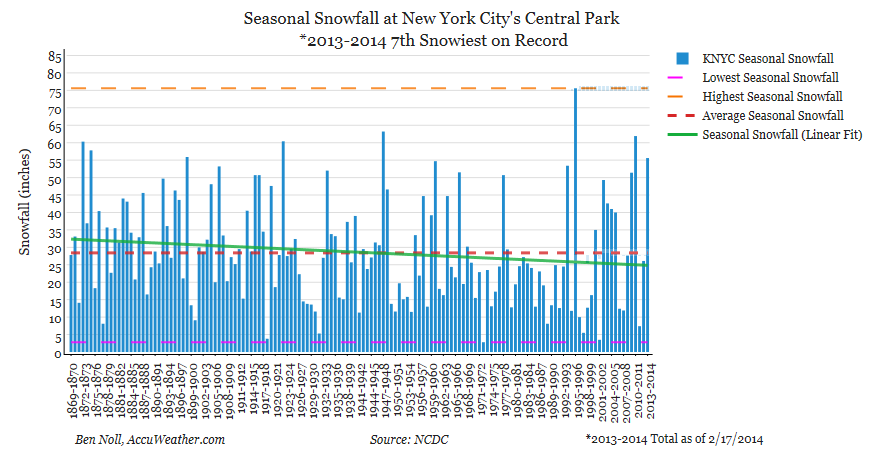
 Patrick Michaels and Paul Knappenberger of the Cato Institute point out the silliness of regarding an unknown human contribution to climate patterns as co-responsible for any bad weather.
Blizzard Juno (like pretty much any storm) was “the result of a very complex system of physical interactions — the precise behavior of each one of which is not completely understood, much less perfectly predictable. This makes ascertaining the influence of human-caused climate change virtually (if not entirely) impossible.”
The authors present a graph of snowfall totals in NYC’s Central Park since the late 19th century. Lots of spikes, lots of troughs. In other words, natural variability in the weather is nothing new.
We can’t always predict the course of storms very exactly. But, these days, we sure can predict that when the storms come, humanity will be indicted along with Mother Nature . . . almost as if there were no weather on earth before human beings showed up.
This is Common Sense. I’m Paul Jacob.
On Jan. 30, 1948, Indian leader Mohandas Gandhi, known for his non-violent, non-cooperation struggle for freedom and national independence, was assassinated by a Hindu extremist.
On Jan. 30, 1956, Martin Luther King, Jr.’s home was bombed in retaliation for his work on the Montgomery Bus Boycott.
On Jan. 30, 1972, British soldiers killed fourteen unarmed civil rights marchers in Northern Ireland in what came to be known as “Bloody Sunday.” Soldiers shot 26 unarmed protesters and bystanders – 13 males, seven of whom were teenagers, died immediately, while another man died of his injuries nearly five months later. In the immediate aftermath, an investigation by the British Government largely cleared the soldiers and British authorities of blame. A second investigation begun in 1998, released a report in 2010 declaring that all of those shot were unarmed, and that the killings were both “unjustified and unjustifiable.”