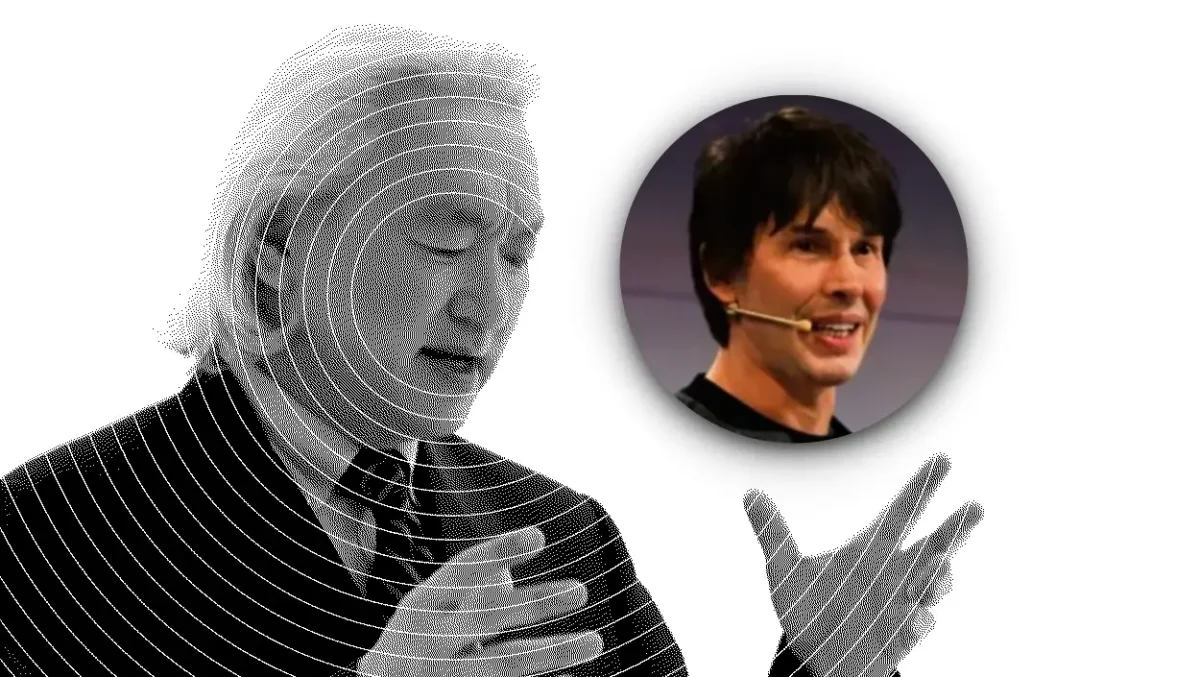
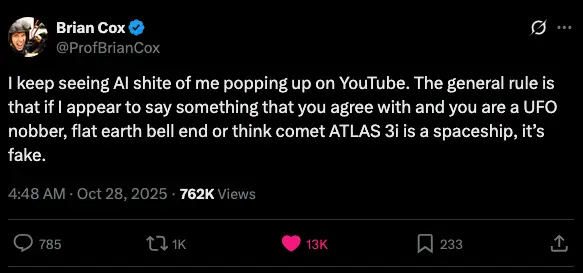
Physicist Brian Cox is more than a little annoyed. He keeps seeing online videos of “himself” saying things that he has never said. And he complained on X:
Michio Kaku has even more cause for complaint: false video of him yammering on about 3I/ATLAS appears to have been more numerous. And he, too, protests. See for yourself on his website:
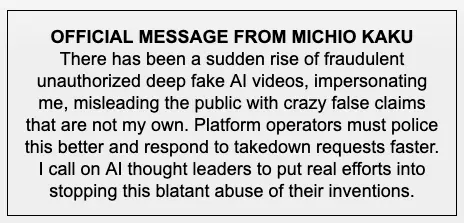
But how much misleading of the public is going on? Isn’t the standard reaction to do a double take the first time you see one of these fakeries, and then spot it out for what it is within half a minute?
AI is not quite that convincing. Yet. There are tells.
And the fact that the videos show these scientists saying outrageous things about our solar system’s third official interstellar visitor is a pretty big clue. (Though it is worth noting that Michio Kaku has scientifically studied UFOs, and may not be quite as negative to “believers” as is Brian Cox.)
Meanwhile, 3I/ATLAS continues to surprise scientists. Just be a bit cautious with media reports. You do not have to use AI or thrill over every UFO rumor to pass for a “nobber.”
Take the New York Post’s recent story by Ben Cost: “Possible alien spacecraft 3I/ATLAS makes unusual shift while hurtling towards the Sun.” Terrible title, for it suggests that, before perihelion, the putative comet was heading towards the Sun. It wasn’t. And isn’t.
“Manhattan-sized comet 3I/ATLAS allegedly executed an unusual maneuver while approaching the Sun earlier this week, fueling theories that it could be an extraterrestrial spacecraft.” Astounding! But is it true?
Oh. That word “allegedly” — who alleges?
Not Harvard astrophysicist Avi Loeb. He writes about the “First Evidence for a Non-Gravitational Acceleration of 3I/ATLAS at Perihelion.”
The non-gravitational acceleration was measured at the perihelion distance of 1.36 times the Earth-Sun separation (defined as an astronomical unit or `au’), equivalent to 203 million kilometers. It had two components in the orbital plane of 3I/ATLAS:
· A radial acceleration away from the Sun of 135 kilometers (=9×10^{-7}au) per day squared.
· A transverse acceleration relative to the Sun’s direction of 60 kilometers (=4×10^{-7}au) per day squared.
If 3I/ATLAS is propelled by the rocket effect of ejected gas, then momentum conservation implies that the object would lose half its mass over a characteristic timescale equal to the ejection speed divided by the measured non-gravitational acceleration.
Ben Cost’s word “maneuver” suggests (to this reader) a purposive act rather than a mere alteration of physical behavior. But that is not what Loeb . . . “alleges.”
We have to have a wait-and-see attitude — which is what Loeb insists upon and what he has been saying all along, even as he also insisted that we must consider the possibility that this ninth-degree anomalous object is artificial in origin.
For the record, these appear to be the list of Avi Loeb’s observed 3I/ATLAS anomalies:
- Ecliptic Alignment: Trajectory aligned within 5° of the solar system’s ecliptic plane (0.2% likelihood by chance).
- Sunward Jet (Anti-Tail): A persistent forward-pointing jet toward the Sun, not an optical illusion as in typical comets.
- Extreme Mass: ~1 million times heavier than ‘Oumuamua and 1,000 times heavier than Borisov (>5 km diameter, ~33 billion tons), while moving faster (<0.1% likelihood).
- Fine-Tuned Flybys: Arrival timing optimized for close passes by Mars, Venus, and Jupiter (~tens of millions km), unobservable from Earth at perihelion (0.005% likelihood).
- Nickel-Rich Composition: Gas plume shows excess nickel over iron (resembling industrial alloys) and high nickel-to-cyanide ratio, unlike any known comet (<1% likelihood).
- Low Water Content: Gas plume only 4% water by mass, far below typical comets (which are water-dominated).
- Extreme Negative Polarization: Light shows unprecedented -2.7% negative polarization at small phase angles, unseen in comets or asteroids (<1% likelihood).
- Wow! Signal Coincidence: Arrival direction within 9° of the 1977 “Wow!” radio signal origin (0.6% likelihood).
- Blue Spectral Surge at Perihelion: Unexpected blue glow (bluer than the Sun), defying dust-reddening in comets; possibly from ionized CO or a “hot engine” source.
Which would make the current observation of trajectory alteration the tenth, wouldn’t it?
Loeb has emphasized that these low-probability coincidences (cumulative odds <1 in 10¹⁶) warrant further scrutiny, though he rates natural origins as most likely. These contribute to its “4/10” ranking on his Loeb Scale (0 = natural; 10 = technological).
But in yesterday’s post, Loeb added the information about course alteration. According to observations, 3I/ATLAS experienced
· A radial acceleration away from the Sun of 135 kilometers (=9×10^{-7}au) per day squared.
· A transverse acceleration relative to the Sun’s direction of 60 kilometers (=4×10^{-7}au) per day squared.
This means, in layman’s language:
3I/ATLAS has demonstrated an extra “push” directly outward, away from the Sun, beyond what gravity alone would cause. (Which means that the pre-perihelion trajectory, which was scheduled to reach its perihelion — closest-to-Sol — point in late October, would now move further outward and definitely not be “hurtling towards towards the Sun.”)
3I/ATLAS has also demonstrated an extra “push” forward as it swings around the Sun, again due to non-gravitational effects (e.g., asymmetric outgassing).
Meanwhile, UFO enthusiasts/nobbers are upset that NASA hasn’t released any recent images of the object. They aren’t buying the “government shutdown” excuse. The complaint seems to be that the summaries of data so far distributed require more editorial work than merely relaying some data. How hard is it to put the most recent photos up on NASA.gov?
Apparently harder than getting an AI to fake videos of Brian Cox and Michio Kaku.
Here is an illustration — that is, a fake photo: