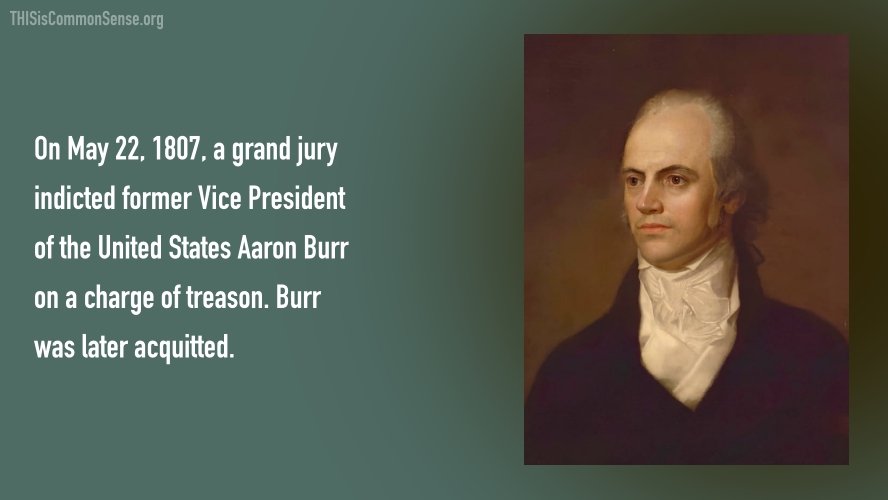
On May 22, 1807, a grand jury indicted former Vice President of the United States Aaron Burr on a charge of treason.
At issue in the trial was Burr’s dealings in Louisiana, including leasing 40,000 acres and forming “an army.” President Thomas Jefferson issued an order for Burr’s arrest, and, after a chase, Burr was captured and charged with treason, though the case was always shaky. His defense lawyers included Edmund Randolph, John Wickham, Luther Martin, and Benjamin Gaines Botts. Jefferson’s distant cousin, Chief Justice John Marshall — who hated Jefferson — presided over the trial, which began on August 3. Article 3, Section 3 of the U.S. Constitution requires that treason either be admitted in open court or proven by an overt act witnessed by two people. No witnesses came forward; Burr was acquitted on the first of September. He was ten immediately tried on a misdemeanor charge and was again acquitted.
Other May 22 events include:
- 1848: Slavery was abolished in Martinique.
- 1856: South Carolina Congressman Preston Brooks savagely beat Massachusetts Senator Charles Sumner in the halls of Congress as tensions rise over the expansion of slavery. Sumner did not return to the Senate for the three years of his recovery period.
- 1995: In U.S. Term Limits v. Thornton, the U.S. Supreme Court struck down Arkansas’s congressional term limits law, 5-4, overturning the congressional term limits then the law in 23 states: Arizona, Arkansas, California, Colorado, Florida, Idaho, Louisiana, Maine, Massachusetts, Michigan, Missouri, Montana, Nebraska, Nevada, New Hampshire, North Dakota, Oklahoma, Ohio, Oregon, South Dakota, Utah, Washington and Wyoming.