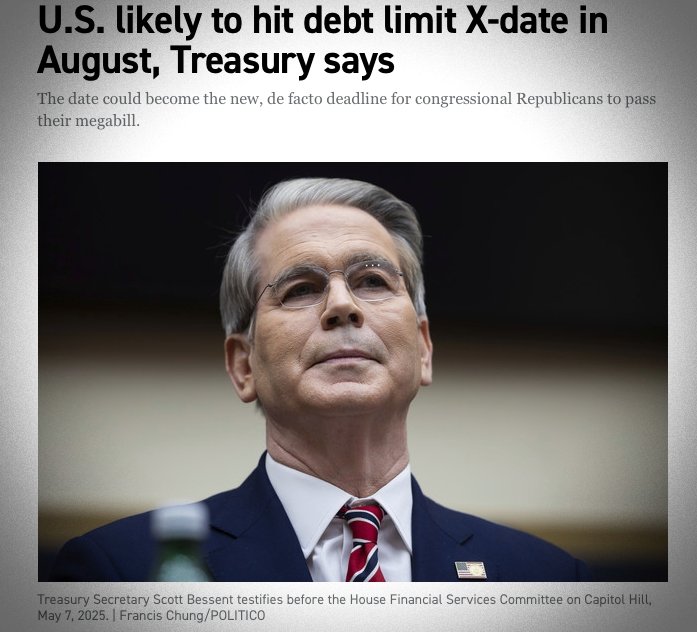
“The Treasury Department said Friday it would likely run out of cash to pay the nation’s bills by August,” Politico tells us, “setting a new, firmer deadline for Congress to act to avoid a catastrophic default on the United States’ more-than $36 trillion debt.”
“Because there is significant uncertainty in projecting cash flows months into the future,” Secretary of Treasury Scott K.H. Bessent wrote Speaker of the House Mike Johnson, on Friday, “it is impossible to identify precisely how long cash and extraordinary measures will last.” Bessent went on to surmise that funds “will be exhausted in August while Congress is scheuled to be in recess.”
The Secretary urged “Congress to increase or suspend the debt limit by mid-July,” to prevent another scurrying chaos about government operations, like we’re used to, and “to protect the full faith and credit of the United States.”
Not doing so, the Secretary informed the Speaker, “would wreak havoc on our financial system and diminish America’s security and global leadership position.”
Michael Stratford and Jennifer Scholtes at Politico draw the obvious extrapolation: “If congressional Republicans don’t get their party-line bill to President Donald Trump’s desk before Treasury exhausts its borrowing power, GOP leaders will likely be forced to seek votes from Democrats to head off the fiscal cliff — an exercise that would likely require making major policy concessions to the minority party and risk alienating fiscal hawks.”
“GOP Lawmakers are hashing out the details of what will be in the sweeping package,” explains USA Today, “which is expected to boost funding for border security and defense while cutting taxes and possibly cutting social programs such as Medicaid.”
What are the odds that Republicans will work together to reduce government in their promised megabill before this new “deadline”?
Odds are that they will only increase spending. No?
Paul Jacob writes about the budgeting process, debt crises, and allied subjects with some regularity. “The Continuing Crisis,” from March, gives a good idea of his general tenor.