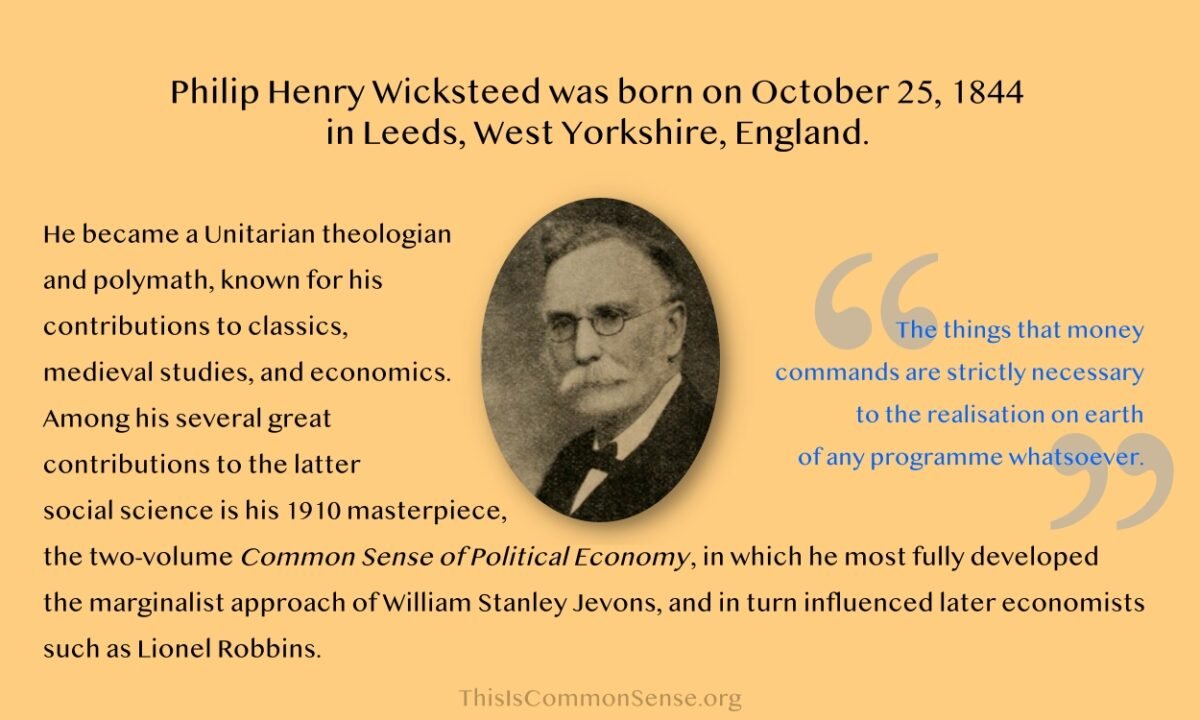
[E]ven “waiting” requires money, if not so much as marrying does. In fact, a man can be neither a saint, nor a lover, nor a poet, unless he has comparatively recently had something to eat. The things that money commands are strictly necessary to the realisation on earth of any programme whatsoever. The range of things, then, that money can command in no case secures any of those experiences or states of consciousness which make up the whole body of ultimately desired things, and yet none of the things that we ultimately desire can be had except on the basis of the things that money can command. Hence nothing that we really want can infallibly be secured by things that can be exchanged, but neither can it under any circumstances be enjoyed without them.
Philip Henry Wicksteed, The Common Sense of Political Economy (1910), Book One, pp. 153–154,
Philip Henry Wicksteed was born on October 25, 1844 in Leeds, West Yorkshire, England. He became a Unitarian theologian and polymath, known for his contributions to classics, medieval studies, and economics. Among his several great contributions to the latter social science is his 1910 masterpiece, the two-volume The Common Sense of Political Economy, in which he most fully developed the marginalist approach of William Stanley Jevons, and in turn influenced later economists such as Lionel Robbins.
Wicksteed died on March 18, 1927.