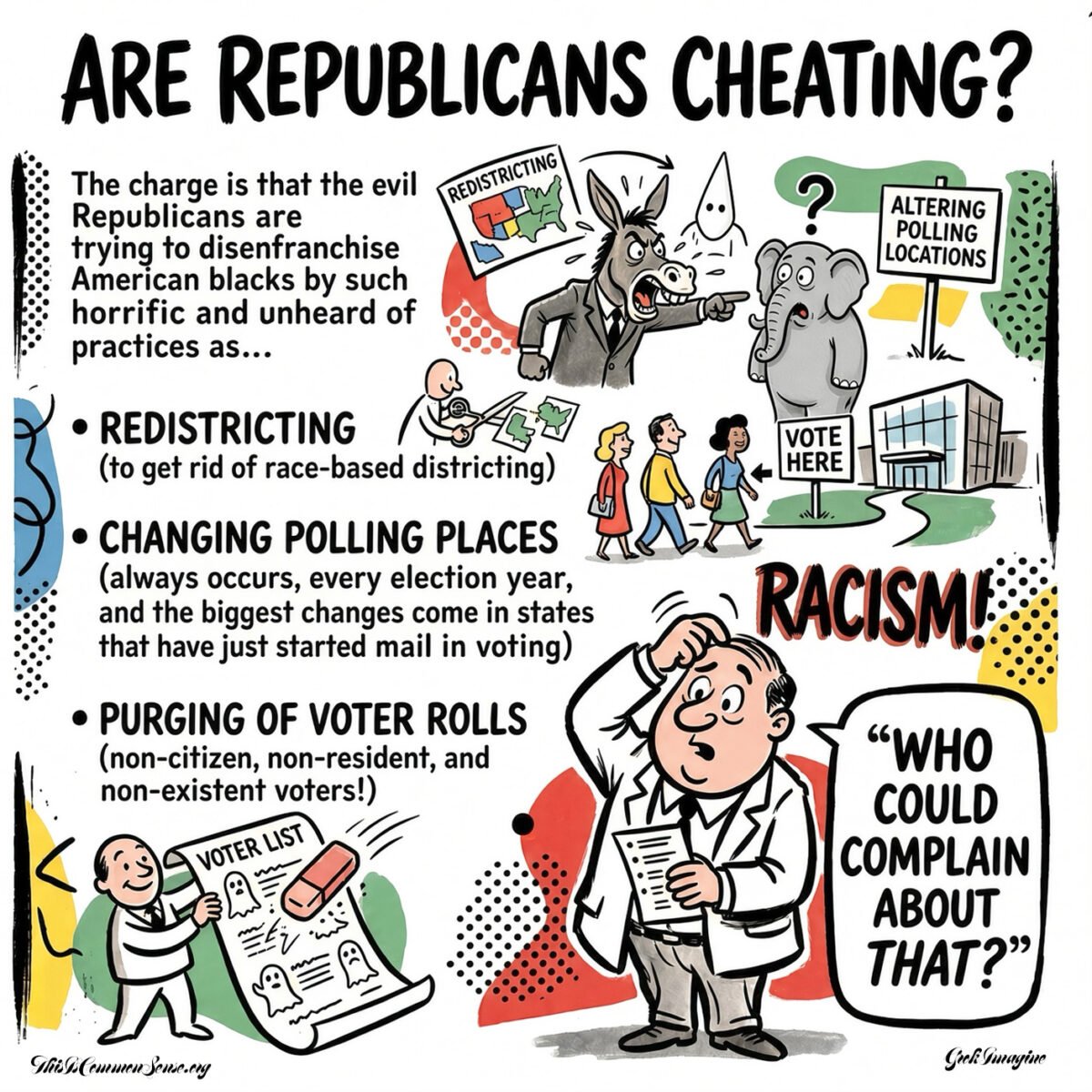
They’re cheating, she says.
Kamala Harris insists that the Trump administration and Republicans across the union are “cheating with all this redistricting that they
“They are cheating,” she goes on, “by changing polling locations so that our elders who are used to voting at the elementary school down the street may go there on Election Day and find out it is no longer a
“They are cheating by purging voter rolls,” and . . . well, she breathlessly moves on, explaining why leaders like her have to remind people that “not only must you regislur [sic] to vote, but you must check your registration status to make sure you haven’t been purged from the rolls!”
Well, it is a good idea to check your registration status every now
But the assumptions undergirding these charges, which she made on the 22nd in front of the Detroit NAACP, is that the evil Republicans are trying to disenfranchise American blacks by such horrific and unheard of practices as redistricting, by altering polling locations, and by scouring the official lists of voters for people who have moved without informing officials, for those who are ineligible because of lack of citizenship, and for the inconvenient lack of existence.
A democracy cannot run well without careful attention to all three of these things.
What’s happened with redistricting is that the Democrats have used race — illegally — as an excuse to concentrate blacks, and recently Republicans have re-instituted non-race-based standards for districting.
Changing polling places always occurs, every election year, and the biggest changes in this regard have been in the eight states (and D.C.) that have established mail-in only voting. Talk about a change of
And then there is the purging of voter rolls of non-citizen, non-resident, and non-existent voters! Who could complain about that?
Only unserious people. Like Democrats. Like Kamala Harris.
And those who seek to game elections.
This is Common Sense. I’m Paul Jacob.
Coda: “That’s how I feel about this moment,” concluded Harris, “I feel about this moment like this.”
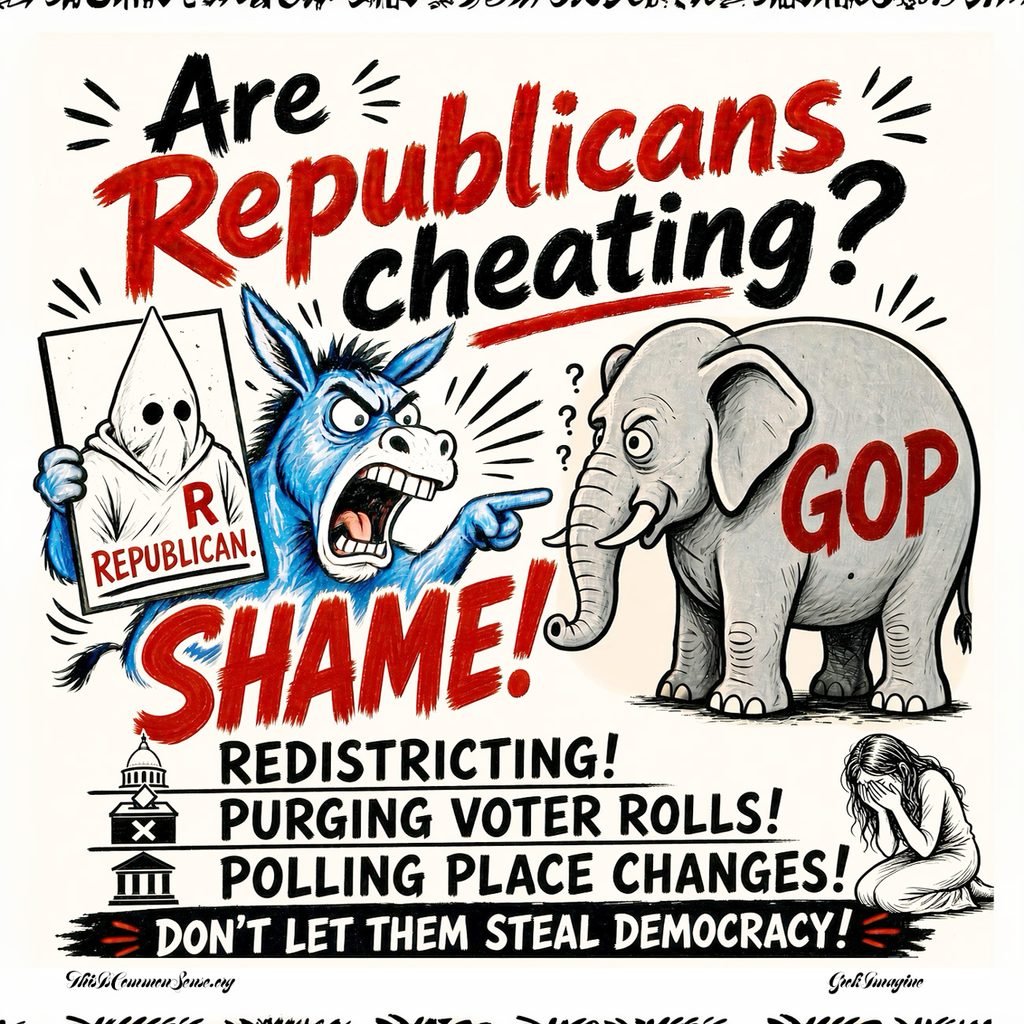
Illustration created with Grok Imagine
See all recent commentary
(simplified and organized)
See recent popular posts
6 replies on “Cheating with Democracy”
Most leftists sincerely do not know what “racism” means, and would have genuine difficulty understanding why actual racism is an evil. Their flinging-about of charges of “racism” has become so free and careless that the word no longer has much sting. Some share of their audience believes that “racism” means denying the members of their race special prerogatives owed to such members. That’s not even approximately correct as a definition, nor do the members of any race as such have any rightful peculiar prerogatives.
When last my polling place was changed, with only quiet notice, I grumbled at the extra distance that I would walk, but I did not feel disenfranchised. I don’t think that the people whose walks were shortened got more of a vote. And those who went to the old polling place were told where the new place were. I told my acquaintances where the new place were, even when I knew those acquaintances would vote stupidly; after all, they’d get to the new place, with or without a side-trip.
We lived in the suburbs of Chicago and there was a joke about dead voters and now we live near Denver and a friend who lives in Denver received three ballots in the mail that were not for her. Here is the joke about Chicago that I found with Google: A classic joke about voting in Chicago and Illinois goes like this:The Joke: An old man passes away, and his family is talking to the local precinct captain about the funeral arrangements. The captain shakes his head and sighs, “This is a terrible tragedy for the party. He voted in every single election for forty years, and now we’re supposed to just lose his vote?” The widow looks confused and asks, “Well, what do you want me to do?” The captain replies, “Do what everyone else does in Chicago—keep filling out his ballot, just make sure the handwriting changes every few years.”
I call BS! “ Yes. There are several well-documented examples where Republican-controlled legislatures used redistricting to give Republican candidates a substantial partisan advantage. There are also comparable examples involving Democrats, but sticking specifically to your question:
1. North Carolina — 2016 congressional map
This is probably the clearest example.
After courts struck down portions of North Carolina’s earlier map as an unconstitutional racial gerrymander, the Republican-controlled legislature drew a replacement congressional map.
The U.S. Supreme Court’s description of the case records that Republican legislators instructed their mapmaker to use political data with the goal of producing a 10-Republican/3-Democrat congressional delegation. One of the legislators involved explicitly said he drew the map to help elect Republicans.
The federal district court subsequently found that the plan intentionally discriminated against voters based on their political affiliation and ordered it not to be used.
There is an important legal wrinkle: in Rucho v. Common Cause (2019), the U.S. Supreme Court did not say the North Carolina map was a good or fair map. Instead, it held that partisan-gerrymandering claims present a political question that federal courts could not adjudicate under the federal Constitution.
And the results illustrate the intended effect: in 2016 Republicans received about 53% of the statewide congressional vote but won 10 of 13 seats.
2. Ohio — 2022 congressional map
This one went further legally because Ohio’s own Supreme Court actually rejected the map.
The Republican-controlled Ohio General Assembly adopted a congressional map in 2021. In January 2022, the Ohio Supreme Court ruled that the map violated the Ohio Constitution’s prohibition against partisan gerrymandering, finding that it unduly favored Republicans and unnecessarily split major metropolitan areas to create Republican advantages.
The court specifically found that the map was adopted without bipartisan support and that it was designed to produce a Republican advantage beyond what the state’s neutral redistricting criteria permitted.
3. Alabama — congressional map
This is a somewhat different situation because the issue was racial representation rather than simply Republican-versus-Democrat partisanship.
Alabama’s Republican-controlled legislature drew a 2021 map containing only one district in which Black voters constituted a sufficiently large voting-age population to have a realistic opportunity to elect their preferred candidate, despite the state’s Black population being roughly 27%.
In Allen v. Milligan (2023), the U.S. Supreme Court held that the plaintiffs had established that the map likely violated Section 2 of the Voting Rights Act. The Court required Alabama to create a second district providing Black voters an opportunity to elect a candidate of their choice.
4. Wisconsin — Republican legislative map
Wisconsin provides another famous example.
After Republicans gained control of the legislature, a map for the state Assembly was challenged as an extreme partisan gerrymander. Evidence presented in the litigation indicated that the map was designed so Republicans could retain a legislative majority even with less than half of the statewide vote.
In the 2012 election, Republicans won 60 of 99 Assembly seats while receiving about 48.6% of the statewide vote.
The Supreme Court ultimately avoided deciding whether the Wisconsin map was an unconstitutional partisan gerrymander because of procedural/jurisdictional issues.”
More BS. “ . North Carolina — 2016 congressional map
This is probably the clearest example.
After courts struck down portions of North Carolina’s earlier map as an unconstitutional racial gerrymander, the Republican-controlled legislature drew a replacement congressional map.
The U.S. Supreme Court’s description of the case records that Republican legislators instructed their mapmaker to use political data with the goal of producing a 10-Republican/3-Democrat congressional delegation. One of the legislators involved explicitly said he drew the map to help elect Republicans.
The federal district court subsequently found that the plan intentionally discriminated against voters based on their political affiliation and ordered it not to be used.
There is an important legal wrinkle: in Rucho v. Common Cause (2019), the U.S. Supreme Court did not say the North Carolina map was a good or fair map. Instead, it held that partisan-gerrymandering claims present a political question that federal courts could not adjudicate under the federal Constitution.
And the results illustrate the intended effect: in 2016 Republicans received about 53% of the statewide congressional vote but won 10 of 13 seats.
2. Ohio — 2022 congressional map
This one went further legally because Ohio’s own Supreme Court actually rejected the map.
The Republican-controlled Ohio General Assembly adopted a congressional map in 2021. In January 2022, the Ohio Supreme Court ruled that the map violated the Ohio Constitution’s prohibition against partisan gerrymandering, finding that it unduly favored Republicans and unnecessarily split major metropolitan areas to create Republican advantages.
The court specifically found that the map was adopted without bipartisan support and that it was designed to produce a Republican advantage beyond what the state’s neutral redistricting criteria permitted.
3. Alabama — congressional map
This is a somewhat different situation because the issue was racial representation rather than simply Republican-versus-Democrat partisanship.
Alabama’s Republican-controlled legislature drew a 2021 map containing only one district in which Black voters constituted a sufficiently large voting-age population to have a realistic opportunity to elect their preferred candidate, despite the state’s Black population being roughly 27%.
In Allen v. Milligan (2023), the U.S. Supreme Court held that the plaintiffs had established that the map likely violated Section 2 of the Voting Rights Act. The Court required Alabama to create a second district providing Black voters an opportunity to elect a candidate of their choice.
4. Wisconsin — Republican legislative map
Wisconsin provides another famous example.
After Republicans gained control of the legislature, a map for the state Assembly was challenged as an extreme partisan gerrymander. Evidence presented in the litigation indicated that the map was designed so Republicans could retain a legislative majority even with less than half of the statewide vote.
In the 2012 election, Republicans won 60 of 99 Assembly seats while receiving about 48.6% of the statewide vote.”
Alma Adam’s! “ Yes. Alma Adams is directly connected to the North Carolina racial-gerrymandering controversy involving the 12th Congressional District, although there is an important distinction about exactly what happened to her.
After the 2010 census, the Republican-controlled North Carolina legislature redrew Congressional District 12, which at the time included parts of Charlotte, Greensboro, and other areas. The U.S. Supreme Court later held in Cooper v. Harris that race predominated in the construction of District 12, making it an unconstitutional racial gerrymander.
The Court noted that the legislature increased District 12’s Black voting-age population from 43.8% to 50.7%, adding roughly 35,000 Black voters while removing about 50,000 white voters. Evidence included statements from Republican legislative leaders and testimony from the mapmaker about the racial considerations involved.
Where Alma Adams comes in
Adams was the Democratic congresswoman representing the old 12th District. When the unconstitutional map was challenged, the legislature eventually had to redraw the district.
The 2016 replacement map changed District 12 substantially, concentrating it in Mecklenburg County. Adams had previously lived in Greensboro, which was removed from the new 12th District, so she moved to Charlotte and changed her registration in order to run in the reconfigured district. She subsequently won the Democratic primary there.
So there are really two separate facts:
* Yes: Adams represented the district that was found to have been unconstitutionally racially gerrymandered.
* No: The Supreme Court case wasn’t a finding that Alma Adams herself was the target or beneficiary of racial gerrymandering. The legal finding concerned how the Republican-controlled legislature drew the district and whether race predominated in its construction.”
Both parties game elections. Both parties gerrymander.
And no, the Republicans don’t do it to “re-institute non-race-based standards for districting.” They do it for the same reason Democrats do it: To maximize the number of seats their party can hope to win.
The only thing really different in this round of re-gerrymandering is that the GOP departed from the constitutionally mandated decennial redistricting to just saying “we’ll just change districts on the fly any time we happen to feel like it.” And they haven’t been the least bit shy about admitting that the sole reason for doing so is to increase Republican power and decrease party power.
The fix is simple, and was proposed by Robert Bork (years before he was unsuccessfully nominated to SCOTUS): Districting by algorithm to produce compact, contiguous districts based solely on population numbers with no account taken of race, party registration numbers, etc. Racial groups don’t get their own districts. Religious demographics don’t get their own districts. Districts aren’t combobulated to ensure that three are 80%+ Party A and one is 80% Party B. One person, one vote, end of story.