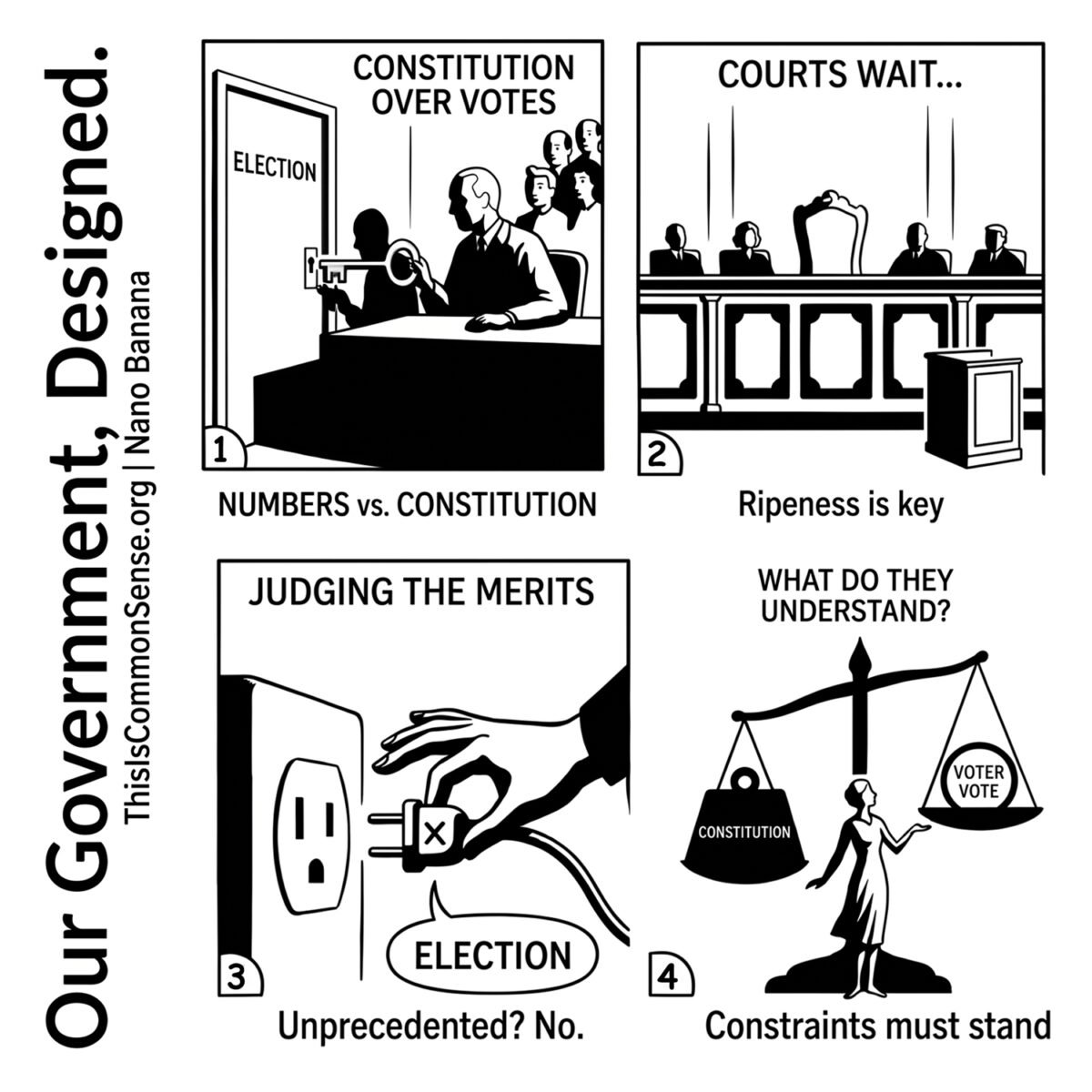
Do senior Democrats not understand how our government is designed?
“Today the Supreme Court of Virginia has chosen to put politics over the rule of law by issuing a ruling that overturns the April 21st special election on redistricting,” Virginia Attorney General Jay Jones said last week.
“What Jones didn’t say in his statement,” explained a Washington Post editorial, “is that he is the one who insisted the court wait until after the election to judge the merits of the challenge, over the objections of those who sued.”
“If the Virginia Supreme Court had legitimate concerns about this referendum, the time to stop it would have been before three million Virginians cast their ballots,” U.S. Senator Tim Kaine (D-Va.) declared. “But the Court let the process move forward, and Virginians sent a message loud and clear. . . .”
Come now, Senator, courts act only when a case comes before them that is ripe for adjudication. In my experience, courts rarely rule on the constitutionality of a ballot measure until after voters pass it.
Moreover, under our system, when something violates the constitution it matters not at all whether it passed with 99.9 percent support or the slightest majority. For the record, the redistricting referendum passed “loud and clear” with 51.7 percent of the vote. That was after national Democratic groups splurged $64 million to drown out opponents. And with an “intentionally misleading” ballot title officially informing voters it would “restore fairness.”
Democratic House Minority Leader Hakeem Jeffries also entered the fray, arguing that the “decision to overturn an entire election is an unprecedented and undemocratic action that cannot stand.”
Hard to be wrong that many times in such a short sentence. The ruling will stand and is not “unprecedented”: it did what courts have always done.
Moreover, the democratic vote on the referendum was set aside by the constraints of Virginia’s democratically enacted constitution.
This is Common Sense. I’m Paul Jacob.
Previously:
Un-Redistricting Virginia / April 23, 2026
(On a constitutional monkey wrench thrown into the Democratic Party’s latest scheme to out-trump Trump.)
Against Fairness? / April 2, 2026
(On a dishonest ballot title being foisted on Virginia voters.)
Immoderate Bullets / Oct. 6, 2025
(On the man who should most definitely not be attorney general.)
Illustration created with Nano Banana
See all recent commentary
(simplified and organized)
See recent popular posts
One reply on “Democracy, Democrats & the Constitution ”
“In my experience, courts rarely rule on the constitutionality of a ballot measure until after voters pass it.”
Here in Florida, it seems like most ballot measures go through multiple rounds of court challenges and subsequent modifications before being deemed constitutionally compliant enough to appear on the ballot — if it EVER happens.
The big one is legalization of marijuana for personal use. Every two years, groups propose a ballot measure, then go through a court fight over whether it is properly formed such that they can begin gathering signatures to put it on the ballot. If they finally succeed, there’s another round of court fights over whether it’s constitutional or not AFTER they’ve spent the money gathering the signatures.
I suppose it might be different in other states, though.