
The Hubble telescope’s photo looks like an iPhone snap of a faux-granite countertop, complete with the intrusive glare of an overhead kitchen light.
But scientists swear it is indeed a real photo of a real object in outer space — and one that stirs up substantive controversy. Discovered on July 1, it sports a hyperbolic trajectory and was designated 3I/ATLAS, with the “3” and the “I” indicating the third interstellar object discovered in our solar system.
So it’s not the first. In October of 2017, astronomers espied an object apparently coming from the direction of the star Vega. Its brightest was the opposite of constant, with a light curve (of dark-light-dark-light . . .) that most scientists extrapolated evidence of an oblong object tumbling, not spinning, through space. Most intriguingly, it picked up speed after perihelion (when it was closest to the sun), which could not be attributed to a gravitational effect. The object goes by a number of related names, 1I; 1I/2017 U1; 1I/ʻOumuamua; or 1I/2017 U1 (ʻOumuamua), with the “I” standing for “interstellar” and the proper name deriving from Hawaiian, meaning “scout.”
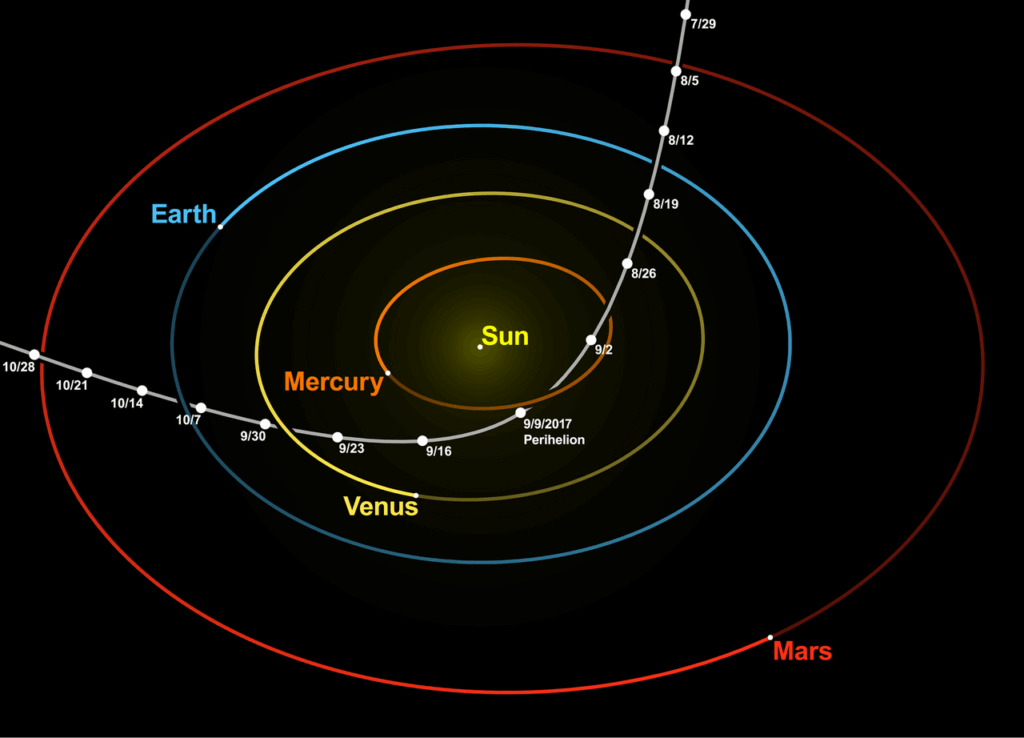
A second interstellar visitor passed through our system two years later. Unlike ‘Oumuamua, it showed a “coma” (cloud of surrounding gas, or out-gassing from the object) that lit up as it approached the Sun, so it is generally designated a comet. (Comets got comas.)
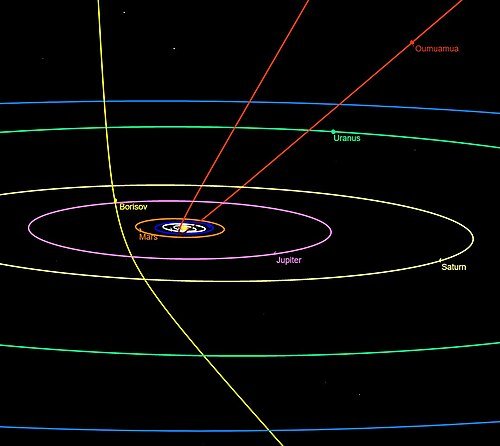
3I/ATLAS, however, has some more striking oddities. It is bigger than the others. Much bigger: perhaps 20 kilometers wide.
It will come close to three planets: Mars, Venus, and Jupiter. When closest to Mars, it may reach an apparent magnitude of 11 from the planet, perhaps allowing Mars orbiters to observe it. On the other hand, it will not be observable from Earth when at perihelion because Earth and the comet will be on opposite sides of our yellow star. In early December, if all goes according to normal, predictable comet behavior, 3I/ATLAS will be observable again.
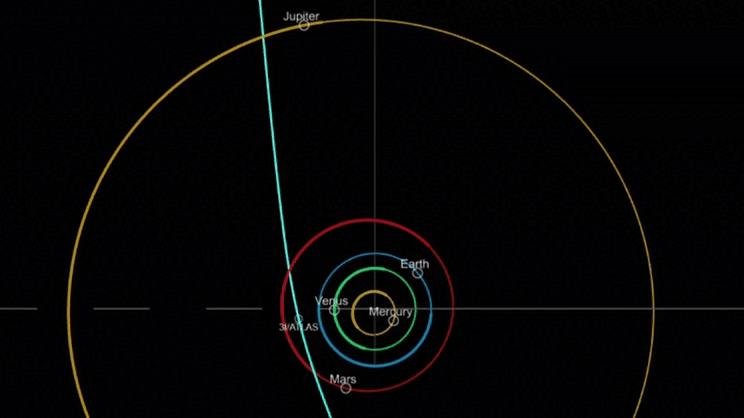
This odd transit, coming so close to three planets but “avoiding” the most interesting (ours), has suggested to statisticians that something funny is going on. And some scientists are taking note:
A new study authored by Adam Hibberd, Adam Crowl, and Abraham Loeb proposes a possibility that 3I/ATLAS may be technological in origin. While the authors openly describe their hypothesis as a speculative and pedagogical exercise, the investigation itself is grounded in detailed trajectory analysis, dynamic modeling, and mission planning frameworks used in interplanetary navigation.
David Freeman, “Is 3I/ATLAS Acting Like a Probe? New Models Say Yes” (July 19, 2025).
The underlying premise of the paper is a simple one: if 3I/ATLAS exhibits features or behaviors inconsistent with known natural interstellar bodies, then it is worth investigating whether those features point to artificiality. . . .
The object’s passage through the Solar System is unusually efficient in its interactions with planetary orbits. Its trajectory brings it into close proximity with Venus, Mars, and Jupiter. Each of these encounters happens within a tight orbital window. The likelihood of all three alignments occurring simultaneously, if 3I/ATLAS had entered the system at a random time and trajectory, is calculated to be less than 0.005 percent. These odds, according to the authors, are small enough to merit attention. The close approach distances are not trivial. In the case of Mars, the approach is as close as 0.19 astronomical units, with a longitude difference of just over 7 degrees. Jupiter and Venus show similarly close alignments. The low inclination of 3I/ATLAS’s orbit allows for such interactions to occur without substantial maneuvering.
The authors make a rather obvious point: the object passes close enough to Jupiter that, with minor modifications of trajectory, the gas giant could be used to be used to decelerate and swing into an orbit in the solar system.
If artificial.
The timing of any interaction with Earth is another feature analyzed in the study. The authors project that an optimal intercept trajectory would lead to an arrival in Earth’s vicinity sometime between November 21 and December 5, 2025. While this does not confirm intent, it sets a testable timeframe. If no perturbations or anomalies are observed during that window, the hypothesis can be weakened. If, however, a significant change in course, acceleration, or luminosity occurs, the discussion would need to be revisited.
Ibid.
This moves us to something out of a science fiction story. And the authors of the paper have indeed made public comments on this eerie element. See Avi Loeb, “Is the Interstellar Object 3I/ATLAS Alien Technology?” (Medium, July 16, 2025):
One of the solutions to Enrico Fermi’s question about extraterrestrials: “where is everybody?” is offered by the dark forest hypothesis, popularized by Cixin Liu’s science fiction novel “The Dark Forest.” This hypothesis proposes that our cosmic neighborhood is dangerous, filled with intelligent civilizations that are hostile and silent to avoid detection by potential predators. In this context, the silence in searches for radio signals by the SETI community is not caused by the lack of extraterrestrial intelligent civilizations, but is instead a consequence of them fearing mutual destruction.
Our paper explores the possibility that the recently discovered interstellar object, 3I/ATLAS, may provide evidence in support of the dark forest hypothesis.
Yikes?
Yes, yikes: “The velocity thrusts needed for launches of gadgets out of 3I/ATLAS to intercept Venus, Mars, or Jupiter are smaller than 5 kilometers per second, achievable by intercontinental ballistic missiles.” In other words: possible probe. Or probe carrier.
3I/ATLAS comes from the direction of the galactic center. But what matters is where it is going. And, if it changes course, why.