
Rep. Thomas Massie (Ky.-R) explains the budgeting process on X:
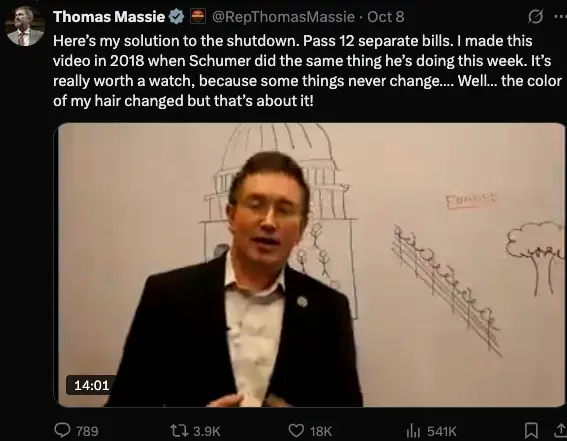
He is recirculating an old video. But that is OK: Congress is recirculating old arguments for the budget impasse.
Every Continuing Resolution and government shutdown is an argument for term limits!
So what has been happening this time around?
September 30 – October 1: The shutdown began at midnight after Senate Democrats rejected a House-passed “clean” CR (extending funding at current levels through November 21) in a 55 – 45 vote. Republicans held slim majorities (House: 221 – 214; Senate: 53 – 47), but the Senate requires 60 votes to overcome a filibuster.
October 2 – 6: Senate voted on competing bills, failing five times. Democrats’ alternative (funding through October 31, plus ACA extensions) was rejected 47 – 53. Republicans blamed Democrats for obstruction; Democrats accused Republicans of ignoring healthcare needs.
October 7 – 8: Two more failures (sixth and seventh votes). Only three Democrats (Sens. Fetterman, Cortez Masto, and King) crossed the aisle for the GOP bill. Senate adjourned without progress, with Republicans considering standalone funding for key agencies.
October 9 – 10: Shutdown extended into a second week after the Senate adjourned until October 14. The House GOP bill failed again (54 – 45), with no additional Democratic support. Speaker Mike Johnson noted “some discussion” of shortening the CR timeline due to delays, but no decisions were made. The Congressional Budget Office reported a $1.8 trillion federal deficit for FY 2025, highlighting fiscal pressures.
October 11 (Today): No new votes scheduled over the weekend. Discussions continue amid growing public frustration — polls show 60 – 67% of Americans blame both parties, with Republicans and President Trump slightly more faulted (10 – 17 percent gap).
Paul Jacob has been writing about Continuing Resolutions and Congress’s habitual, repeated budget impasses for decades now, most recently on October 3rd, with “Pleistocene Politics.”
One reply on “Why Congress Can’t Budget”
I think that the primary reason that the Republicans don’t want to exercise the option of changing the rules to allow a simple majority vote is that they would then have far less excuse for relying upon continuing resolutions, as opposed to passing proper budgets.
Indeed, whatever the virtues of a system with filibusters, perhaps the costs have become far too great.