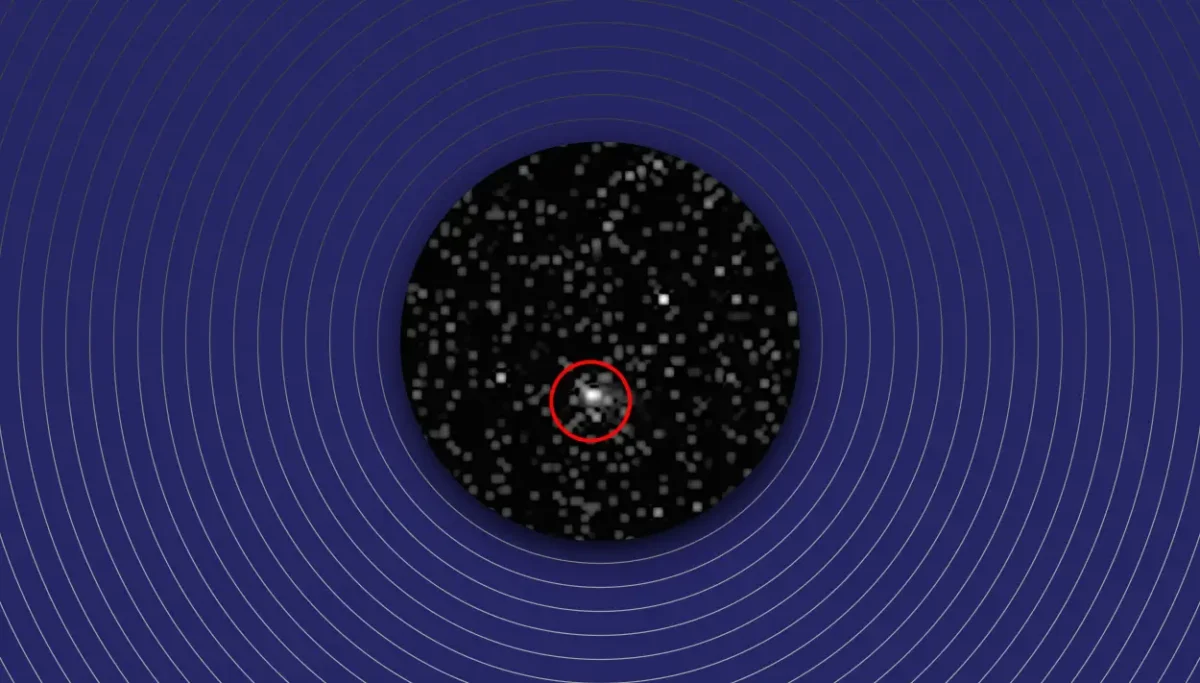
You may have seen headlines noting that 3I/ATLAS has changed colors again. You may also have seen reports that it has broken up, as one might expect of a comet this size.
The truth?
It has indeed changed colors.
And no, it has not broken up. Latest reports suggest that it is quite intact.
The color change is not shocking: changes in color have occurred roughly once every month or so. The initial color was reddish; in mid-approach (August-September) it appeared greenish; at perihelion, last month, it turned blue.
The headlines about 3I/ATLAS “breaking apart” appear to stem from misinformation or AI-generated videos circulating online. Neither NASA, ESA, nor peer-reviewed studies report a breakup.
No fragmentation: Post-perihelion images (e.g., November 5 from R. Naves Observatory, Spain) show a compact, fuzzy “ball of light” with a diffuse greenish-white coma (~0.6 arcmin diameter) but no visible tail or fragments. SOHO/LASCO C3 data confirms residual sunward jets and four faint tails from outgassing, not breakup. Mass loss is ~13 – 50% from evaporation (half-life ~6 months), but the nucleus (est. 1 – 6 km wide) remains whole.
Activity and trajectory: It’s outbound at ~62 km/s on its hyperbolic path (eccentricity >5), showing non-gravitational acceleration from outgassing recoil. Position: In Virgo constellation (RA 13h 26m 52s, Dec ‑06° 46′ 12″), low on the eastern horizon before dawn (~8 – 12° altitude). Magnitude ~14 (fading to ~18 by mid-Nov), visible with 15 – 25 cm telescopes from Nov 11.
Inexplicable Increase in Speed: An eleventh anomaly can be added to Avi Loeb’s official count. On October 29th, the interstellar object sped up and moved a bit outward from the Sun. Loeb figured to accomplish this the object wuld have to eject one-sixth its mass. A week later? Nothing observed. No ejecta. The likelihood of an artificial object just went up — or it being a form of life itself became a possibility. So far? No good explanation for the non-gravitational alteration in trajectory has been offered.
China released new data and images of the interstellar comet 3I/ATLAS (C/2025 N1) in early November 2025, filling a gap during the U.S. government’s ongoing shutdown. The key release came from the China National Space Administration (CNSA) on November 6, showcasing images captured by the Tianwen‑1 (Zhurong) Mars orbiter. These were taken on October 3, 2025, from approximately 30 million km away during the comet’s closest approach to Mars (about 0.2 AU, or 30 million km).
Details of the images: The sequence, obtained using the orbiter’s High Resolution Imaging Camera (HiRIC) with a 15.2‑inch aperture, reveals a bright nucleus surrounded by a diffuse coma (thousands of kilometers across) and faint dust tails. The resolution is sharp enough to show structural details like asymmetric outgassing jets, though not as fine as Earth-based telescopes due to distance. CNSA described it as “one of the closest probe-based looks at the object to date,” highlighting its role as a testbed for the upcoming Tianwen‑2 asteroid sample-return mission in 2025.
Scientific insights: Spectral analysis from the images confirms elevated CO₂ and CO emissions, consistent with pre-perihelion data, and no signs of fragmentation. Chinese astronomers noted the coma’s greenish tint from CN and C₂ fluorescence, aligning with September observations.
NASA, citing the federal government shutdown, has furloughed ~15,000 NASA employees and halted most non-essential operations, including public data releases and non-critical science processing, has not yet released any new post-perihelion images of 3I/ATLAS as of November 7, 2025.
Because of NASA’s silence, outrageous speculation is rampant. Who knows? Maybe some of it is warranted.