Categories
Accountability general freedom moral hazard nannyism national politics & policies privacy tax policy

Hey, It’s Your Money

I leave it up to you how to spend your own money. You decide, based on your own circumstances and priorities.

Oh, you don’t need my permission?

Of course not.

But some people think that if you spend your own money on your own priorities in accordance with your own judgment, it is indeed a problem. At least when you get to keep more of your own money because of tax cuts.

President Trump has often suggested that recipients of new corporate tax cuts will spend the additional money mostly on increasing wages and hiring new workers. Yet some major corporations reportedly say that they will spend the additional money on paying dividends or buying back shares. Maybe others will buy more advertising, storage space or tools. Various commentators fret. But why should a firm hire new workers if other expenditures would be more productive at the moment?

Of course, in the long run, a company that is more profitable and successful can hire more people and can pay them more.

But wages are not the only expense that companies must cover in order to be successful in the long run. Managers do, and should, devote resources first to the improvements that they conclude are most urgent. That a company’s resources increase because of a tax cut doesn’t alter the necessity or reasonableness of pursuing economic goals in accordance with one’s best judgment.

An approach that, to be sure, also benefits present employees as well as future ones.

This is Common Sense. I’m Paul Jacob.


PDF for printing


Categories
Today

A Freedom for the Nobles

On January 11, 1571, the freedom of religion was granted to Austrian nobility.

Categories
Thought

F. A. Hayek

The curious task of economics is to demonstrate to men how little they really know about what they imagine they can design. To the naive mind that can conceive of order only as the product of deliberate arrangement, it may seem absurd that in complex conditions order, and adaptation to the unknown, can be achieved more effectively by decentralizing decisions and that a division of authority will actually extend the possibility of overall order. Yet that decentralization actually leads to more information being taken into account.

Categories
general freedom media and media people national politics & policies too much government U.S. Constitution

Happy Birthday, America!

What? Oh, sure, I know the United States of America has its birthday on July 4th, that day in 1776 when the Second Continental Congress adopted the Declaration of Independence.

Let’s agree I’m early. (Oh, how I wish it were July.)

But the interesting thing about history is how we get to those moments wherein the great “we” declare our independence or fill the streets or storm the beaches — or the polls. The many big, important days that lead to THE day.

Today is such a date, because 242 years ago on January 10, 1776, Thomas Paine published Common Sense. Without this day 242 years ago, we wouldn’t have had Independence Day six months later.

Using common and direct language, and speaking to all the “inhabitants of America,” Common Sense made the case for both independence from Britain and the establishment of a democratic republic. Boy, did it make the case. On a per capita basis, Paine’s pamphlet is the bestselling American publication in history.

His pamphlet or parts were read publicly, reprinted in newspapers and spread throughout the colonies. This common man — barely an American,* having landed on our shores in November 1774 — used the universal language, speaking truth to power.

“Every spot of the old world is overrun with oppression,” Paine told his fellow Americans. “Freedom hath been hunted round the globe. Asia, and Africa, have long expelled her. Europe regards her like a stranger, and England hath given her warning to depart. O! receive the fugitive, and prepare in time an asylum for mankind.”

The original idea of these United States was freedom.

And that, my friends, is Common Sense. (I’m Paul Jacob.)


* Of course, this makes Paine almost quintessentially American.


PDF for printing


Categories
Today

Tom Paine’s Pamphlet

On January 10, 1776, Thomas Paine published Common Sense.

Categories
Thought

Robert Nozick

Is there really someone who, searching for a group of wise and sensitive persons to regulate him for his own good, would choose that group of people that constitute the membership of both houses of Congress?

Categories
Accountability crime and punishment folly free trade & free markets general freedom moral hazard nannyism national politics & policies too much government U.S. Constitution

The Ninth and the Tenth of It

When Attorney General Jeff Sessions rescinded the Obama Administration enforcement guidelines regarding the states that have legalized (in their 29 different ways) marijuana, last week, supporters of freedom expressed some worry.

But we had to admit, one excuse for Sessions’s nixing of the mostly hands-off policy seemed to make sense on purely legal grounds. If we want to liberalize drug laws, then our Cowardly Congress should do it.

Definitely not the Executive Branch.

And yet, over at the Volokh Conspiracy, Will Baude argues that “the rule of law” does not require “renewed enforcement of the Controlled Substances Act.”

If anything, he argues, it “requires the opposite.”

Baude mostly rests his case on the Constitution’s Commerce Clause, which does not authorize regulation of intra-state trade. An issue on which the AG does possess a duty to weigh in.*

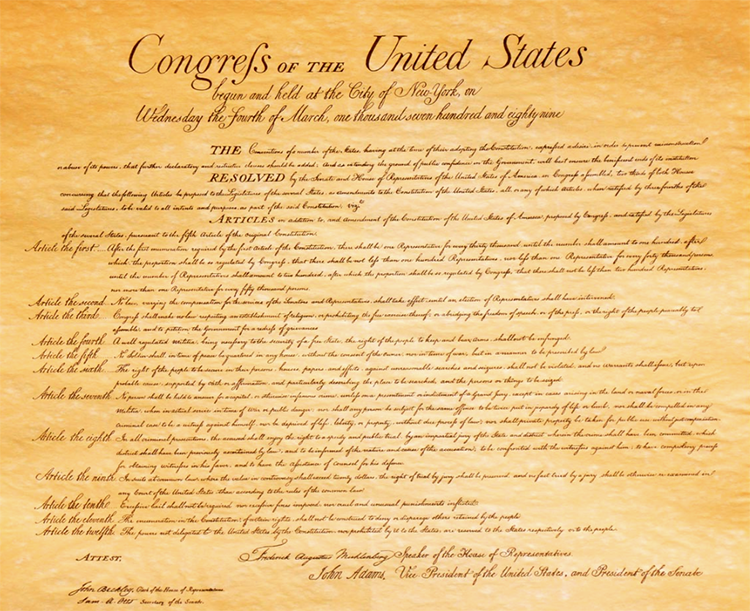
This rubs against FDR-Era constitutional theory, of course, which treats all commerce as regulate-able interstate trade. But this makes no sense. The Tenth Amendment declares that states possess powers not given to the federal government. An interpretation of the Constitution cannot be justified if it effectively nullifies other parts of the Constitution. (If all trade is “inter” state, what’s left for the states? Powers to do what? And how could there be any constraints on federal power?)

And then there is the Ninth Amendment, which states that the people retain rights not listed in the Constitution.

When citizens assert rights — such as the option to cultivate, sell, buy or ingest a common and quite hardy plant — in their states (largely through ballot initiatives), the federal government should butt out.

This is Common Sense. I’m Paul Jacob.

 

* “Members of the executive branch have their own obligation to interpret the Constitution,” Baude writes, “and if a federal law is unconstitutional in part then the executive branch, no less than the courts, should say so. It is the Constitution, not the Court, that is the ultimate rule of law in our system.”


PDF for printing


Categories
Thought

Yves Guyot

If you try to lessen or restrict competition for your private benefit, you are not denying the truth of an economic law; you are only trying to turn it to your own advantage.


Yves Guyot, The Principles of Social Economy (1892).

Categories
Today

Fifth to Ratify

On January 9, 1788, Connecticut became the fifth state to be admitted to the United States under the new Constitution. Connecticut was one of the first nine states of the original union, under the Articles of Confederation, to accept the Constitution, and thus officially ratify it. All 13 original states had ratified that new compact, officially, by May 29, 1790. The first state to be added to the original 13 was Vermont, in 1791.

Categories
Accountability folly

Win On the Field

Tonight, the College Football Playoff (CFP) National Championship Presented by AT&T will pit the University of Alabama Crimson Tide (12-1) against the University of Georgia Bulldogs (13-1). Millions of Americans will tune in to see the game’s winner declared “national champion.”

Regardless, University of Central Florida Athletic Director Danny White, after UCF won the Peach Bowl to finish the season 13-0, stated emphatically, “National champs. Undefeated.”*

What’s going on here? Well, UCF wasn’t ranked in the top four or chosen for the four-team championship playoff. Coming from the American Athletic Conference, UCF’s strength of schedule was far below that of Alabama, Clemson, Georgia and Oklahoma — all representing major conferences.

But strength of schedule is not everything; it should not trump what takes place on the field. Alabama, Georgia and UCF all played Auburn University. Alabama lost to Auburn. Georgia lost to Auburn, too, but then played again weeks later in the Southeastern Conference championship game and beat Auburn. On the other hand, the UCF Knights defeated Auburn on New Year’s Day, 34-27.

The whole point of the College Football Playoff is to have the champion decided on the field of play — not in a backroom by computers and politics.

As happened this year.

The CFP should go to an eight-team playoff, which would allow any undefeated team, even from less prestigious conferences, to be included.

Isn’t this awfully reminiscent of U. S. presidential campaigns? There, so-called “minor” party candidates are prevented from appearing in the debates — and thus removed from competition not by votes but by private poll results. Often before most voters have heard anything about them.

Let winners be decided on the field and at the ballot box. Not by backroom experts limiting opportunities.

This is Common Sense. I’m Paul Jacob.

 

* Apparently, UCF is putting its money where its mouth is: paying out $325,000 in contracted bonuses to the coaching staff for winning a national championship.


PDF for printing