On Jan. 4, 1642, King Charles I of England sent soldiers to arrest members of Parliament, beginning England’s slide into civil war.
On Jan. 4, 1649, the English “Rump Parliament,” having purged those members willing to restore Charles I to the throne, voted to put Charles I on trial for high treason. Before the month was over, the king had been executed.
The best thing for being sad . . . is to learn something. That’s the only thing that never fails. You may grow old and trembling in your anatomies, you may lie awake at night listening to the disorder of your veins, you may miss your only love, you may see the world about you devastated by evil lunatics, or know your honour trampled in the sewers of baser minds. There is only one thing for it then — to learn. Learn why the world wags and what wags it. That is the only thing which the mind can never exhaust, never alienate, never be tortured by, never fear or distrust, and never dream of regretting. Learning is the only thing for you. Look what a lot of things there are to learn.”
T. H. White, The Book of Merlyn (1977, posthumous)
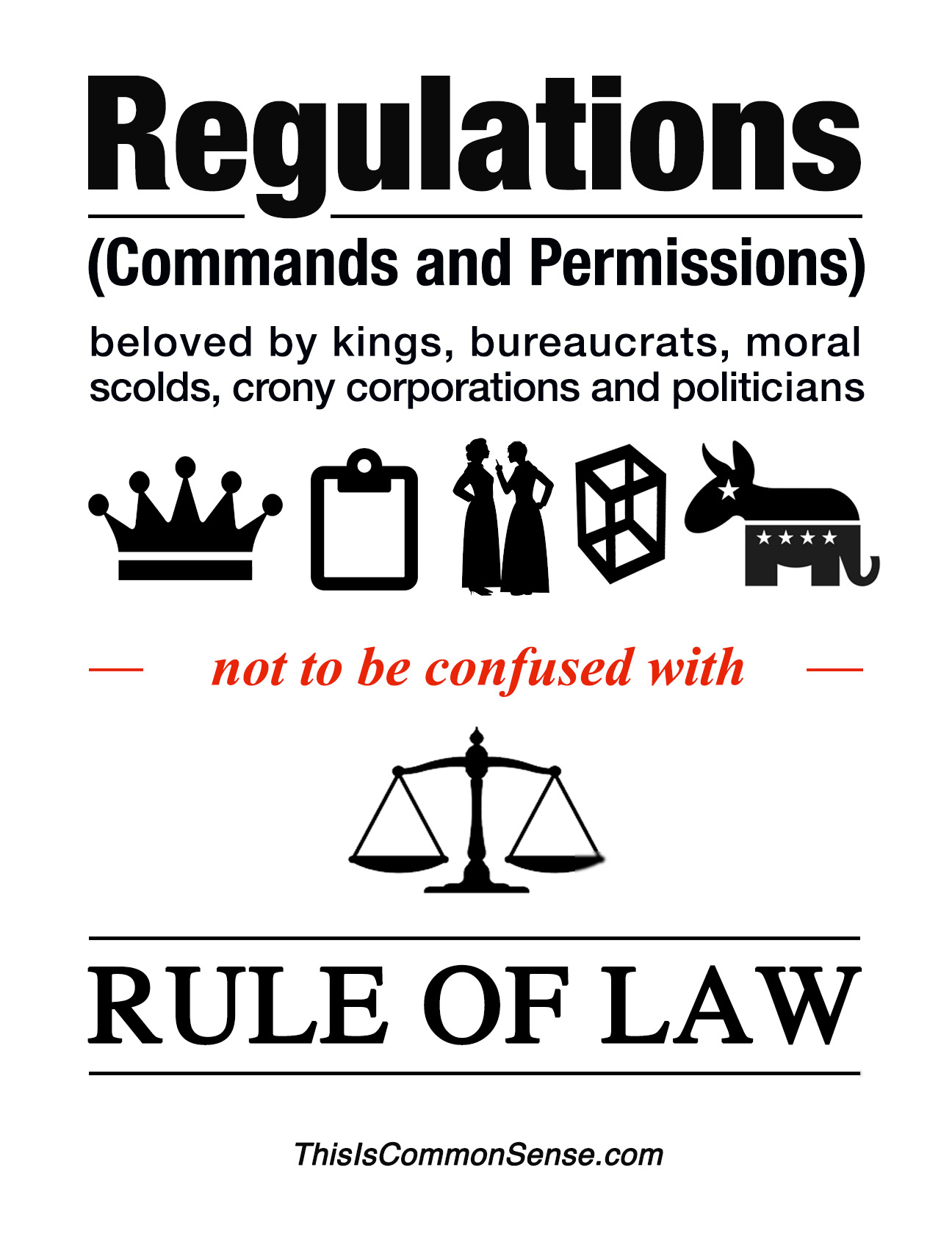
A “rule of law” is based on general principles, and makes room for — or, better yet, is based upon — the protection of individual rights.
It used to be common to say, “a rule of law, not of men”; it was even
as common in political oratory as was spouted out over drinks at the
Rotary. But as the modern Regulatory State has grown in scope and power,
most folks seem to have lost track of the notion. It is now not even a
cliché. Few even of our most educated folks can explain this idea. Vast
swaths of the mis-educated public appear not to “get” the idea of
limiting government to the enforcement of a few general principles;
instead, they cry for more “regulations” (along with additional spending
and maybe even a whole new division of the executive government) every
time a crisis, tragedy or atrocity occurs.
So we are left with a political culture in which the words of Tacitus
seem to a majority as implausible at best, evil at worst: “The more the
laws, the more corrupt the State.” Contrary to today’s trendy
prejudice, we do not need “more laws” — edicts legislated by
representatives, or regulations concocted by bureaucracies — we need
Law.
Bob Tillman wants to build a 75-unit apartment building in San Francisco.
He owns the property — a laundromat. He just wants to convert it. But although there are no good reasons why he shouldn’t, city officials and activists opposed to the property rights of developers have been blocking the project. Tillman has spent years and hundreds of thousands of dollars just trying to get started.
His plight “encapsulates the political dysfunction that’s turning San Francisco . . . into an exclusive playground for the ultra-wealthy,” saysReason magazine.
Because of the government’s general antagonism to development, and specific policies such as rent control, much less housing is getting built in the city than would have been possible in a fully free market.
The population is growing quickly, but housing isn’t keeping up. Which results in unnecessarily high rents and housing prices.
None of this is shocking if you understand basic economics. The greater the supply of a good, the cheaper the price tends to be — all other things being equal. That qualification is important. If the supply of oranges doubles but everybody suddenly starts an all-orange-juice diet, orange prices may remain the same or even rise — but less than the price would have risen without the greater supply.
Many factors, including monetary factors, can affect the price of a good. All I’m saying is that if you want the benefits of more housing, including rents that are lower than they would have been without the new housing, you must build houses and apartment complexes.
Stop something from being built and, unfortunately, it won’t be there.
On January 3, 1933, Minnie D. Craig became the first woman elected as Speaker of the North Dakota House of Representatives, the first female to hold a Speaker position anywhere in the United States.
On the third of January in 1777, American General George Washington defeats British General Lord Cornwallis’s forces in the Battle of Princeton.
On the same date in 1977, Apple Computer was incorporated.
January 3rd birthdays include that of Cicero (106 BC), Roman philosopher and theorist of republicanism, and J. R. R. Tolkien (1892 AD), English philologist and author of The Hobbit and The Lord of the Rings. Both were deeply concerned about the problem of absolute power.
The news today about ‘Atomic bombs’ is so horrifying one is stunned. The utter folly of these lunatic physicists to consent to do such work for war-purposes: calmly plotting the destruction of the world! Such explosives in men’s hands, while their moral and intellectual status is declining, is about as useful as giving out firearms to all inmates of a gaol and then saying that you hope ‘this will ensure peace.’ But one good thing may arise out of it, I suppose, if the write-ups are not overheated: Japan ought to cave in. Well we’re in God’s hands. But He does not look kindly on Babel-builders.
J. R. R. Tolkien, letter to his son Christopher Tolkien (August 9, 1945)
“Negotiations are impossible without trust,” wrote Leon Panetta in a Washington Postop-ed.
What with all his experience, Mr. Panetta has some reason to be trusted on his chosen subject, government shutdowns. The California Democrat spent 16 years in the Congress before joining the Clinton Administration as Director of the Office of Management and Budget and later serving as White House Chief of Staff. He was Obama’s first CIA Director and then Secretary of Defense.
But not every one of the sage’s pronouncements passes muster.
“Never,” he advised, “negotiate in public.”
He is of course referring to the hilarious chat President Trump had with two Democratic leaders . . . and a bland, bored, and blank Vice President Pence.
“The talks to avert a shutdown got off to a terrible start,” Panetta argues, “when the president, during an Oval Office meeting with likely incoming speaker Nancy Pelosi (D-Calif.) and Senate Minority Leader Charles E. Schumer (D-N.Y.), began arguing his position in front of White House reporters. . . . In all the negotiations on the budget that I took part in as both House Budget Committee chairman and the director of the Office of Management and Budget, not one took place in front of the media. Public shouting matches usually guarantee failure.”
The implication? That these previous negotiations were “successful.”
To those with careers ensconced in Washington power, they worked out just splendidly, I’m sure. But the aftermath of these private, secretive agreements on the rest of us? It can be quantified: $21 trillion.
In federal debt.
We do not need more of that “success.”
Let’s put the public back in public policy decisions. “It’s called transparency,” President Trump said.
On January 2, 1788, Georgia became the fourth state to ratify the United States Constitution.
On the second day of 1819, the Panic of 1819, the first major peacetime financial crisis in the United States, began. The classic historical treatment of this crisis is Murray Rothbard’s dissertation.