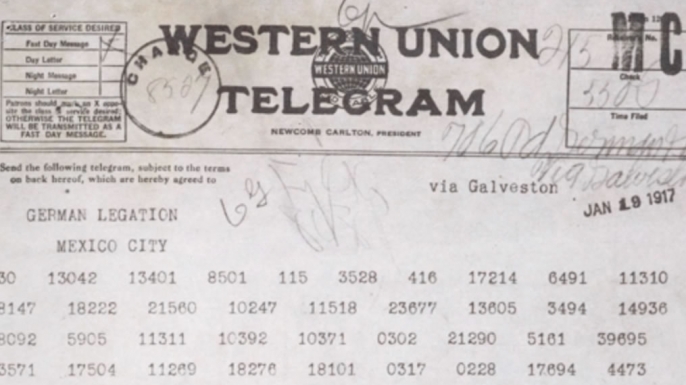
A century ago today, on February 24, 1917, United States ambassador to the United Kingdom, Walter Hines Page, was shown the intercepted Zimmermann Telegram, in which Germany offered to give the American Southwest back to Mexico if Mexico were to declare war on the United States.
On February 24, 1803, the Supreme Court, in Marbury v. Madison, established the principle of judicial review.
Paul Jacob and two young activists who accompanied him to the hearing.
With talk of forcing young people to provide a year of “national service” to the government, why was Paul Jacob offering this exalted congressionally-established Commission advice about their website address? You must watch to discover. Sure, Congress may not be quite on the verge of legislating a mandatory year of national service for those guilty of being young, but Congress is certainly looking into the idea through the National Commission on Military, National, and Public Service. On Thursday, Paul Jacob traveled to American University to address the Commission, where for three minutes he implored them to recognize the not-so-subtle difference between inspiring citizens to serve and enslaving them, forcing citizens to serve. “Forswear any forced service whatsoever,” he urged. “That shouldn’t happen in America.” Oh, and consider changing your website address. Just watch.
Event: National Commission Hearing on Mandatory Service Policy (second hearing) Date: Thursday, February 21, 2019 Location: American University, Washington College of Law; Claudio Grossman Hall; 4300 Nebraska Ave NW, Washington, D.C., 20016
Paul Jacob would like to thank two great young people (pictured above), Sophia and Marquis, for volunteering to travel with him into Washington. “May they never be robbed of one second of their lives to the enforced designs of Congress . . . much less a year or two.”
I do not like the idea of happyness — it is too momentary — I would say that I was always busy and interested in something — interest has more meaning to me than the idea of happyness.
Georgia O’Keeffe, a corrective note marked in Anita Pollitzer’s mss. biography of the artist.
On February 23, 1898, Émile Zola was imprisoned in France after writing J’accuse, a letter accusing the French government of anti-Semitism and wrongfully imprisoning Captain Alfred Dreyfus. Zola was a leading force in extending realism to the novel.
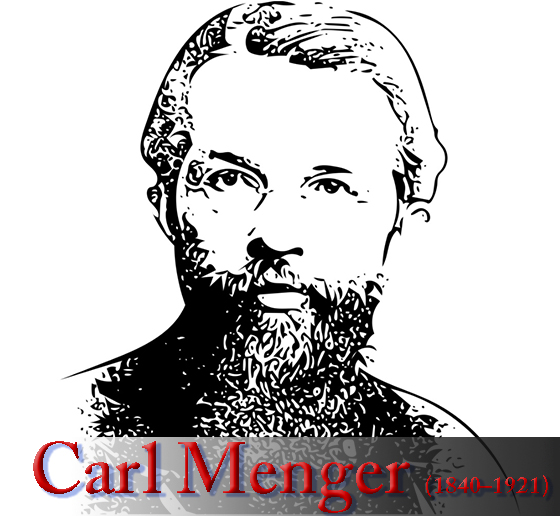
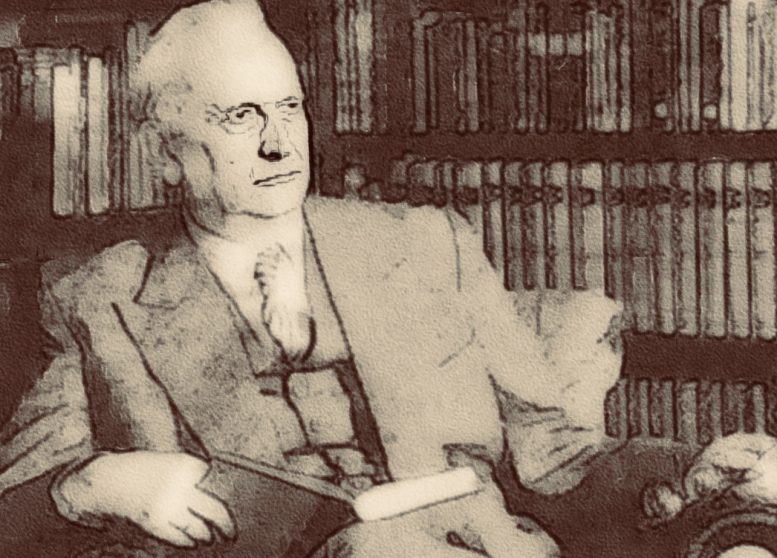
Fifty-eight years earlier, Austrian economist Carl Menger was born.
Menger would go on to contribute to the development of the theory of marginal utility, which supplanted cost-of-production theories of value in economics, in his first book, translated into English as Principles of Economics. Though expert in mathematics (he served as tutor in economics and statistics to Archduke Rudolf von Habsburg, the Crown Prince of Austria not long after the publication of the Principles), his approach to marginal theory was the least mathematical of his famous “co-discovers” of the principle, William Stanley Jevons and Leon Walras. Rooted in a subjective theory of value, it was the most realistic and least model-based of the marginalist revolutionaries, and he was most interested in price formation, not “price determination,” which focused almost exclusively on equilibrium conditions. He developed an evolutionary theory of money, as well. His second book expanded upon invisible hand processes in society.
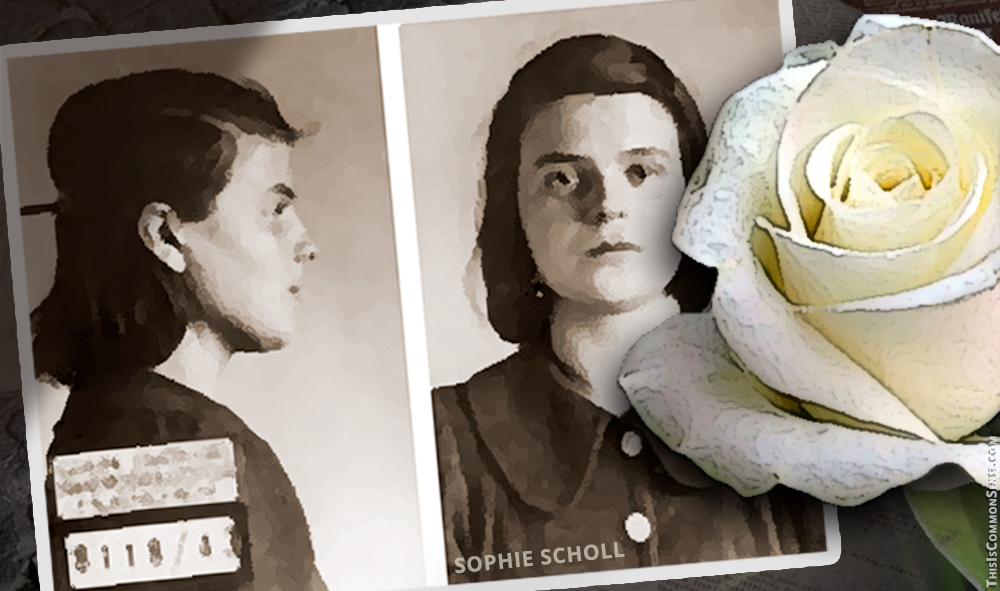
Today marks a solemn anniversary. Seventy-six years ago — on Feb. 22, 1943 — three German students at the University of Munich were tried for treason by the Nazis, convicted and then executed, all in one day.
The method of execution: guillotine.
Days earlier, Hans Scholl and his sister Sophie had been caught distributing a leaflet at the university. It was damning — of the Nazi regime; and, from the perspective of that Nazi regime, of the Scholls: “In the name of German youth, we demand restitution by Adolf Hitler’s state of our personal freedom, the most precious treasure we have, out of which he has swindled us in the most miserable way.”
Hans had in his pocket a draft of another leaflet, in Christoph Probst’s handwriting. That seventh leaflet, never distributed, led to the arrest and execution of Christoph, along with Hans and Sophie.
The three were part of a cadre of students who wrote and distributed leaflets under the name The White Rose — a symbol of purity standing against the monstrous evil of the Third Reich. The leaflets decried the crimes of National Socialism, including the mass murder of Jews. And they urged Germans to rise up.
Three more members were later executed: Willi Graf, Alex Schmorell and Professor Kurt Huber. Another eleven were imprisoned.
Their resistance was ultimately futile, unsuccessful . . . but not pointless.
They would not remain cogs in the killing machine that had taken the most advanced society in the world to the depths of depravity. They took a stand against what George Orwell later characterized as “a boot stamping on a human face, forever.”
We often say, with earnest piety, “Never again.” But our dedication should be inspired by the White Rose. When we encounter tyranny, think of the Scholls and say “Again for Freedom.”
This is Common Sense. I’m Paul Jacob.
N.B. For an excellent account of The White Rose, consult the aptly titled A Noble Treason, by Richard Hanser. See also Jacob Hornberger’s The White Rose — A Lesson in Dissent. The Orwell quotation is from the dystopian novel 1984.
One who would influence the masses must have recourse to the art of advertisement. The clamor of puffery is to-day requisite even for an intellectual movement.
On February 22, 1632, Galileo’s Dialogue Concerning the Two Chief World Systems was published. The manner in which the great scientist chose to marshal the heliocentric theory of the solar system in that work was especially vexing to the Vatican, and it led to his trial by the Inquisition.
Galileo Galilei (1564-1642) was one of the major intellectual figures at the dawn of the modern age, and his treatment by the Catholic Church has served as a marker in the fight for freedom of thought, speech, and press ever since. Galileo, the son of composer and lutenist Vincenzo Galilei, was born on February 15, 1564. He died January 8, 1642.
On the same date in 1819, Spain sold Florida to the United States for five million U.S. dollars. Exactly 70 years later President Grove Cleveland signed a bill to admit North Dakota, South Dakota, Montana and Washington into the federal union.
It can happen here. Congress could simply identify a group of citizens and pass a law forcing them into servitude.
At least, Congress thinks it has this incredibly abusive power . . . even though the 13th Amendment specifically prohibits it.*
In fact, the idea of conscription — not merely for military service, but also for performing the most routine civilian government functions — is this very day being debated in Washington by a congressionally-empowered body: The National Commission on Military, National and Public Service. The commission is charged with advising Congress on whether to expand draft registration to women or end it for men, as well as whether or not to create a mandatory “national service” program for young people.**
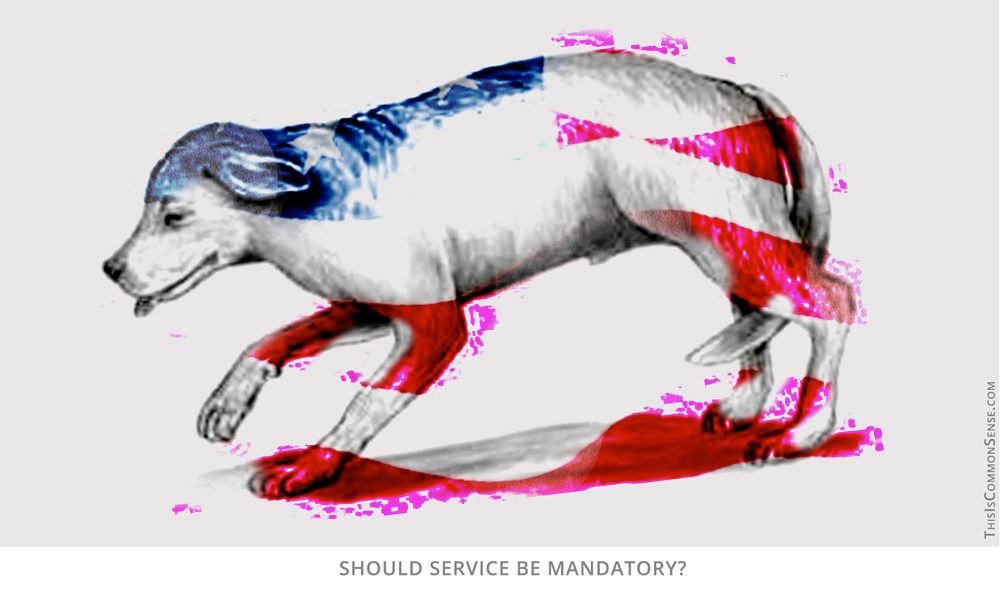
“Should Service be Mandatory?” is the title of the afternoon hearing at American University.
The Brookings Institution’s William Galston and author Ted Hollander will advocate for drafting all young Americans and sentencing each to a year of compulsory service to the federal government. Thank goodness, my friend Doug Bandow, a senior fellow at the Cato Institute, will speak against mandatory national service, as will soon-to-be-friend Lucy Steigerwald, a contributing editor at Antiwar.com.
The public can comment for up to two minutes, and I certainly will demand the commission abandon any contemplation of assaulting the freedom of young people under the false claim of “national service.”
True public service is not involuntary servitude to the government. And vice-versa. Americans, even young Americans, have rights.
Tell the Commission to tell Congress: No forced service.
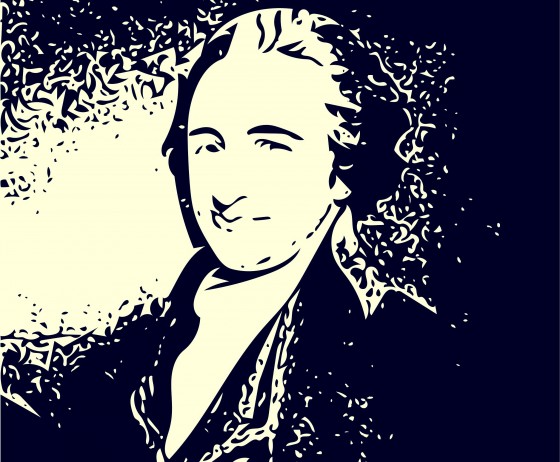
Some writers have so confounded society with government, as to leave little or no distinction between them; whereas they are not only different, but have different origins. Society is produced by our wants, and government by our wickedness; the former promotes our happiness positively by uniting our affections, the latter negatively by restraining our vices. The one encourages intercourse, the other creates distinctions. The first is a patron, the last a punisher.
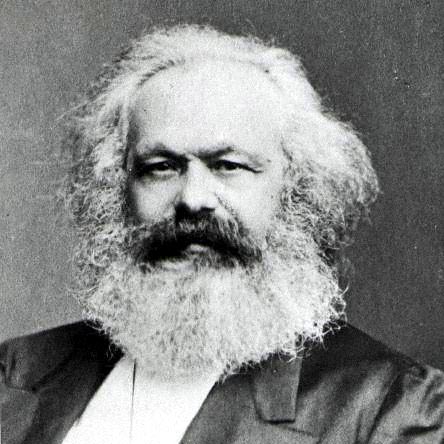
On Feb. 21, 1848, Karl Marx and Friedrich Engels published The Communist Manifesto.
On Feb. 21, 1916, the Battle of Verdun began with German bombardment of the city of Verdun, France. For ten months, the longest single engagement of the First World War, German forces attacked the French along a 20-kilometer front crossing the Meuse River. When the battle ended, with no change in the strategic position of either army, the combined death toll was over 300,000 (out of over 700,000 casualties).
On Feb. 21, 1965, Malcolm X was gunned down by rival Black Muslims while addressing his Organization of Afro-American Unity in New York City.