[T]here is a proverbial maxim which bears witness to the advantage sometimes possessed by an observant bystander over those actually engaged in any transaction. “The looker-on often sees more of the game than the players.” Now the looker-on is precisely (in Greek θεωρòς) the theorist.
When then you find any one contrasting, in this and in other subjects, what he calls experience, with theory, you will usually perceive on attentive examination, that he is in reality comparing the results of a confined, with that of a wider, experience; — a more imperfect and crude theory, with one more cautiously framed, and based on a more copious induction.
Richard Whately, Introductory Lectures on Political Economy (1832), Lecture III.
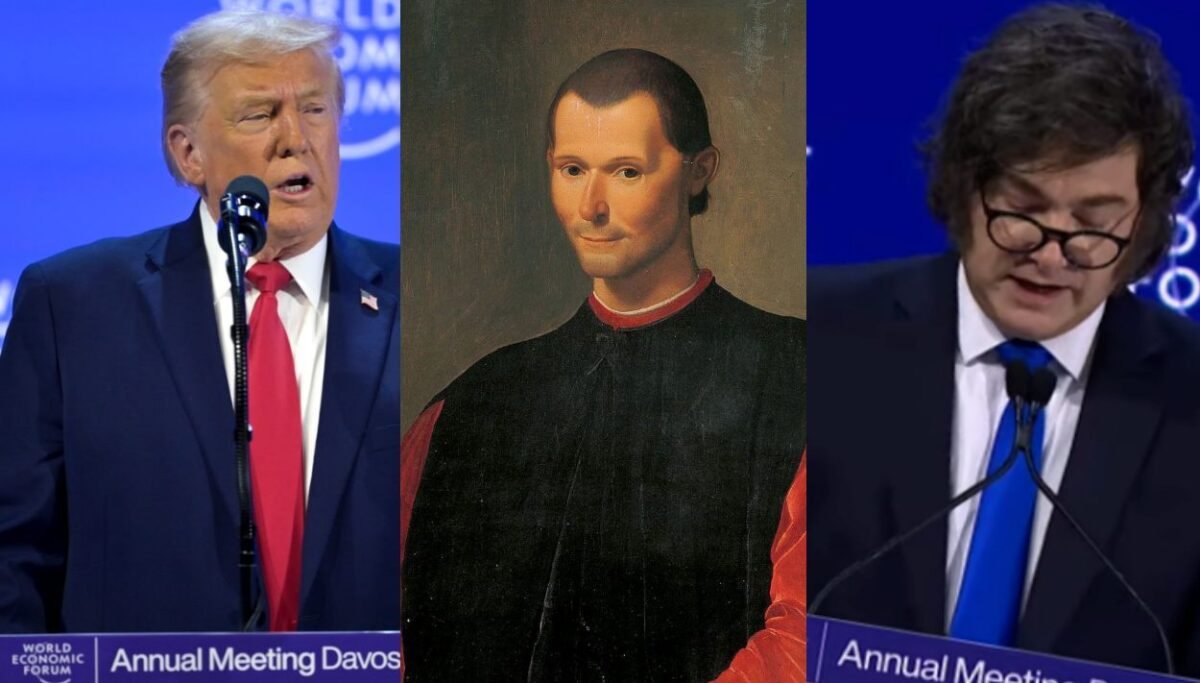
Javier Milei, the President of Argentina, delivered a special address at the World Economic Forum’s annual meeting in Davos on January 21, 2026:
President Milei began by proclaiming that “Machiavelli is dead,” and in general championed free-enterprise capitalism as not only the most productive economic system but also the only morally just one. He structured his speech around themes of justice, efficiency, and ethics, arguing that capitalism aligns with natural law, Judeo-Christian values, Greek philosophy, and Roman law. Milei drew on economists like Adam Smith, Murray Rothbard, Thomas Sowell, Israel Kirzner, Hans-Herman Hoppe and Jesús Huerta de Soto to support his points, emphasizing that free markets foster entrepreneurial creativity, dynamic efficiency through innovation and coordination, and increasing returns without government intervention. He rejected the idea of market failures justifying regulation, claiming interventions violate property rights and the non-aggression principle, leading to lower growth and injustice.
He also referenced the Bible, according to The Jerusalem Post, in an article titled “Milei says Bible shows ‘where woke-ism leads’ in Davos, urges return to Judeo-Christian roots”:
In the closing section of his speech, Milei referenced Moses’s confrontation with Pharaoh and the final three plagues described in Parshat Bo: locusts, darkness, and the death of the firstborn.
The Argentinian President cast Pharaoh as “the symbol of the oppressive power of the state,” and argued that the sequence of plagues illustrated how societies slide from economic ruin to moral confusion and, ultimately, collapse when they deny freedom.
In comparison, U.S. President Donald Trump boasted about America’s “fastest and most dramatic economic turnaround in history” under his second term, citing 5.4% Q4 growth, core inflation at 1.6%, 52 stock market highs adding $9 trillion in value, over $18 trillion in secured investments, and lifting 1.2 million off food stamps. He attributed this to policies like massive tax cuts (no taxes on tips, overtime, or Social Security for seniors; 100% expensing), slashing regulations at a 129:1 ratio, firing 270,000 federal bureaucrats, cutting the deficit by 27%, and imposing tariffs that reduced the trade deficit by 77% without inflation. Trump criticized Biden-era “stagflation” and Europe’s “Green New Scam” as a hoax, praising U.S. record energy production (oil, gas, nuclear) that dropped gasoline below $2.50 per gallon and positioned America to lead in AI.
Both leaders’ appearances underscored pro-capitalist stances, with Milei hailing Trump’s U.S. as a “beacon of light,” echoing Trump’s MAGA with “Make Argentina Great Again” rhetoric, aligning on deregulation, free markets, and socialism critiques. But Milei’s speech was, on the whole, an example of politic ideological libertarianism, while Trump’s was far more about deal-making and nationalism.
The property right in one’s own body must be said to be justified a priori, for anyone who would try to justify any norm whatsoever would already have to presuppose the exclusive right to control over his body as a valid norm simply in order to say “I propose such in such.”
Hans-Hermann Hoppe, The Economics and Ethics of Private Property (1993).
On January 25, 1787, Shays’ Rebellion experienced its largest confrontation, outside the Springfield Armory, with four of the rebels dead, 20 wounded.
The rebellion was a key moment in United States history. Daniel Shays and his followers objected to Massachusetts’s high taxes and rampant cronyism. The revolt, which was completely suppressed, led to the adoption of the U.S. Constitution, drawing George Washington from his retirement to serve as the new union’s president.
The attitude of Somalian refugees to their United States hosts does not usually, these days, seem like one of gratitude. But then, we cannot expect them to be thrilled with the federales (ICE, actually) arresting, systematically, those Somalians in the country illegally.
Most are legal, considering the mountains moved by politicians to bring them here (starting with the Refugee Act of 1980), but taking sides has largely been a matter of taking sides against, well, “the U.S. ‘god-damned’ States.” A colorful phrasing by Representative to the United States Congress, Ilhan Omar (D-Minn.)
Of course, much of this is about the fraud — about which the Duck.ai search assistant urges caution:
The Somali-American community, particularly in Minnesota, has expressed fear and frustration over recent fraud accusations, feeling that the allegations have led to increased xenophobia and discrimination against them. Community leaders urge individuals to conduct their own research rather than rely on social media narratives that generalize the actions of a few to the entire community.
Immigration raids prompt volunteers to share leaflets, accompany elders in Somali community
Trump invokes fraud scandal to send immigration agents to Minnesota
Some Somali Americans say they fear immigration raids are bid to suppress future voter turnout
A jaded person might say that these reactions are odd, but human. There is nothing shocking about a refugee crackdown after uncovering what has been reported to be billions of welfare fraud within a refugee community: Many Somali-American immigrants “feared they were being singled out, a worry that revived memories of the state surveillance and arbitrary authority they thought they had left behind when they resettled in the United States.”
This latter point must be at least somewhat dissonant to the meme-obsessed from a decade ago, where Somalia was said to be anarchic, not state-totalitarian. It shows that Somalians have had to weather all sorts of changes. Now, within the U.S., too.
The Reuters article focuses on Kowsar Mohamad, who states that his people, now understandably alarmed by raids and demands for identification, had “just believed the Constitution was going to protect us from this level of interrogation.”
One thing the article does not mention is that the community and its current activists did not think to police their own against illegality, whether that of illegal entry or mass fraud.
“You look as if you’ve just discovered the secret of perpetual motion.”
“Franklin W. Dixon,” in The Hardy Boys’ Guide to Life (2002), cited as if from the 18th Hardy Boys’ mystery, The Twisted Claw (1939; 1969), not confirmed.
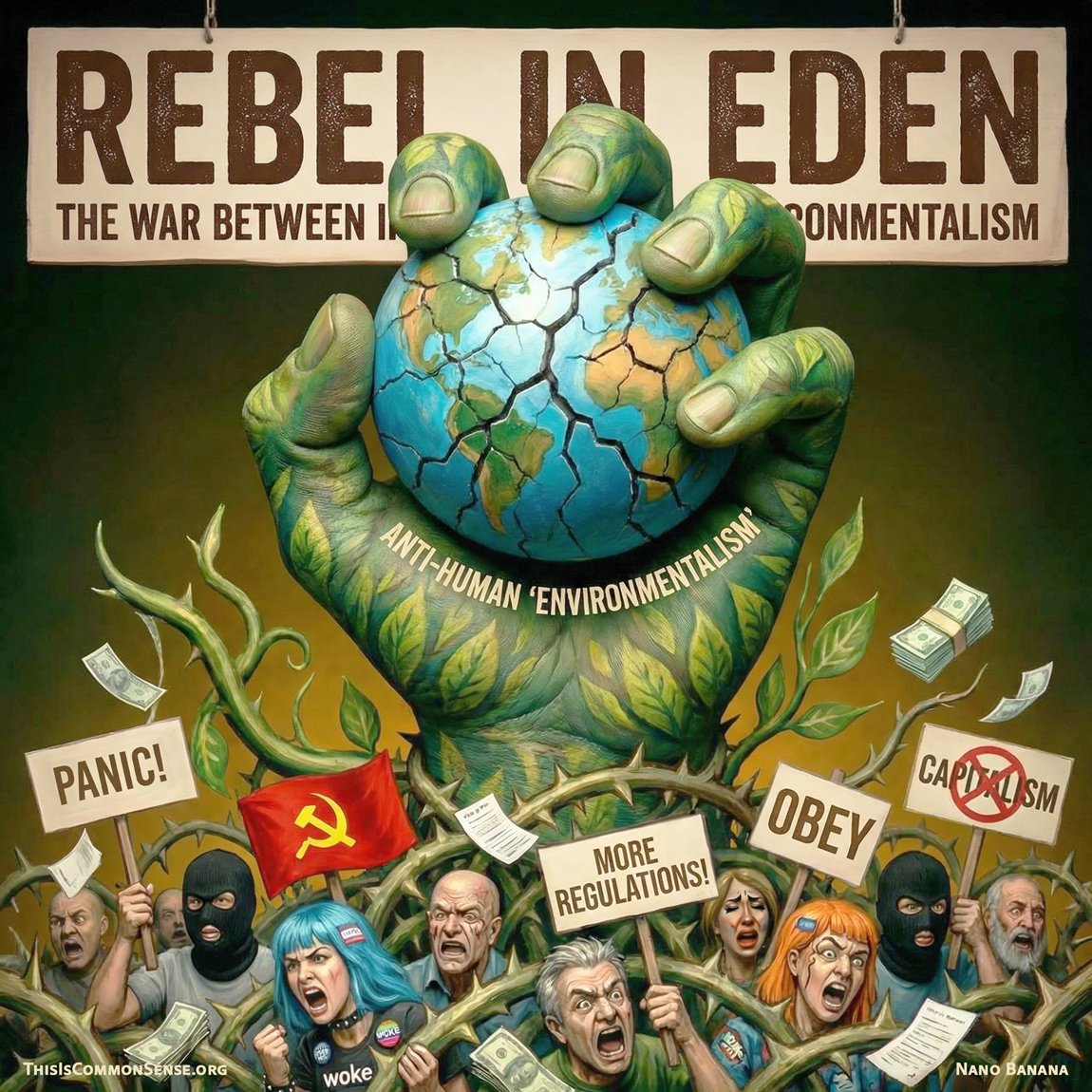
The title of Robert Bidinotto’s bracing new collection, Rebel in Eden: The War Between Individualism and Environmentalism, may occasion objection to the word “environmentalism.”
Of course, if “environmentalism” pertained only to how best to reduce pollution and litter and so forth, who would have need to combat it? Freedom-minded individualists, for example, would debate means, not ends.
But that’s not the kind of thing that the environmentalists themselves — or “radical environmentalists,” to distinguish them from people who manage cleanup crews — focus on.
Radical environmentalists regard humanity as a blight on the face of the earth; they regard nature as an end itself (an “intrinsic value”) that should be left alone regardless of the cost to that mere interloper, man. In their view, plants and animals have “rights,” men and women do not; mining is “raping” the earth — all documented here.
These are issues that Bidinotto has been reporting on and analyzing since at least the early 1980s, in places like the On Principle and Intellectual Activist newsletters and Reader’s Digest. So this collection has been in the making for some forty years.
Some of the don’t-miss essays: “Death by Environmentalism,” “The Great Pesticide Panic,” “Animal Rights: A New Species of Egalitarianism,” “Global Warming and the New Totalitarianism,” “California, Thank Environmentalism for Your Wildfires,” “Environmentalism or Individualism?” I might list the whole table of contents.
Take a look. Bidinotto, by the way, has also contributed a piece “On Courage” to our sister website, StoptheCCP.org.