Categories
Thought

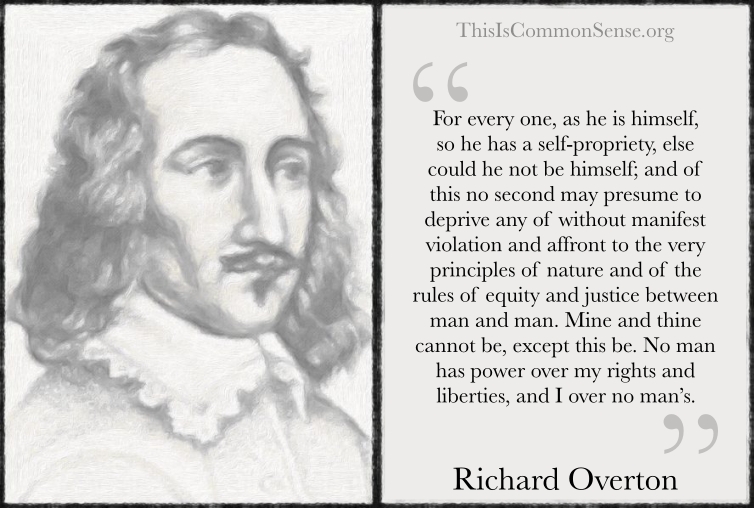
Richard Overton

And this is man’s prerogative and no further; so much and no more may be given or received thereof: even so much as is conducent to a better being, more safety and freedom, and no more. He that gives more, sins against his own flesh; and he that takes more is thief and robber to his kind — every man by nature being a king, priest and prophet in his own natural circuit and compass, whereof no second may partake but by deputation, commission, and free consent from him whose natural right and freedom it is.

Categories
Today

King Charles

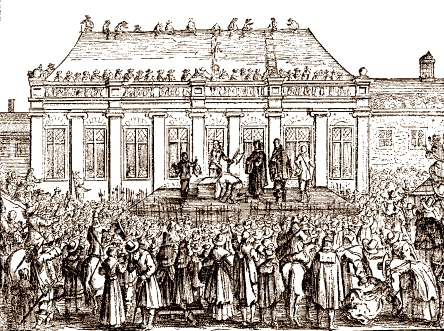
On Jan. 4, 1642, King Charles I of England sent soldiers to arrest members of Parliament, beginning England’s slide into civil war.

On Jan. 4, 1649, the English “Rump Parliament,” having purged those members willing to restore Charles I to the throne, voted to put Charles I on trial for high treason. Before the month was over, the king had been executed.

Categories
by Paul Jacob video

Watch: Liberty is the only thing…

This Week in Common Sense, January 2, 2021.

Categories
Thought

“Cicero”

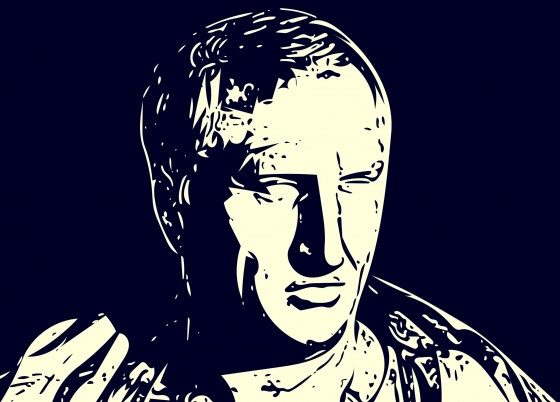
Cicero found himself frequently confounded by Antonius. Antonius heartily agreed with him that the budget should be balanced, that the Treasury should be refilled, that public debt should be reduced, that the arrogance of the generals should be tempered and controlled, that assistance to foreign lands should be curtailed lest Rome become bankrupt, that the mobs should be forced to work and not depend on government for subsistence, and that prudence and frugality should be put into practice as soon as possible.

But when Cicero produced facts and figures how all these things must and should be accomplished by austerity and discipline and commonsense, Antonius became troubled.

A description of Tully’s (Cicero’s) perspective, as imagined by American novelist Taylor Caldwell, A Pillar of Iron (1965).

This passage has appeared on the Internet in varied forms as attributed directly to Cicero, such as this one:

The budget should be balanced, the treasury should be refilled, public debt should be reduced, the arrogance of officialdom should be tempered and controlled, and the assistance to foreign lands should be curtailed lest Rome become bankrupt. People must again learn to work, instead of living on public assistance.

It is a misattribution.

Categories
Today

Cicero, Cornwallis, Craig, et al.

On the third of January in 1777, American General George Washington defeats British General Lord Cornwallis’s forces in the Battle of Princeton.

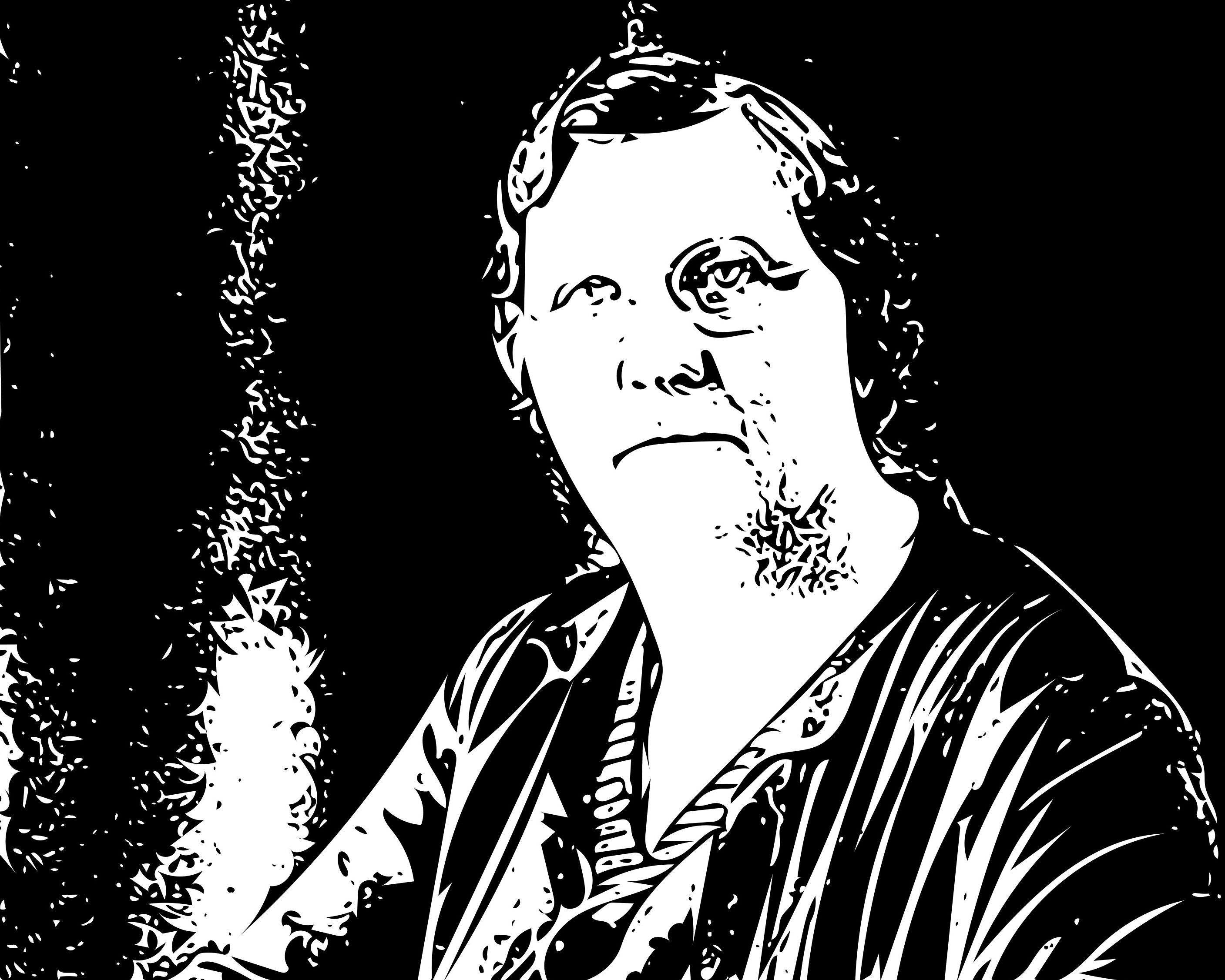
On January 3, 1933, Minnie D. Craig (pictured above) became the first woman elected as Speaker of the North Dakota House of Representatives, the first female to hold a Speaker position anywhere in the United States.

On the same date in 1977, Apple Computer was incorporated.

January 3rd birthdays include that of Cicero (106 BC), Roman philosopher and theorist of republicanism, and J. R. R. Tolkien (1892 AD), English philologist and author of The Hobbit and The Lord of the Rings. Both authors were deeply concerned about the problem of absolute power.

Categories
audio podcast

Listen: Happy New Year!

Paul Jacob wishes you more than a Happy New Year: guess; yes, guess what he wishes for you.

Categories
Thought

Mohandas K. Gandhi

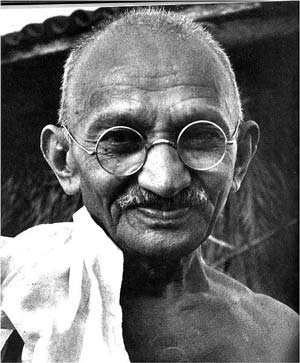
Facts we would always place before our readers, whether they are palatable or not, and it is by placing them constantly before the public in their nakedness that the misunderstanding between the two communities in South Africa can be removed.

Mohandas K. Gandhi, Indian Opinion, October 1, 1903.
Categories
Today

Fourth to Ratify

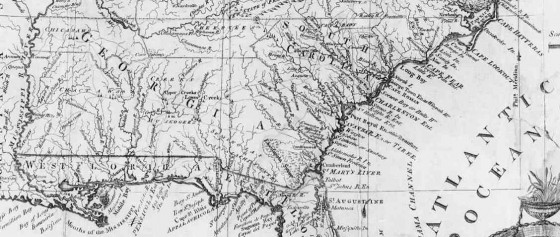
On January 2, 1788, Georgia became the fourth state to ratify the United States Constitution.

On the second day of 1819, the Panic of 1819, the first major peacetime financial crisis in the United States, began. The classic historical treatment of this crisis remains Murray Rothbard’s dissertation.

Categories
media and media people

Reality About Fake News

“Fake news entered the world with the emergence of descriptive language,” writes philosopher Ray Scott Percival on Medium, “perhaps hundreds of thousands of years ago.”

And it is here to stay, because we lack a “fool-proof algorithm” for “disposing of fake news” without cranking out a different variety of fake news.

“But this should not demoralise us,” Percival admonishes. “It is no different from the situation of science. Removing error has to be a piecemeal, tentative enterprise.”

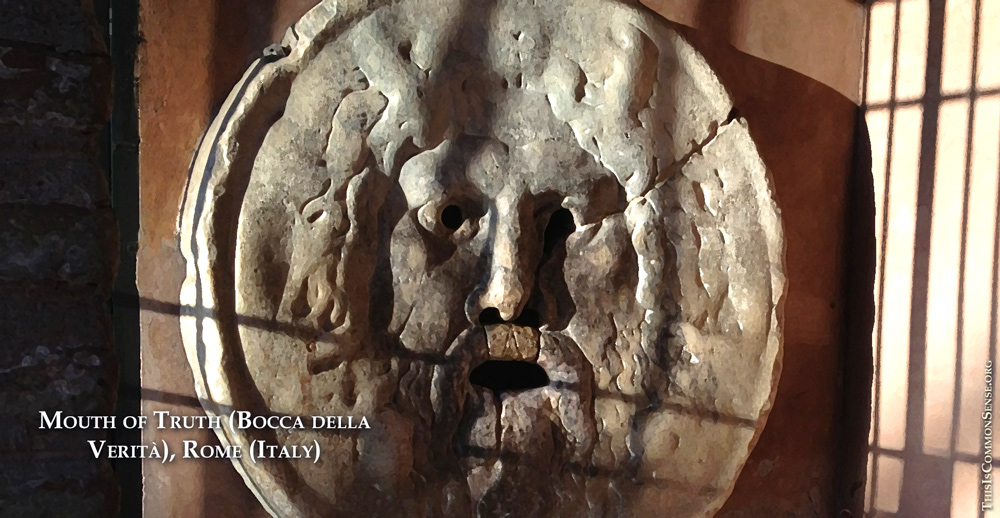
Percival, following a line of argument from philosopher Karl Popper, denies there is such a thing as “manifest truth.” It’s a delusion, says Percival. (The title of his multi-part essay is “Fake News and the Manifest Truth Delusion.”) But you don’t necessarily need to accept wholly his Popperian take on epistemology (or should that be “epistemics”?) to agree with his important conclusion, that a “ministry of fake news is a fantasy, a tool of oppression, suppression and stagnation, and would unavoidably impair our best means of error-correction.”

He recognizes that error isn’t the half of it. People lie. And some lies look pretty convincing, so we spread them. But the bizarre part of the current “fake news” mania is this: too many earnest citizens turn to government to stop “fake news,” though the biggest and most influential liar has always been the government.

What to do? Well, our “biggest gain in the control of error would be through the separation of science and the corrupting influences of politics (e.g. state funding, licensing etc.) and the chilling effect of political correctness on open discussion.”

Percival wants to “keep the enlightenment alive and kicking.” I like to think that’s just common sense.

I’m Paul Jacob.


PDF for printing

See all recent commentary
(simplified and organized)
See recent popular posts
Categories
Thought

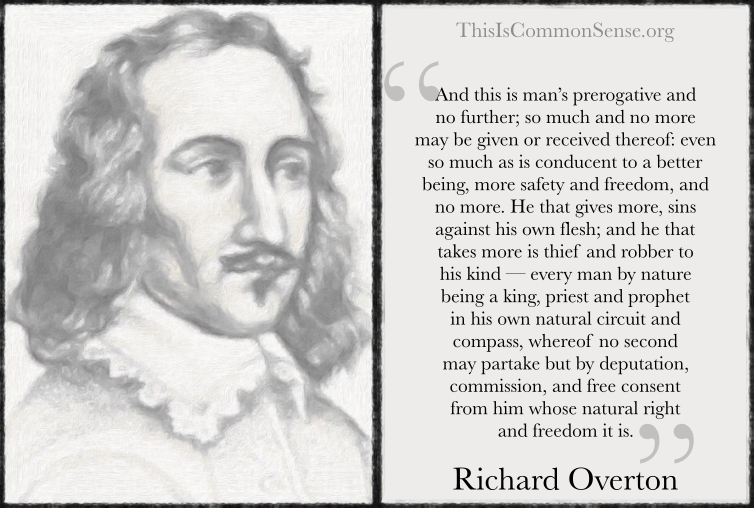
Richard Overton

For every one, as he is himself, so he has a self-propriety, else could he not be himself; and of this no second may presume to deprive any of without manifest violation and affront to the very principles of nature and of the rules of equity and justice between man and man. Mine and thine cannot be, except this be. No man has power over my rights and liberties, and I over no man’s. I may be but an individual, enjoy my self and my self-propriety and may right myself no more than my self, or presume any further; if I do, I am an encroacher and an invader upon another man’s right — to which I have no right. For by natural birth all men are equally and alike born to like propriety, liberty and freedom. . . .

From “Richard Overton shoots An Arrow against all Tyrants from the prison of Newgate into the prerogative bowels of the arbitrary House of Lords and all other usurpers and tyrants whatsoever” (1646).