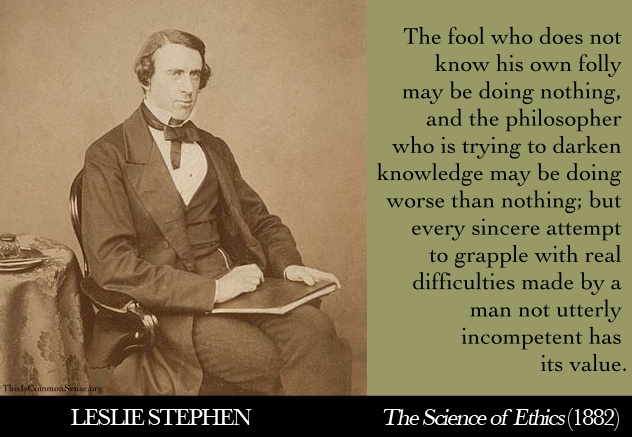
The fool who does not know his own folly may be doing nothing, and the philosopher who is trying to darken knowledge may be doing worse than nothing; but every sincere attempt to grapple with real difficulties made by a man not utterly incompetent has its value.
Leslie Stephen, from his preface to The Science of Ethics (1882).
February 25, 1805, saw the birth of Angelina Emily Grimké Weld, American abolitionist and feminist. She was the younger sister of the equally famed Sarah Moore Grimké.
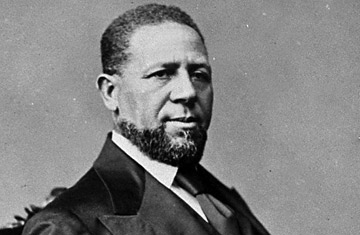
On February 25, 1870, the first African-American entered Congress to serve in the U. S. Senate.
Hiram Rhodes Revels (Sep 27, 1827 – Jan 16, 1901) was a minister in the African Methodist Episcopal Church, a Republican politician, and college administrator. Born free in North Carolina, he later lived and worked in Ohio, where he voted before the Civil War. He was elected as the first African American to serve in the United States Senate, and was the first African American to serve in the U.S. Congress. He represented Mississippi in the Senate in 1870 and 1871 during the Reconstruction era.
In Law #46 of February 25, 1947, the Allied Control Council formally proclaimed the dissolution of Prussia.
The ballot title of Colorado’s Initiative 55 should refer to an amendment “to prevent you from using statewide initiatives to reduce property taxes.”
Instead, it talks about an amendment requiring any citizen-initiated measure “that affects the property tax revenue of a local government by modifying the property tax assessment rate or mill levy rate to be decided only in a local election.”
The politicians hope that this somniferous wording will hide the true nature of the measure.
“Don’t be bamboozled by Initiative 55’s sly wording,” warns Natalie Menton, an anti-tax, pro-petition-rights activist.
Proponents of Initiative No. 55 say they want citizen-initiated changes in property taxes to be decided “only in a local election” without making clear that “under the current law, this is not possible for more than 90% of local situations.”
Menton gives examples of initiatives that would become impossible if Initiative 55 eludes voter skepticism.
One is any statewide measure to provide relief for owners of agricultural land, which “has a far higher tax assessment rate (300%-plus) than single-family homes.” If 55 reaches ballot and passes, it would become unconstitutional for citizens to place a question on the statewide ballot to reduce this burden.
What we see here is an ancient strategy of politicians. In seeking to expand their power, they pretend that increased power isn’t the agenda at all!
They engage in cover-up.
Don’t let it succeed here, Coloradoans. Don’t sign a petition to put 55 on the November ballot. If it gets there, vote No.
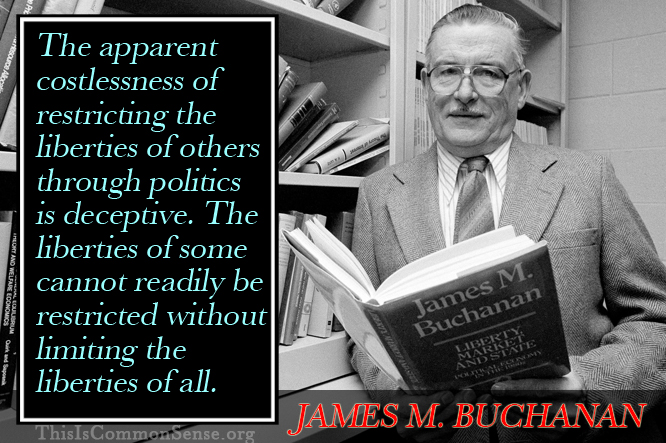
Let those who would use the political process to impose their preferences on the behavior of others be wary of the threat to their own liberties, as described in the possible components of their own behavior that may also be subjected to control and regulation. The apparent costlessness of restricting the liberties of others through politics is deceptive. The liberties of some cannot readily be restricted without limiting the liberties of all.
James M. Buchanan, “Politics and Meddlesome Preferences,” in Smoking and Society: Toward a More Balanced Assessment, edited by Robert D. Tollison, page 340.
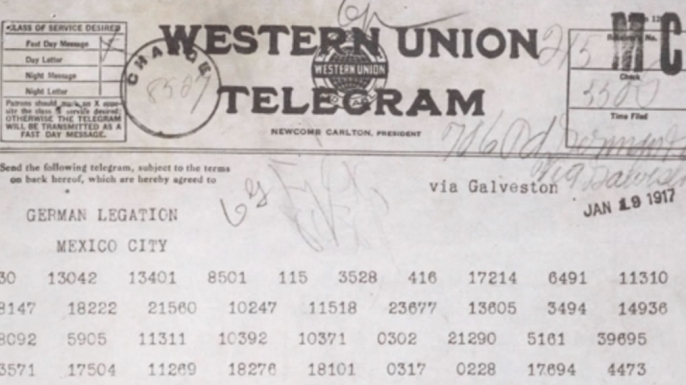
On February 24, 1917, United States ambassador to the United Kingdom, Walter Hines Page, was shown the intercepted Zimmermann Telegram, in which Germany offered to give the American Southwest back to Mexico were Mexico to declare war on the United States.
On February 24, 1803, the Supreme Court, in Marbury v. Madison, established the principle of judicial review.
The willingness of Canada’s thug-in-chief to so obnoxiously penalize protest — for one, “de-banking” trucker-protesters and supporters alike without even fake court orders — has shocked many of civilized sensibility.
Shouldn’t be surprising, though. It’s nothing new either in Justin Trudeau’s conduct or in that of Western governments. (The Canadian parliament has now endorsed the crackdown.)
David Solway reports that Trudeau’s reign has long been blighted by tyrannical policies as well as by overt sympathy for terrorists, dictators, and dictatorship.
And Glenn Greenwald observes that it has become standard in the West for many “who most flamboyantly proclaim that they are fighting fascists [to] wield the defining weapons of despotism” — weapons like squelching dissent (directly or indirectly by enlisting private firms to function as agents of repression) and punishing dissenters without trial.
Greenwald relates the example of Wikileaks founder Julian Assange. When the U.S. government found no way to criminally charge him, it pressured firms to terminate his financial accounts and kick WikiLeaks off private servers.
Such tactics as pressuring, or ordering, companies to censor and financially ostracize political opponents “without a whiff of due process” are now part of the standard governmental toolkit.
The scale on which Trudeau has been doing this, and the flagrancy of it, may seem new in North America. But he is relying on well-established precedent. Pre-pandemic precedent.
But the framework for opposing this new authoritarianism has more precedent. Alberta’s premier, Jason Kenney, has rightly sued Trudeau and the Canadian government for abuse of authority in resorting to emergency powers.
We can no longer be content with refuting our opponents; we are also bound to explain them. The vitality of any doctrine supposed to be erroneous proves that it cannot be entirely erroneous.
Leslie Stephen, The Science of Ethics (1882), page 2.
On February 23, 1898, Émile Zola was imprisoned in France after writing J’accuse, a letter accusing the French government of anti-Semitism and wrongfully imprisoning Captain Alfred Dreyfus. Zola was a leading force in extending realism to the novel.
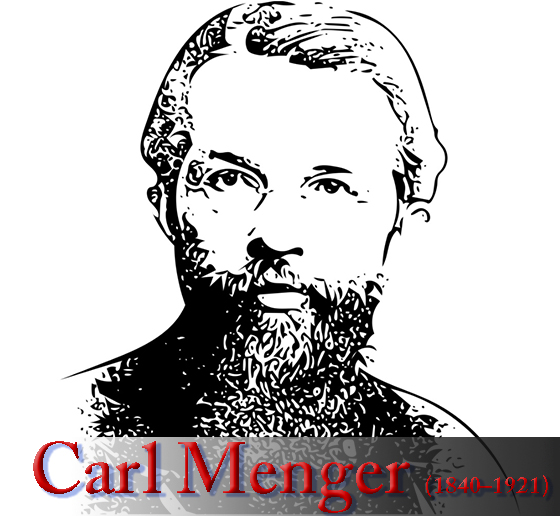
Fifty-eight years earlier, Austrian economist Carl Menger was born.
Menger would go on to contribute to the development of the theory of marginal utility, which supplanted cost-of-production theories of value in economics, in his first book, translated into English as Principles of Economics. Though expert in mathematics (he served as tutor in economics and statistics to Archduke Rudolf von Habsburg, the Crown Prince of Austria not long after the publication of the Principles), his approach to marginal theory was the least mathematical of his famous “co-discovers” of the principle, William Stanley Jevons and Leon Walras. Rooted in a subjective theory of value, it was the most realistic and least model-based of the marginalist revolutionaries, and he was most interested in price formation, not “price determination,” which focused almost exclusively on equilibrium conditions. He developed an evolutionary theory of money, as well. His second book expanded upon invisible hand processes in society.
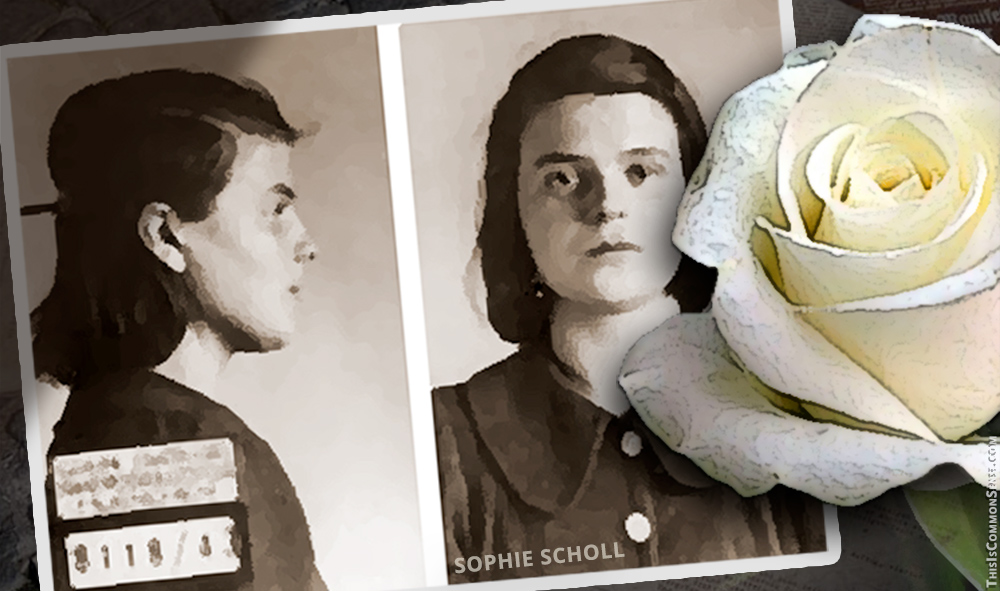
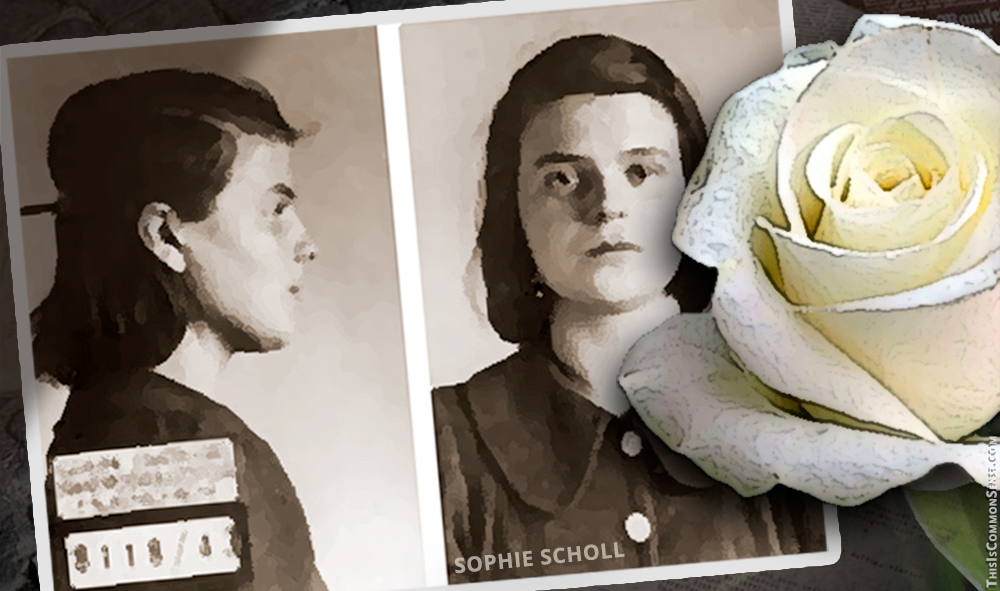
Today marks a solemn anniversary. Seventy-nine years ago — on Feb. 22, 1943 — three German students at the University of Munich were tried for treason by the Nazis, convicted and then executed, all in one day.
The method of execution: guillotine.
Days earlier, Hans Scholl and his sister Sophie had been caught distributing a leaflet at the university. It was damning — of the Nazi regime; and, from the perspective of that Nazi regime, of the Scholls: “In the name of German youth, we demand restitution by Adolf Hitler’s state of our personal freedom, the most precious treasure we have, out of which he has swindled us in the most miserable way.”
Hans had in his pocket a draft of another leaflet, in Christoph Probst’s handwriting. That seventh leaflet, never distributed, led to the arrest and execution of Christoph, along with Hans and Sophie.
The three were part of a cadre of students who wrote and distributed leaflets under the name The White Rose — a symbol of purity standing against the monstrous evil of the Third Reich. The leaflets decried the crimes of National Socialism, including the mass murder of Jews. And they urged Germans to rise up.
Three more members were later executed: Willi Graf, Alex Schmorell and Professor Kurt Huber. Another eleven were imprisoned.
Their resistance was ultimately futile, unsuccessful . . . but not pointless.
They would not remain cogs in the killing machine that had taken the most advanced society in the world to the depths of depravity. They took a stand against what George Orwell later characterized as “a boot stamping on a human face, forever.”
We often say, with earnest piety, “Never again.” But our dedication should be inspired by the White Rose. When we encounter tyranny, think of the Scholls and say “Again for Freedom.”
This is Common Sense. I’m Paul Jacob.
Further reading: For an excellent account of The White Rose, consult the aptly titled A Noble Treason, by Richard Hanser. See also Jacob Hornberger’s The White Rose — A Lesson in Dissent. The Orwell quotation is from the dystopian novel 1984. You can read the six pamphlets on this website.
This article is reprinted from 2019. A previous appreciation was published on Townhall in 2010.
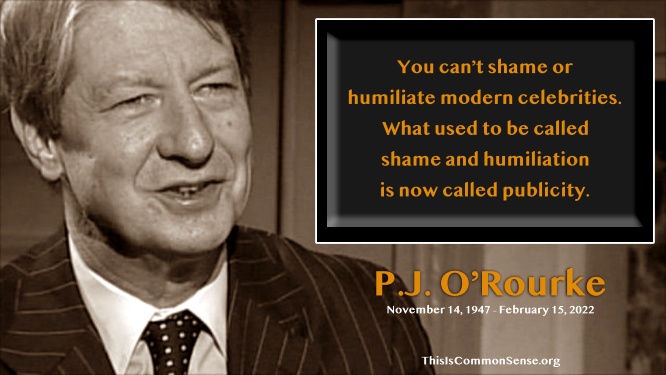
You can’t shame or humiliate modern celebrities. What used to be called shame and humiliation is now called publicity. And forget traditional character assassination; if you say a modern celebrity is an adulterer, a pervert and a drug addict, all it means is that you’ve read his autobiography.