Vice thrives and lives by concealment.
Publius Vergilius Maro (October 15, 70 BC – September 21, 19 BC), known in English as Virgil, Georgics, Book III, line 454.

Vice thrives and lives by concealment.
Publius Vergilius Maro (October 15, 70 BC – September 21, 19 BC), known in English as Virgil, Georgics, Book III, line 454.

On January 12, 1904, Henry Ford set a land-speed record of 91.37 mph on the frozen surface of Lake St. Clair in Michigan, driving a four-wheel vehicle, dubbed the “999,” with a wooden chassis but no body or hood. Ford’s record was broken within a month, but the publicity from Ford’s achievement was valuable to the auto pioneer, who had incorporated the Ford Motor Company the previous year.

In a land where a First Amendment explicitly if imperfectly protects freedom of speech, does anyone believe she should be?
Well, the New Hampshire attorney general, for one.
For two, whoever called his attention to the trivial oversight that led to Ms. Paul’s arrest last August.
Her venial sin, if it’s even that, was to publish political ads that failed to include the legend “Political Advertisement” as required by New Hampshire law.
The violation is punishable by up to a year of incarceration and a fine up to $2,000.
As Paul noted in August, “This is clearly a case of a small business needing to defend itself against overreaching government. To threaten a small business owner with jail time over something this insignificant is very heavy-handed.”
Insignificant, why?
Not labeling a political message “Political Advertisement” is only controversial in the slightest when the message imitates normal editorial or news content. The arrest warrant reports that the ads in question were on the order of “VOTE YES ARTICLE 2.”
Obvious political advertising.
Months later, Paul still awaits her fate. An arraignment is scheduled for later this month. On the advice of her lawyer, she had little to say when we asked her for an update about the case. But she hinted that a political adversary may have filed the complaint against her.
The net of multitudinous picayune laws that snagged Paul can snag anybody who does anything more culturally and socially ambitious than sitting at home staring at the wall all day. Such regulations can be exploited by anyone eager to harass someone for reasons quite apart from an alleged infraction.
This is Common Sense. I’m Paul Jacob.
Illustration created with Midjourney
See all recent commentary
(simplified and organized)
See recent popular posts

Science should remain above politics, if it’s to do its job.
Nancy Kress, Probability Space (2002).

On January 11, 1571, the freedom of religion was granted to Austrian nobility.
Two years earlier, the first recorded lottery in England was held.
In Philadelphia, Pennsylvania, on the eleventh day of the first month of 1759, the first American life insurance company was incorporated.
On January 11, 1935, Amelia Earhart became the first person to fly solo from Hawaii to California.
On this date in 2003, Illinois Governor George Ryan commuted the death sentences of 167 prisoners on Illinois’s death row based on the Jon Burge scandal.

What could possibly go wrong?
In a bill passed and signed last August, “$80 billion worth of new funding over the next decade” was shoveled at the Internal Revenue Service “so it could” — as a recent Reason article summarizes — “hire 87,000 new workers, purportedly to better target millionaire and billionaire scofflaws.”
The assurance that the new investment in personnel would not be directed towards “those making under $400,000 annually” was, as Reason’s Liz Wolfe makes clear, “not provided within the text of the actual bill.”
Ah — political promise over actual law and all bureaucratic experience. The IRS, you see, prefers to focus its audits on the lowest income earners, who were audited more often than millionaires.
Why? Well, the key is one feature of the tax code: the earned income credit. Which, it just so happens, is easy to get wrong. And upon which lower-income workers have come to rely.
The other reason is even more basic: “given a dearth of experienced auditors not likely to be fixed soon, the agency would rely on the easiest and least time-consuming types of audits.” Which are conducted through the mail. Easy. Cheap. And annoying.
Even with more IRS auditors with more experience, this path of least resistance — these earned income credit audits — will likely get the most use.
The reasons behind the reasons? Why were Democrats so eager to increase the ranks of tax collectors? Sure, Democrats love taxes. But like most tax hikers, they promote the idea that others will pay all those taxes; they promise to stick it to the rich . . . while ever-so consistently missing the mark and whacking the poor and middle classes.
This is Common Sense. I’m Paul Jacob.
Illustration created with Midjourney and DALL-E2
See all recent commentary
(simplified and organized)
See recent popular posts
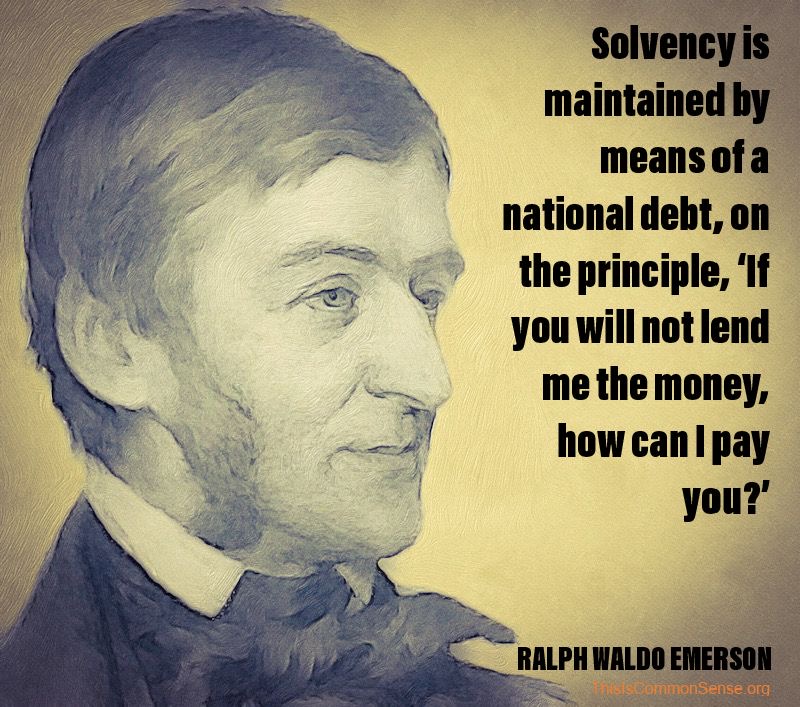
Ralph Waldo Emerson, “English Traits” (1856).
Solvency is maintained by means of a national debt, on the principle, ‘If you will not lend me the money, how can I pay you?’

On January 10, 1776, Thomas Paine published Common Sense.
You can read this classic on this site’s library.

Of all places.
What bizarre chain of events caused career congressmen to start jawboning and horse-trading about the popular reform that most of them viscerally oppose?
It was the work-product of a small number of hardcore conservative Republican legislators, a mere 20, flexing their strength and commitment at a critical political point — the election of the House Speaker — and armed with concrete demands.
“We offered Kevin McCarthy terms last evening that he rejected,” Rep. Matt Gaetz (R-Fla.) told reporters last Tuesday. One of those? “We’ve sought a vote in [the] first quarter of the 118th Congress on term limits.”
By week’s end, however, McCarthy had been elected Speaker of the House . . . but only after having pledged to bring to the floor that congressional term limits amendment, authored by Rep. Ralph Norman (R-SC), one of the 20 holdouts, along with making other concessions.
Meet the Press host Chuck Todd yesterday cast shade on the effort, calling these “show votes.”
While it’s true that incumbents are unlikely to vote for the term limits amendment in the 2/3 supermajority the Constitution requires, or for the balanced budget amendment for which the holdouts, mostly Freedom Caucus members, also secured a commitment from McCarthy.
“We’ve got to start taking steps to make fundamental change in America,” Rep. James Comer (R-Ky.) told Todd. And putting every U.S. representative on record on term limits sounds like a great first step for early 2023.
Worth the battle.
This is Common Sense. I’m Paul Jacob.
Illustration created with Midjourney
See all recent commentary
(simplified and organized)
See recent popular posts
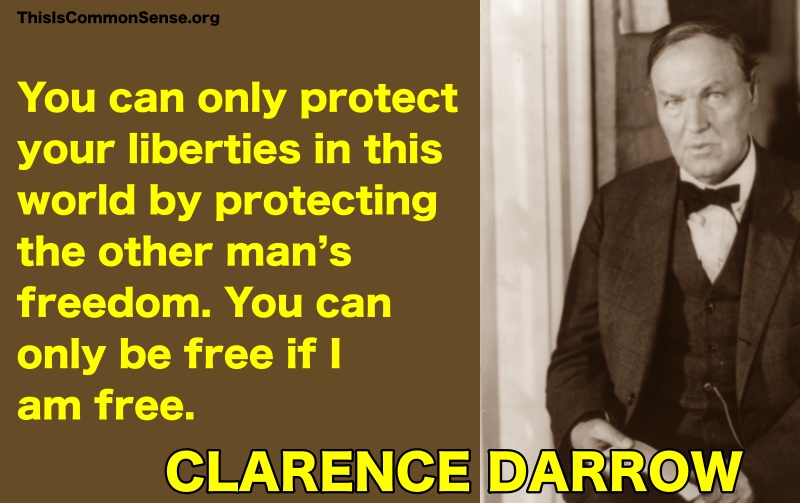
You can only protect your liberties in this world by protecting the other man’s freedom. You can only be free if I am free.
Clarence Darrow, Address to the court in People v. Lloyd (1920).