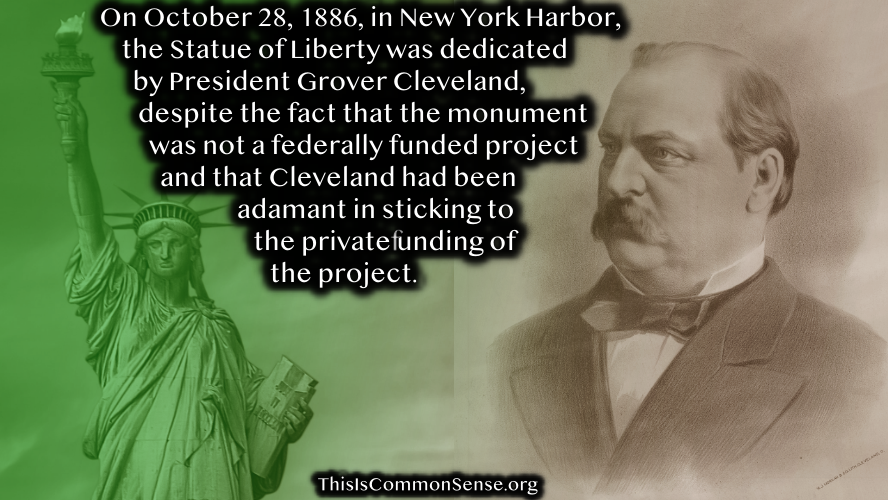
On October 28, 1886, in New York Harbor, the Statue of Liberty was dedicated by President Grover Cleveland, despite the fact that the monument was not a federally funded project and that Cleveland was adamant in sticking to the private funding of the project.
Repeatedly we hear former president and current presidential candidate Donald John Trump accused of declaring he would be “a dictator on Day One,” and that, therefore, we cannot trust him to respect the Constitution.
Sure. He said it. No doubt. But the original statement was a bit of jesting with Sean Hannity:
Hannity had asked if he would ever use power as retribution against anyone, and Trump responded orthogonally, saying “except for Day One,” then clarifying: he’d close the border and “drill, drill, drill.”
He was answering a different question. This is quite clear. You have to be somewhat illiterate not to understand what Trump was doing here. So can we assume that they really object to is his border policy and petroleum production stance?
Bloodbath!
Trump is charged with threatening a bloodbath if he is not elected. And he did say the word. But the context was also closer to anodyne. He predicted a bloodbath if tariffs in automobiles from Mexico were not raised “100 percent,” which he promised to do:
Now, the ultra-protectionist policy Trump lays out here may be close to insane. But it’s not threatening-riots- or threatening-insurrection-insane. That is just a fantasy. Of his opponents.
It is worth remembering, also, that there is a difference between a prophecy (or prediction) and a threat (or dire promise).
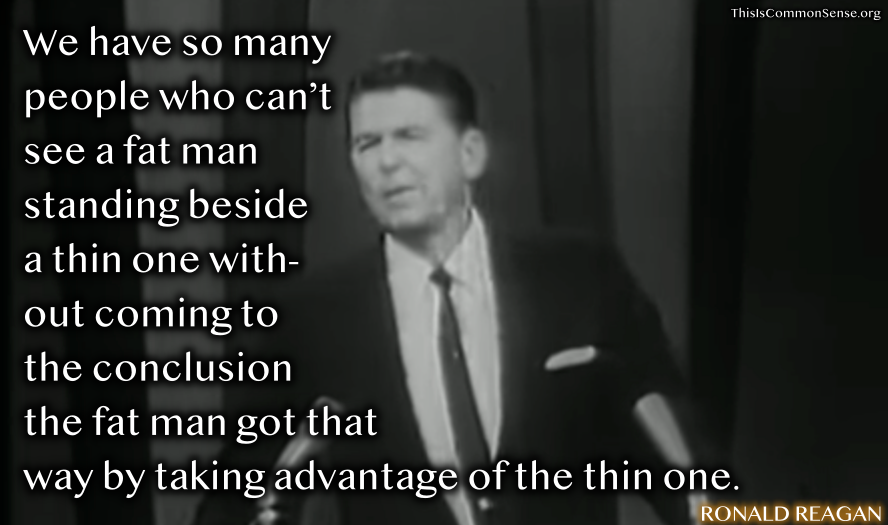
We have so many people who can’t see a fat man standing beside a thin one without coming to the conclusion the fat man got that way by taking advantage of the thin one. So they’re going to solve all the problems of human misery through government and government planning. Well, now, if government planning and welfare had the answer — and they’ve had almost 30 years of it — shouldn’t we expect government to read the score to us once in a while? Shouldn’t they be telling us about the decline each year in the number of people needing help? The reduction in the need for public housing?
But the reverse is true. Each year the need grows greater; the program grows greater.
Ronald Reagan, “A Time for Choosing,” a televised speech in support of Barry Goldwater’s 1964 presidential campaign (October 27, 1964).
On October 27, 1964, Ronald Reagan delivered a speech on behalf of Republican candidate for the United States Presidency, Barry Goldwater, thereby launching Reagan’s political career. The speech came to be known as “A Time for Choosing.”
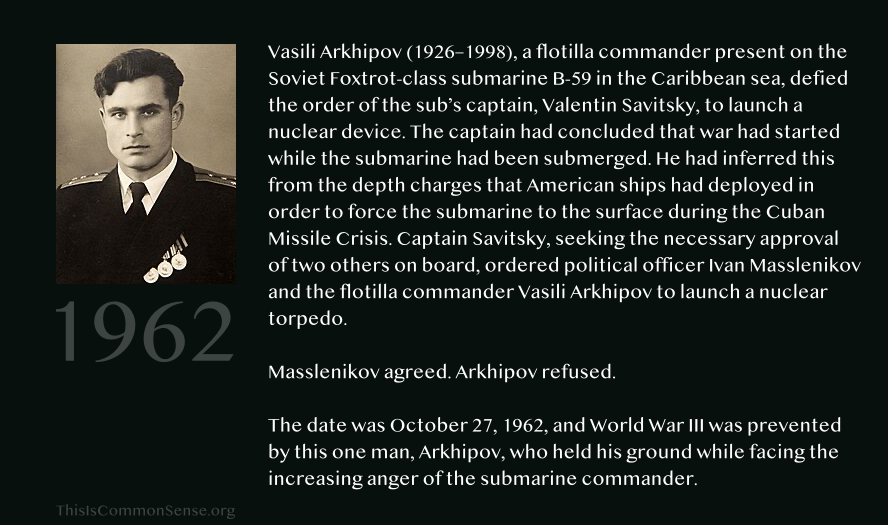
Two years earlier, Vasili Arkhipov, a flotilla commander present on the Soviet Foxtrot-class submarine B-59 in the Caribbean sea, defied the order of the sub’s captain, Valentin Savitsky, to launch a nuclear device. The captain had concluded that war had started while the submarine had been submerged. He had inferred this from the depth charges that American ships had deployed in order to force the submarine to the surface during the Cuban Missile Crisis. Captain Savitsky, seeking the necessary approval of two others on board, ordered political officer Ivan Masslenikov and the flotilla commander Vasili Arkhipov to launch a nuclear torpedo.
Masslenikov agreed. Arkhipov refused.
The date was October 27, 1962, and World War III was prevented by this one man, Arkhipov, who held his ground while facing the increasing anger of the submarine commander, refusing to approve a nuclear torpedo launch that would most almost certainly have triggered a conflict that would have doomed civilization, perhaps most or all of humanity.
That, we can now agree, was a “time for choosing” — and the correct choice was made.
It’s risky, covering the Trump Phenomenon so close to the election and mere hours after the Joe Rogan Experience dropped a much-awaited interview with the candidate.
But in the week following an over-hyped and rather lame October Surprise — the old accusation (from 2022) about Trump griping about not having loyal generals, as Hitler had — it’s worth mention that the most notorious accusations about Trump have fizzled spectaclarly.
And we’re not talking just about the Russia Collusion nonsense, which early could be spotted as made-up “oppo research” fantasy.
Consider just three:
“Very Fine People on Both Sides”
“Dictator on Day One”
“Bloodbath”
In each case we have something Trump actually said (there are few good reasons to be sure about the “Hitler’s loyal generals” comment), but taken completely out of context by his Democratic opposition and by the regular run of news “journalists.”
Let’s take the first accusation today: that Trump said there were “very fine people on both sides” of the August 2017 Charlottesville protests, meaning neo-Nazis were fine and their counter-protesters were fine. Everybody’s fine! But, as Snopes.comexplained, Trump meant that there were “very fine people on both sides” of the Confederate statueiconoclasm issue.
But we know this not just because Snopes said so. Watch Trump’s original statement, but let it run more than ten seconds:
As Snopes summarizes, “He said in the same statement he wasn’t talking about neo-Nazis and white nationalists, who he said should be ‘condemned totally.’”
Joe Biden has repeatedly claimed that he ran for the presidency primarily because of the sheer awfulness of Trump’s “very fine people” comment, and candidate Kamala Harris has repeated the calumny. While Joe may have a senility excuse, does Kamala?
Meanwhile, something was lost in the brouhaha: it was Trump’s comments on George Washington and Thomas Jefferson that were most interesting.
Should we take down statuary of the first and third presidents because they owned slaves?
“What do you think of Thomas Jefferson?” Trump asked a reporter. “You like him?”
Trump was clearly more interested in the iconoclasm issue. But Democrats avoid rationally exploring that subject.
Tomorrow: “Dictator on Day One” and “Bloodbath.” And more!
Truth, crushed to earth, shall rise again; The eternal years of God are hers; But Error, wounded, writhes with pain, And dies among his worshippers.
William Cullen Bryant, The Battlefield (1839), st. 9. Martin Luther King, Jr., cited this poem (Dec. 3, 1956, as quoted in The Papers of Martin Luther King, Jr: Advocate of the social gospel, p. 162) thusly: “There is something in this universe which justifies William Cullen Bryant in saying Truth crushed to earth will rise again.”
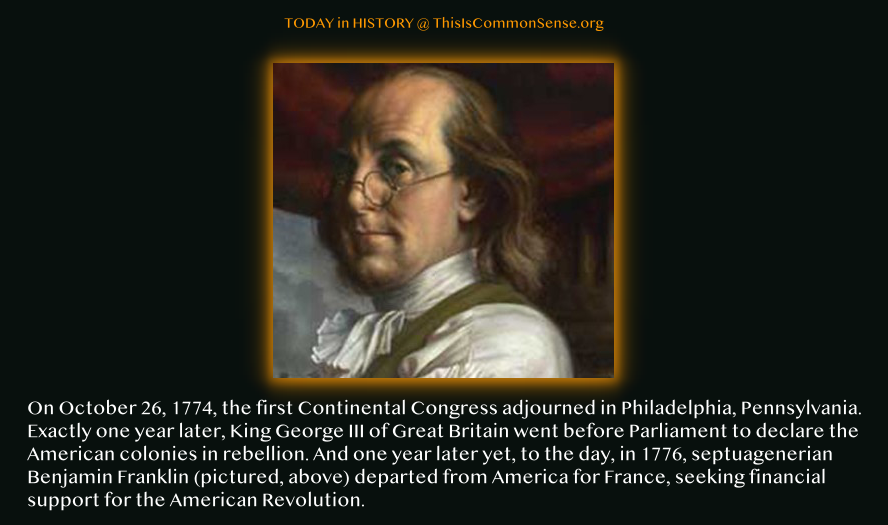
On October 26, 1774, the first Continental Congress adjourned in Philadelphia, Pennsylvania. Exactly one year later, King George III of Great Britain went before Parliament to declare the American colonies in rebellion. And one year later yet, to the day, in 1776, septuagenerian Benjamin Franklin (pictured, above) departed from America for France, seeking financial support for the American Revolution.
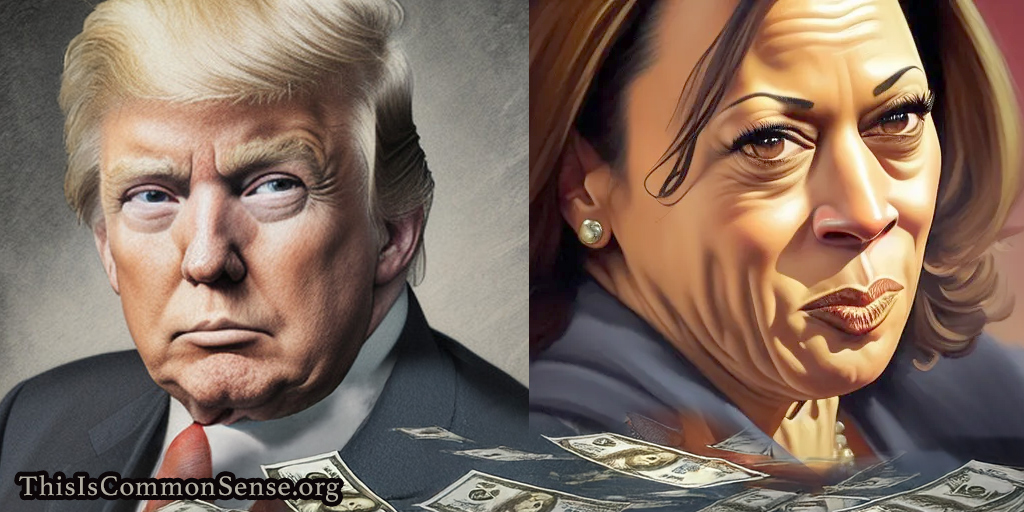
The Epoch Times has produced a handy policy comparison between the two major-party candidates for the presidency of the United States, former President Donald Trump and current Vice President Kamala Harris.
Maybe issues don’t matter so much now, though: more talked-about is Trump’s stunt scooping fries at McDonald’s, which got Democrats so upset (to their detriment), or Kamala Harris’s bizarre quip at a rally where two young men shouted “Jesus Is Lord!” and “Christ Is King!” as they were being thrown out. The Veep’s response that they were at the wrong rally was construed by many to suggest that her supporters aren’t Christians.
Nevertheless, The Epoch Times is right to emphasize policy. It’s a big subject, so let’s just compare the candidates on “The Economy.”
Donald Trump “Pledges to reduce inflation by increasing American energy production, cutting wasteful government spending, and preventing illegal immigration,” and “Seeks to lower commodity prices by ending global wars.” Are these “good for the economy”? Probably; mostly. But distant from the heart of inflation.
Worse, Trump allegedly “‘Strongly’ feels presidents ‘should have at least a say’ in the Federal Reserve’s monetary policy decisions.” The Fed is indeed key, but the only way to reduce inflation immediately is through the kind of policies presidents tend to hate — for example, the deflation that Fed Chairman Paul Volcker performed on Jimmy Carter’s economy that helped get Reagan elected.
Kamala Harris sticks to progressive standards, proposing “a federal ban on corporate price gouging on food and groceries to tackle inflation,” which would backfire into a major economic debacle, complete with shortages and calls for rationing and worse. It fits in nicely with another typical progressive plank, calling for “raising the minimum wage,” which would lead to less employment partly through increased robotization of businesses now employing the workers affected, the low-skilled (the ones Trump calls “great”).
Looking over their substantive policies, it’s easy to see why “culture war” issues prevail.
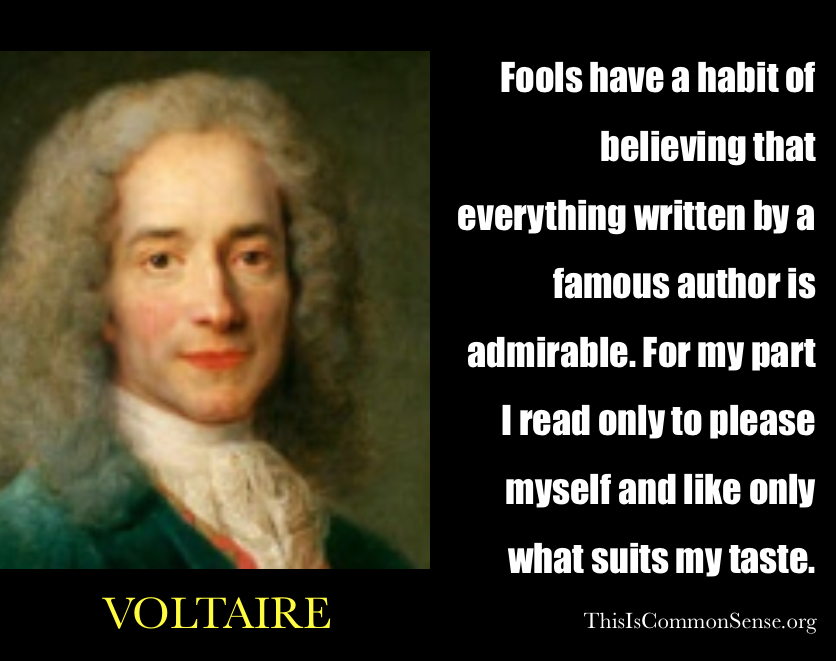
Fools have a habit of believing that everything written by a famous author is admirable. For my part I read only to please myself and like only what suits my taste.
On October 25, 1806, German philosopher Max Stirner was born. Stirner was known for his radical individualism, which under the name of “egoism” became culturally chic in the late 19th and early 20th centuries. In addition to Der Einzige und sein Eigentum, a major work that was famously attacked by Karl Marx, he translated into German Adam Smith’s Wealth of Nations (from its original English) and J.-B. Say’s A Treatise on Political Economy (from its original French).
Der Einzige und sein Eigentum has been translated into English as The Ego and Its Own and The Ego and His Own.
“Max Stirner” is a nom de plume, his birth name being Johann Kaspar Schmidt. He died in 1856, and his biography by John Henry Mackay, Max Stirner — sein Leben und sein Werk, was published in German in 1898 (enlarged 1910, 1914), and finally translated into English in 2005.
The only image we have of him was sketched by Karl Marx’s comrade, benefactor and abuse-buddy, Friedrich Engels. The portrait above has been adapted from that drawing.