On November 11, 1889, the State of Washington was admitted as the 42nd State of the United States.
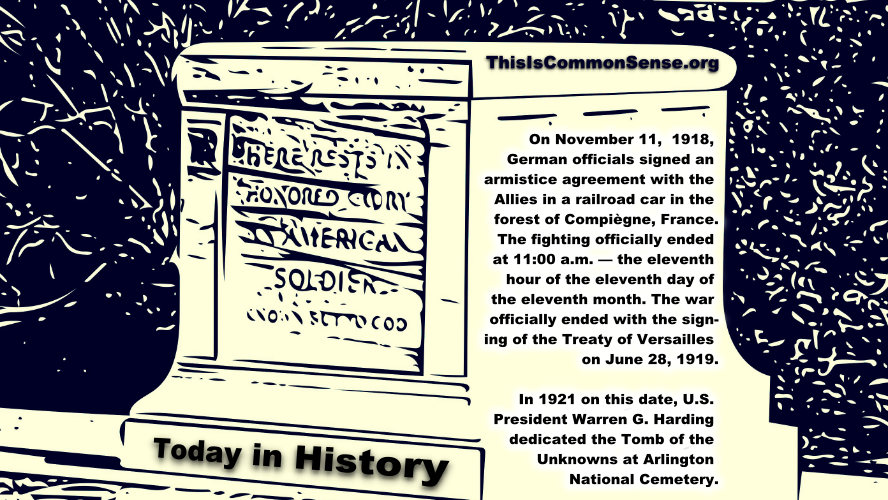
In 1918, German officials signed an armistice agreement with the Allies in a railroad car in the forest of Compiègne, France. The fighting officially ended at 11:00 a.m. — the eleventh hour of the eleventh day of the eleventh month. The war officially ended with the signing of the Treaty of Versailles on June 28, 1919.
In 1921 on this date, U.S. President Warren G. Harding dedicated the Tomb of the Unknowns at Arlington National Cemetery.
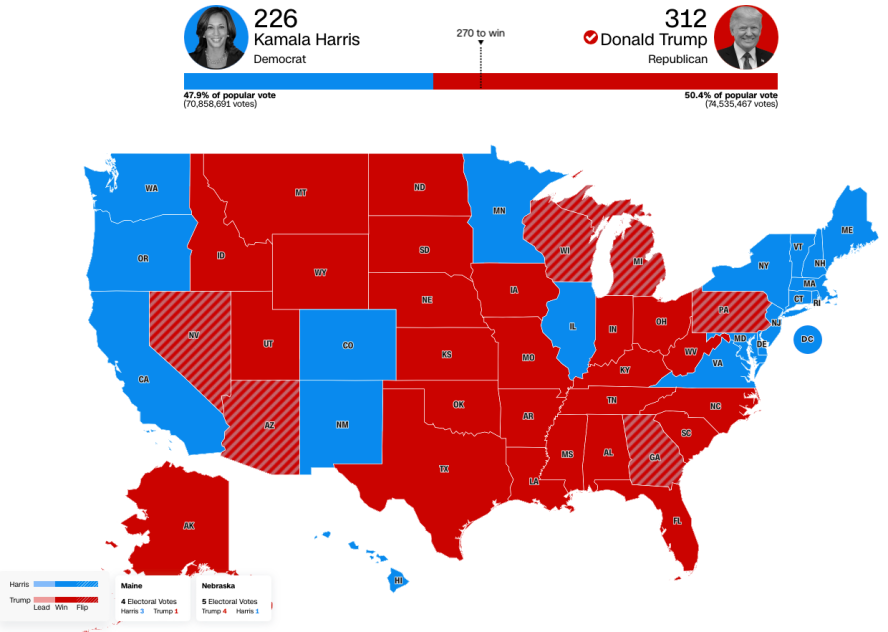
“Donald Trump will be America’s 47th president,” explained CNN on Saturday, “after mounting the most momentous comeback in political history. . . .”
But is it?
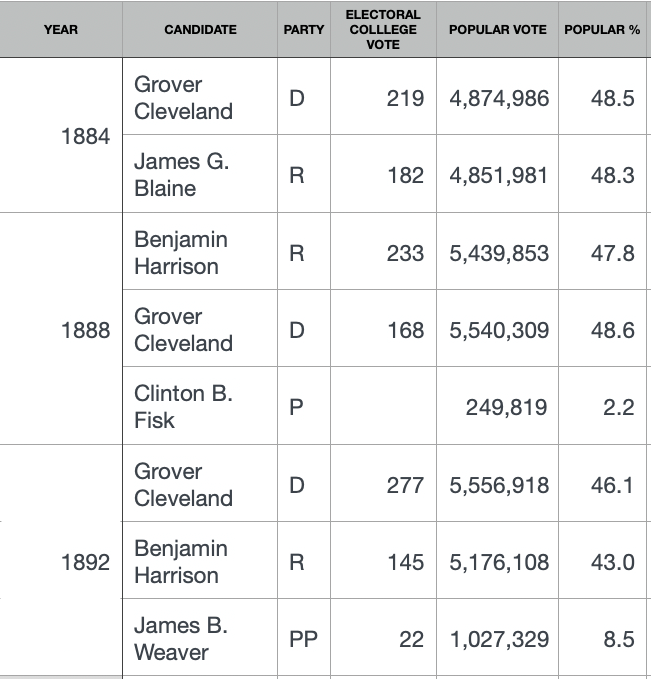
Consider the three federal elections that 19th century Democratic politician Stephen Grover Cleveland participated in (winning two non-consecutive presidencies):
Note the course of Grover Cleveland’s three Electoral College returns: 219; 168; 277. Compare with Trump’s: 304; 232; 312*. Cleveland’s popular vote went up each time. Trump’s did too: 62,984,828; 74,223,975; 74,535,879*. You do the math, but it a quick look suggests that Trump’s comeback is no more momentous than Cleveland’s.
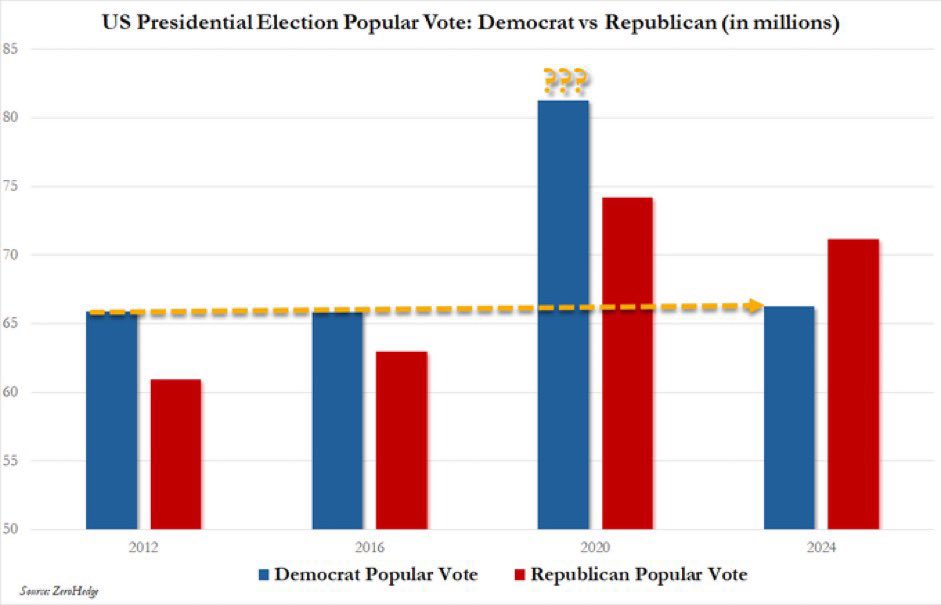
The real anomaly in the recent series of three elections was the whopping turnout for the 2020 outing, where Joe Biden, who did not engage in anything like a normal campaign, garnered a whopping 81,283,501 votes. Compare that to Hillary Clinton’s 65,853,514 votes in 2016 and the less-than 71 million votes for Kamala Harris in 2024.
The real question is what happened, in 2024, to 2020’s over ten million “eager” voters. The question may be easy to answer, but it is nevertheless a huge one, and has elicited a popular graph online, widely shared:
Note that it has at least one obvious inaccuracy: the Republican presidential vote did not go down from 2020 to 2024.
Also note that CNN, quoted above, characterized the election as one that “will hand [Trump] massive, disruptive power at home and will send shockwaves around the world.” Accurate, or just CNN being CNN?
The asterisk, above, for 2024 returns is there to remind us that the election counts are not final.
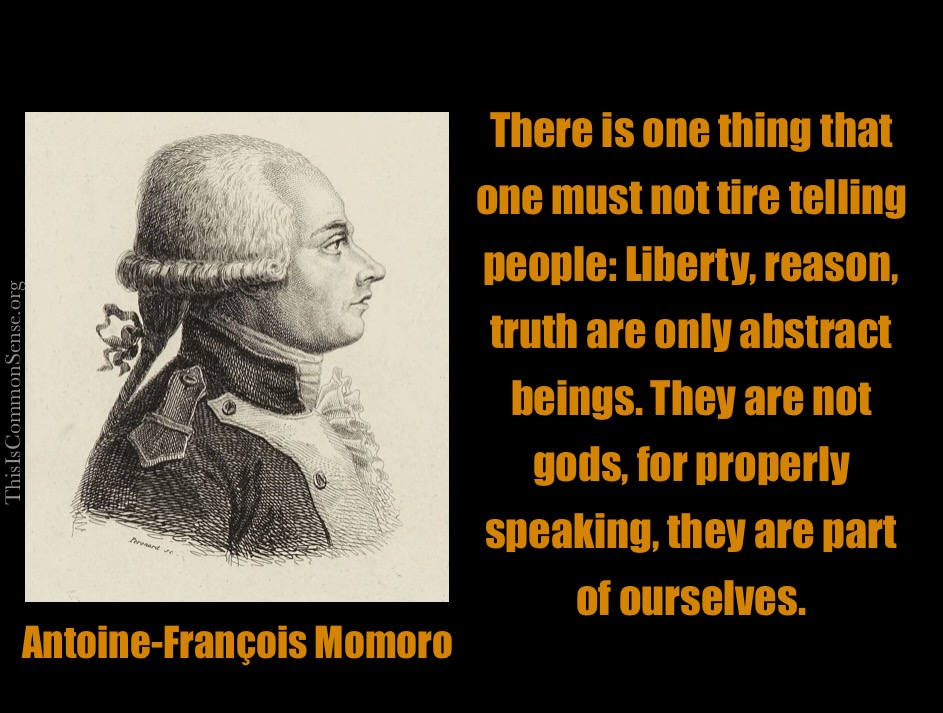
There is one thing that one must not tire telling people: Liberty, reason, truth are only abstract beings. They are not gods, for properly speaking, they are part of ourselves.
Antoine-François Momoro as quoted in Emmet Kennedy, A Cultural History of the French Revolution (1989). See also “20 Brumaire, Year II.” Momoro was guillotined on 4 Germinal, Year II (March 24, 1794).
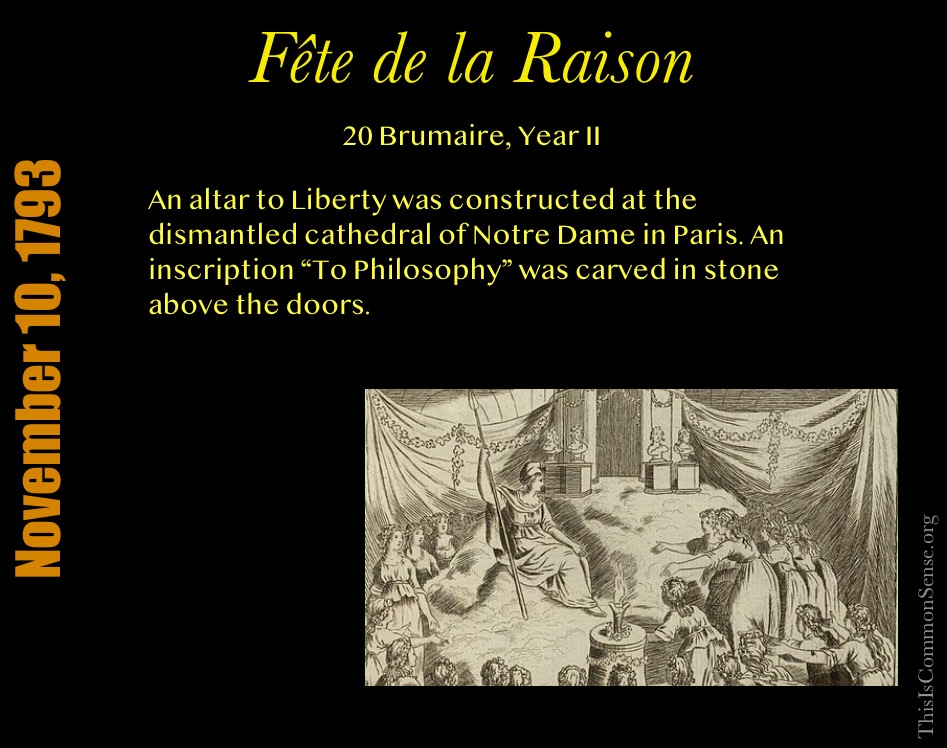
An altar to Liberty was constructed at the dismantled cathedral of Notre Dame in Paris; an inscription “To Philosophy” was carved in stone above the doors — all at “The Festival of Reason” on 20 Brumaire, Year II (November 10, 1793).
In 2016, when Donald John Trump won the presidency in a squeaker election, major news media and the Deep State worked together to censor online and free speech in a big way, culminating in the election of Joseph Robinette Biden, Jr., in 2020. Now, in November 2024, with many millions fewer voting than for Biden, Trump wins handily, taking the swing states and achieving what looks like a popular vote majority.
So what are major news media mavens doing?
Complaining about a lack of censorship!
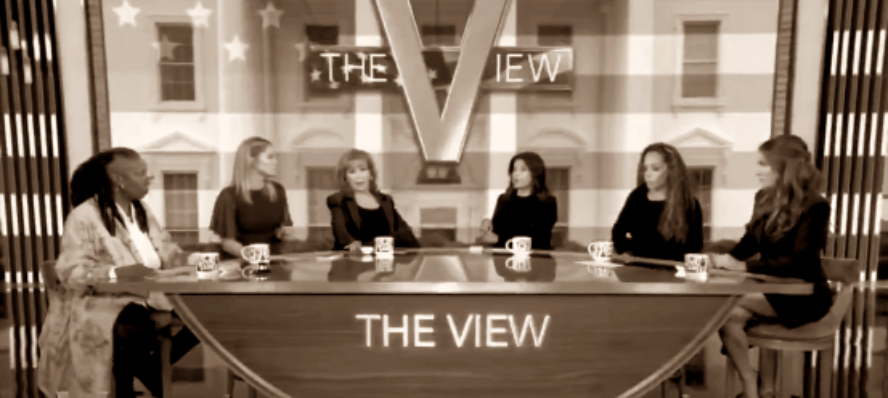
Well, some are. Specifically, as said on The View, “It would help if we could regulate social media, because one of the biggest offenders is D.C. and Congress have not been able to do one thing in regard to the rogue corporations of social media,” meaning, mainly but not exclusively, ex-Twitter/X.
There are many such laments out there. Just remember the Constitution of the United States, though:
Congress shall make no law respecting an establishment of religion, or prohibiting the free exercise thereof; or abridging the freedom of speech, or of the press; or the right of the people peaceably to assemble, and to petition the Government for a redress of grievances.
First Amendment, approved by Congress along with other amendments and submitted to the states for their ratification on September 25, 1789; ratified December 15, 1791.
Paul Jacob has covered online censorship extensively. Here are just a very few examples:
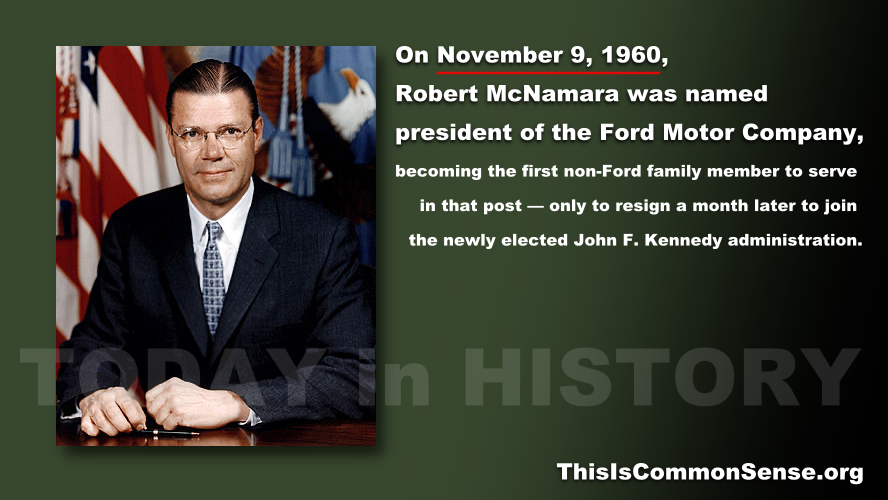
On November 9, 1960, Robert McNamara was named president of the Ford Motor Company, becoming the first non-Ford family member to serve in that post — only to resign a month later to join the newly elected John F. Kennedy administration.
Lately, Americans have been distracted by a federal-level election. But we’ve also had important state-level matters to attend to during the recent election cycle, including some legislatively referred questions about citizen initiative rights.
In my experience, whenever many politicians push for a ballot measure in order to supposedly “fix” an already-established right of citizen initiative, the goal is usually to make it harder for people to get a question onto the ballot.
Three questions on state ballots this November exemplify the pattern. Fortunately, voters have rejected the sly politicians’ gambit in each case.
In Arizona, Proposition 136 would have let opponents of a ballot question force a doubt about its constitutionality to be adjudicated before the measure can be placed on the ballot. (Nothing prevents a measure from being challenged in court after passage.) Of course, sometimes litigation, whether sincere or not, can’t be entirely resolved before proposed urgent deadlines, like the deadline for submitting signatures to place a question on the ballot.
Arizona voters clobbered Prop 136 with about 64 percent of the vote.
In North Dakota, voters had to again defeat a lawmaker-referred measure to weaken citizen initiative rights. Among other arbitrary burdens, Measure 2 would have increased the number of signatures required to send a question to ballot.
Lastly, Colorado’s Amendment K sought to impose an earlier deadline for submitting initiative signatures. This, too, voters declined by about a ten point margin.
Good results. Voters tend to see the elite’s designs and react appropriately.
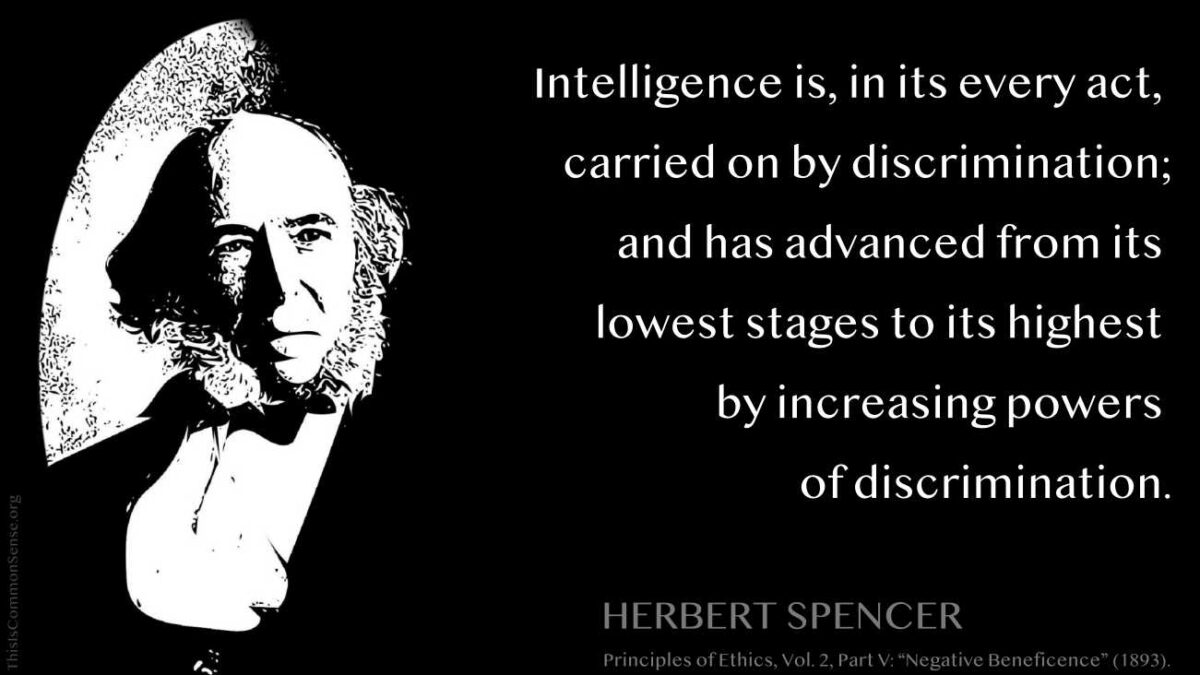
The mental action by which from moment to moment we thus, in ways commonly too rapid to observe, class the objects and acts around, and regulate our conduct accordingly, has been otherwise named by some, and especially by Professor Bain, ‘discrimination.’ Intelligence is, in its every act, carried on by discrimination; and has advanced from its lowest stages to its highest by increasing powers of discrimination. It has done this for the sufficient reason that during the evolution of life under all its forms, increase of it has been furthered by practice or habit as well as by survival of the fittest; since good discrimination has been a means of saving life, and lack of it a cause of losing life.
Herbert Spencer,Principles of Ethics, Vol. 2, Part V: “Negative Beneficence” (1893), Chapter 1: “The Kinds of Altruism.”
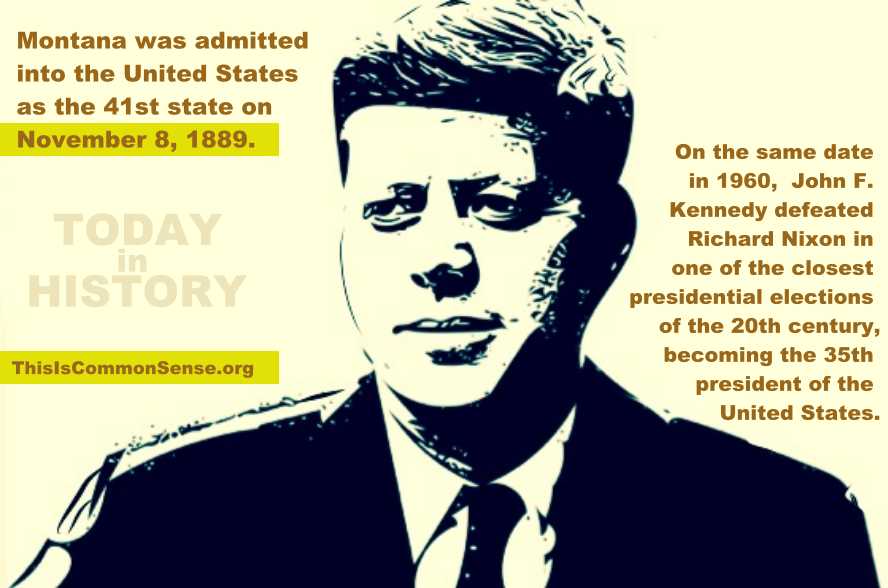
Montana was admitted into the United States federal union as the 41st state on November 8, 1889. On the same date in 1960, John F. Kennedy defeated Richard Nixon in one of the closest presidential elections of the 20th century, becoming the 35th president of the United States.