Categories
Today

Singing Revolution

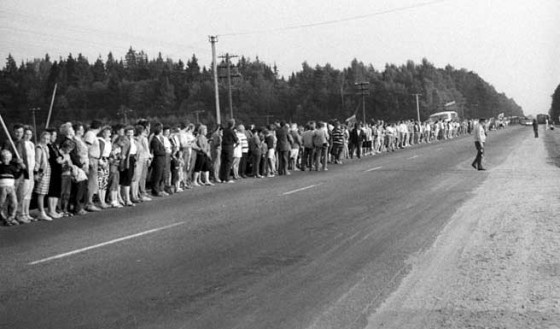
On August 23, 1989, two million people from Estonia, Latvia and Lithuania stood on the Vilnius-Tallinn road, holding hands, as part of the “Singing Revolution” that helped set the Soviet Union to its fateful implosion.

Categories
Today

Devil’s Island

On August 22, 1952, France closed its penal colony on Devil’s Island.

At first a leper colony, it had been transformed by the end of the 19th century into a prison tasked primarily with housing enemies of the French state.

Categories
Today

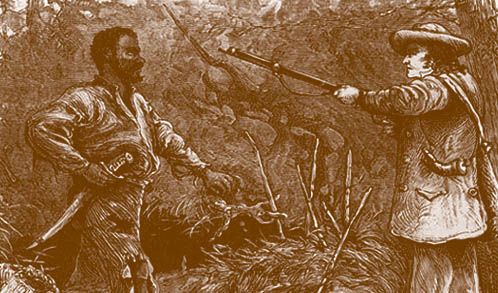
Nat Turner

On August 21, 1831, Nat Turner led slaves and freed black Americans in a rebellion that was quickly suppressed.

Categories
Today

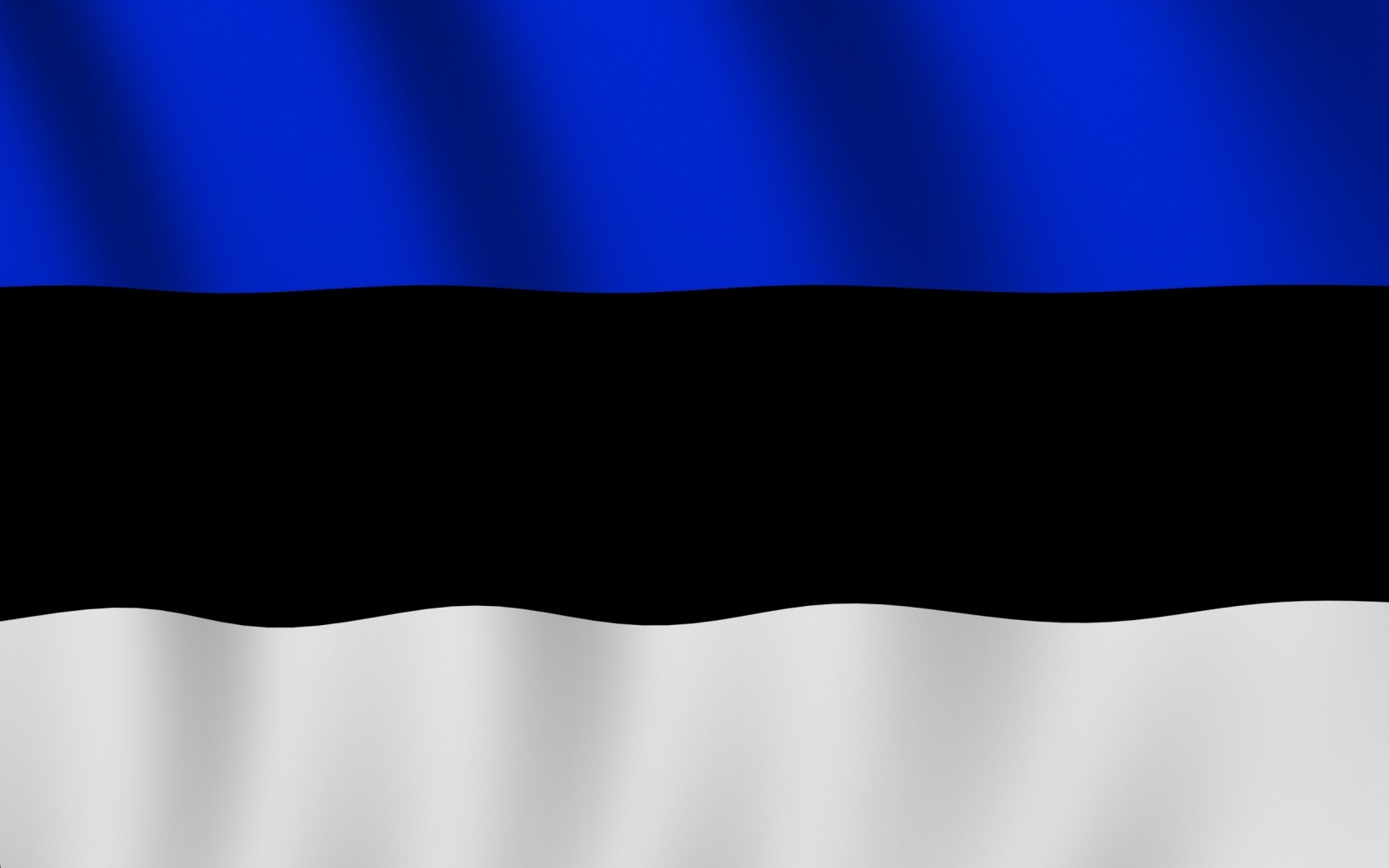
Estonia & Ron Paul

On August 20, 1991, Estonia issued a decision to re-establish independence on the basis of historical continuity of the Baltic country’s pre-World War II statehood, sloughing off Soviet rule since 1940.


On August 20, 1935, Ron Paul was born. Paul is now famous for his heroic congressional record, his several presidential campaigns, and for books such as End the Fed and Liberty Defined.

Categories
Today

Patriotism & Protest & Ousting

On August 19, 1919, Afghanistan gained full independence from Great Britain. The British attempts to maintain an imperial presence in this region elicited an earlier, infamous essay in protest by English sociologist and anti-imperialist Herbert Spencer (pictured), “Patriotism” (Facts and Comments, 1902).

On this day in 1991, Soviet President Mikhail Gorbachev was placed under house arrest, a crucial event leading to the dissolution of the Soviet Union.

In 1999, a mass rally of Serbians demanded the resignation of Slobodon Milosevic.

Categories
Today

Nineteenth on the Eighteenth

On August 18, 1920, the Nineteenth Amendment to the United States Constitution was ratified, guaranteeing women’s suffrage.

Categories
Today

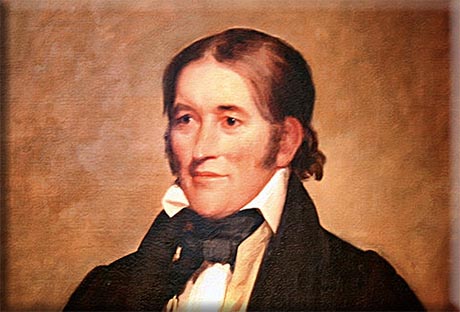
David Crockett

On August 17, 1786, American backwoods hero and politician, David Crockett, was born. Famous as a politician, he brought personal principle and honor and a “common sense” approach in representing Tennessee in the U.S. House of Representatives. He later played a part in the Texas Revolution, dying at the Battle of the Alamo.

Crockett grew up in East Tennessee, where he gained a reputation for hunting and storytelling, which helped make him a legend in his own time. After being made a colonel in the militia of Lawrence County, Tennessee, he was elected to the Tennessee state legislature in 1821.

In 1825, Crockett was elected to the U.S. Congress, where he vehemently opposed many of the policies of President Andrew Jackson, most notably the Indian Removal Act.

Crockett wrote a number of books, including a biography of Martin Van Buren.

Categories
Today

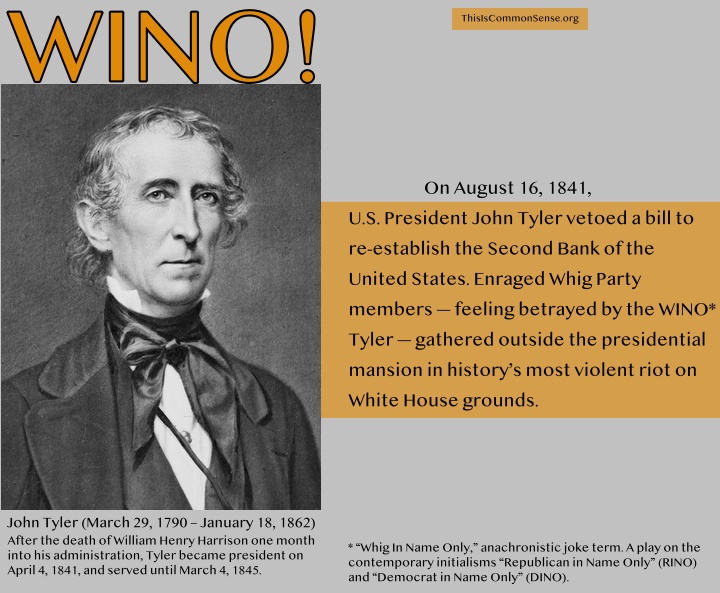
The WINO!

On August 16, 1841, U.S. President John Tyler vetoed a bill to re-establish the Second Bank of the United States. Enraged Whig Party members — feeling betrayed by the WINO* Tyler — gathered outside the presidential mansion in history’s most violent demonstration on White House grounds.


* “Whig In Name Only,” anachronistic joke term. A play on the contemporary initialisms “Republican in Name Only” (RINO) and “Democrat in Name Only” (DINO).

Categories
Today

The Signal & the Window

On August 15, 2012, a complex, high-powered radio transmission was sent from the Arecibo Observatory in Puerto Rico towards the constellation Sagittarius. The signal consisted of a digital stream of approximately 10,000 Twitter messages solicited for the purpose by the National Geographic Channel, bearing the hashtag “#ChasingUFOs” (a promotion for one of the channel’s TV series). The sponsor also included a series of video vignettes featuring verbal messages from various celebrities.

The transmission was sent on the 35th anniversary of the reception of a mysterious signal that was interpreted as an alphanumeric sequence, “6EQUJ5,” dubbed the “Wow!” signal, from the general direction of the star Tau Sagittarius. This signal was received by Ohio State University’s Big Ear radio telescope in the United States, and was noticed a few days after August 15, 1978, by astronomer Jerry R. Ehman.


On August 15 in 1971, President Richard Nixon ended convertibility of the United States dollar into gold by foreign investors. The dollar has remained fiat money ever since, but — mysteriously! — did not succeed in retaining its previous value.

But then, the dollar under the previous quasi-gold, Bretton-Woods Agreement wasn’t stable either, which is why Nixon felt compelled to close the gold window.

Categories
Today

They Led

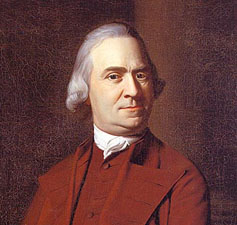
On August 14, 1765, Sam Adams led the first rebel mob against enforcers of the Stamp Act in Britain’s American colonies.

On this day in 1980, Lech Wałęsa led strikes at the Gdańsk, Poland, shipyards.