On April 20, 1657, freedom of religion was granted to the Jews of New Amsterdam, which was later renamed New York City.
New Amsterdam
On April 20, 1657, freedom of religion was granted to the Jews of New Amsterdam, which was later renamed New York City.
On April 19, 1775, the American Revolution began when the “shot heard around the world” was fired between the 700 British troops on a mission to capture Patriot leaders Sam Adams and John Hancock and to seize a Patriot arsenal and the 77 armed minutemen under Captain John Parker waiting for them on the Lexington town green. The Battle of Lexington ended with eight Americans killed and ten wounded, along with one wounded British soldier.
In Concord, a couple of hours later, British troops were encircled by hundreds of armed Patriots. The British commander ordered his men to return to Boston without directly engaging the Americans, but on the 16-mile journey they were constantly attacked by Patriot marksmen firing at them Indian-style from behind trees, rocks, and stone walls. By the time the British reached the safety of Boston, nearly 300 soldiers had been killed, wounded, or were missing in action. The Patriots suffered fewer than 100 casualties.
On April 19, 1782, John Adams secured the Dutch Republic’s recognition of the United States as an independent government.
April 18 marks the 1772 birthday of David Ricardo, English political economist and one of the most influential thinkers in economic theory. An advocate for free trade and the abolition of slavery, Ricardo’s most famous work is his Principles of Political Economy and Taxation (1817).
April 17 marks the 1937 birth of Ronald Hamowy, Canadian historian, who first came to international prominence for his writings in the short-lived but influential New Individualist Review. Hamowy died in 2012.
April 17, 1907 — The Ellis Island immigration center processed 11,747 immigrants, more than on any other day.
April 17, 1942 — French prisoner of war General Henri Giraud escaped from his castle prison in Königstein Fortress.
April 17, 1969 – Communist Party of Czechoslovakia chairman Alexander Dubček was deposed.
Dr. Martin Luther King, Jr., penned his Letter from Birmingham Jail while incarcerated in Birmingham, Alabama, for protesting segregation, on April 16, 1963.
On April 15, 1945, the Bergen-Belsen concentration camp was liberated.
On April 14, 1775, the Society for the Relief of Free Negroes Unlawfully Held in Bondage, the first American organization committed to the abolition of slavery, was formed in Philadelphia.
On April 14, 1818, Noah Webster published his American Dictionary of the English Language, one of the first lexicons to include distinctly American words. The dictionary, which took him more than two decades to compile, introduced more than 10,000 “Americanisms.”
On April 14, 1988, representatives of the Soviet Union, Afghanistan, the United States, and Pakistan signed an agreement calling for the withdrawal of Soviet forces from Afghanistan. In exchange for an end to the disputed Soviet occupation, the United States agreed to end its arms support for the Afghan anti-Soviet factions, and Afghanistan and Pakistan agreed not to interfere in each other’s affairs.
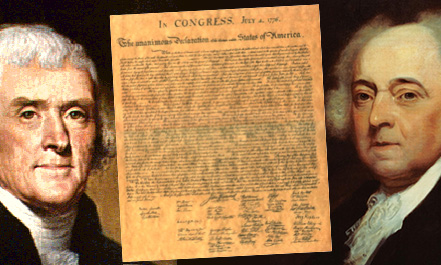
On April 13, 1743, Thomas Jefferson was born. Author of Notes on the State of Virginia and the first draft of the United States’ Declaration of Independence, Jefferson was also a scientist, philosopher, inventor, diplomat, and American politician. He also composed music, designed buildings, and translated works from his favorite French writers, whom he had met in his diplomatic missions to Paris: Volney and de Tracy.
On April 12, 1914, American economist Armen Alchian was born. His contributions to economic theory and teaching were many and varied — his textbook, co-authored with William R. Allen, University Economics (also titled Exchange and Production), was widely considered one of the finest intermediate texts in microeconomics — but he remains perhaps best known for his work on property rights.
Alchian died in 2014, in late February, at the age of 99.
Fourteen years later, on April 9, 1928, American mathematician, singer-songwriter, satirist, and pianist Tom Lehrer was born. He is best known for the pithy, humorous songs he recorded in the 1950s and ’60s, often parodying popular song forms, though he usually created original melodies when doing so. Standouts in black humor as in “I Hold Your Hand in Mine,” “The Irish Ballad,” and “Poisoning Pigeons in the Park” vie for fan attention with songs dealing with social and political issues of the day, particularly when he wrote for the U.S. version of the television show That Was the Week That Was. These latter included “Pollution,” “We Will All Go Together When We Go” (a rousing nuclear Armageddon anthem), “Werner von Braun” (an arch look at America’s paperclip hero), and “The Vatican Rag” (memorializing Vatican III reforms).
In October and November of 2020, Mr. Lehrer relinquished all his musical works into the public domain. See his still-existing website Tom Lehrer Songs.
On April 11, 1945, the American Third Army liberated the Buchenwald concentration camp, near Weimar, Germany, a camp that would later be judged second only to Auschwitz in the horrors it imposed on its prisoners.
Among those in the camp saved by the American soldiers was Elie Wiesel, who would go on to win the Nobel Peace Prize in 1986.
Shown in photograph: German citizens ushered to the camp by American soldiers, post-conquest.