Categories
Today

An Attack

On April 12, 1861, the Confederate attack on Fort Sumter marked the start of the American Civil War. Firing on the Union-held fort for 34 hours, the Confederate bombardment killed no soldiers in the exchange of artillery fire.

The Union garrison, led by Major Robert Anderson, surrendered on April 13, 1861, and was allowed to evacuate without loss of life.

During the evacuation on April 14, however, a Union soldier, Private Daniel Hough, was killed, and another, Private Edward Galloway, was mortally wounded due to an accidental explosion of a cannon during a salute to the U.S. flag. These are the only recorded deaths associated with the Fort Sumter incident.

Categories
Today

Buchenwald

On April 11, 1945, the American Third Army liberated the Buchenwald concentration camp, near Weimar, Germany, a camp that would later be judged second only to Auschwitz in the horrors it imposed on its prisoners.

Among those in the camp saved by the American soldiers was Elie Wiesel, who would go on to win the Nobel Peace Prize in 1986.


Shown in photograph: German citizens ushered to the camp by American soldiers, post-conquest.

Categories
Today

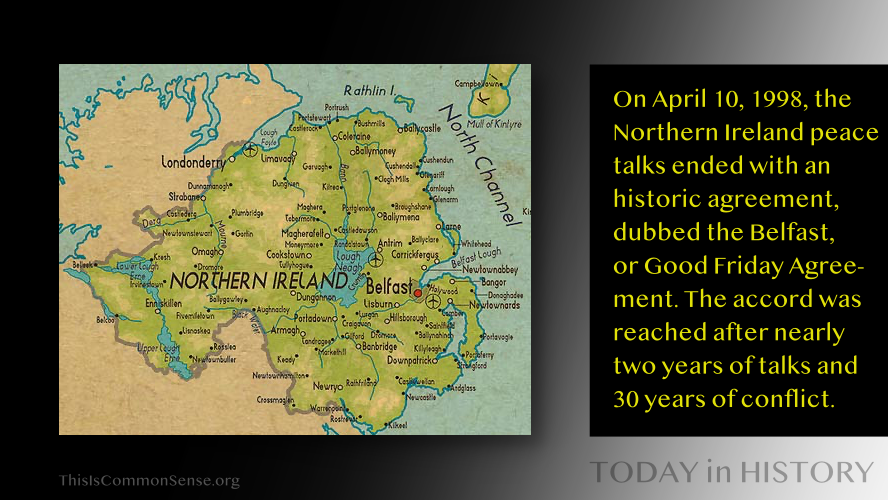
Good Friday Agreement

On April 10, 1998, the Northern Ireland peace talks ended with an historic agreement, dubbed the Belfast, or Good Friday Agreement. The accord was reached after nearly two years of talks and 30 years of conflict.

The agreement was approved by voters across the island of Ireland in two referendums held on May 22, 1998. The agreement came into force on December 2, 1999. 

Categories
Today

Näfels

Despite being outnumbered 16 to one, forces of the Old Swiss Confederacy proved victorious over the Archduchy of Austria in the Battle of Näfels, April 9, 1388.


On this date in 1991, Georgia declared its independence from the Soviet Union.

Categories
Today

The 17th Amendment

On April 8, 1913, the 17th amendment to the Constitution, providing for the popular election of U.S. senators, was ratified.

Prior to this, senators had been appointed by state legislatures. It was John Dickinson of Delaware who suggested that the Senate be selected by state legislatures. “The combination of the state governments with the national government was as politic as it was unavoidable,” he argued. But as early as 1826, resolutions calling for direct popular election of senators appeared in the House of Representatives, but none succeeded. Following the Civil War, disputes among state legislators over Senate elections resulted in deadlocks, leaving some Senate seats vacant for long periods — Delaware remained without representation in the U.S. Senate for two years. In light of such problems, reformers in many states began calling for a change to the system of electing senators. In 1906, publisher William Randolph Hearst, a proponent of direct election, hired novelist David Graham Phillips to write a number of articles on the subject. Phillips’ series, “The Treason of the Senate,” portrayed senators as pawns of industrialists and financiers — with no small amount of hyperbole (to put it politely). The articles further galvanized public support for reform. 

Senator Joseph Bristow of Kansas offered, in 1911, a Senate resolution to amend the Constitution. In two years the Constitution was amended.

Categories
Today

Prohibition Begins to End

On April 7, 1933, Prohibition in the United States was repealed for beer of no more than 3.2 percent alcohol by weight — eight months before the ratification of the 21st amendment, which repealed the 18th (or Prohibition) Amendment.

The enabling legislation was the Cullen-Harrison Act, which figured the low alcohol content as the excuse to get around the 18th Amendment’s prohibition of intoxicating beverages. The act passed Congress on March 21, 1933, and was signed into law by Franklin Delano Roosevelt the next day.

Categories
Today

Salt Rebel

On April 6, 1930, Mohandas K. Gandhi raised a lump of mud and salt, declaring, “With this, I am shaking the foundations of the British Empire.”

Thus began the Salt Satyagraha.

Categories
Today

One of Two Washington Vetos

On April 5, 1792, George Washington exercised the first presidential veto of a congressional bill, a new plan for dividing seats in the House of Representatives, which would have increased the number of seats for northern states.

Washington vetoed only one other bill during his two terms in office, an act that would have reduced the number of cavalry units in the army.

Categories
Today

Tippecanoe and Tyler Next

On April 4, 1841, William Henry Harrison died of pneumonia, becoming the first President of the United States to die in office and the one with the shortest term served (he died on his 32nd day as president). A renowned Indian killer (having risen to fame for his part in 1811’s Battle of Tippecanoe), a proponent of the expansion of slavery into Northwest Territories, and a Whig, Harrison won the presidency in part by turning the Democrats’ “log cabin and hard cider” aspersions on his character as the basic symbols of the campaign.

Though hardly a “limited government man,” some limited government history buffs proclaim him the Greatest President, on the ostensibly droll and possibly cynical grounds that he spent so little time in office.

The campaign slogan of 1840, “Tippecanoe and Tyler Too,” proved an actual campaign promise, as Vice President John Tyler took over the job of the presidency, establishing a precedent on presidential succession that would later be enshrined into constitutional law, in the form of the Twenty-fifth Amendment.

Categories
Today

To the Mountaintop

On April 3, 1968, Martin Luther King, Jr., delivered his “I’ve Been to the Mountaintop” speech.