Categories
Today

Out the Window!

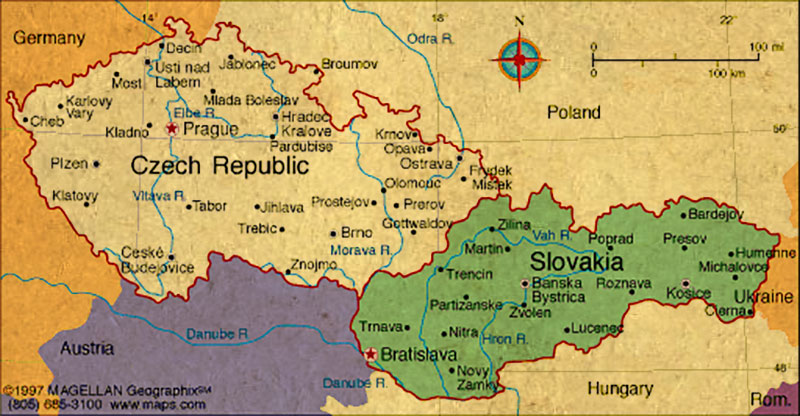
July 30, 1419, the First Defenestration of Prague: Jan Želivský, a Hussite priest at the church of the Virgin Mary of the Snows, led his congregation on a procession through the streets of Prague to the New Town Hall, on Charles Square. While they were marching, a stone was thrown at Želivský from the window of the town hall. The mob, enraged, stormed the hall. Once inside, the group threw the judge, the burgomaster, and some thirteen members of the town council out of the window and into the street, where they were killed by the fall or dispatched by the mob.

King Wenceslaus IV of Bohemia, upon hearing this news, was so stunned, the legend goes, that he died soon after.

On July 30, 1619, the first representative assembly in the Americas, the House of Burgesses, convened for the first time in Jamestown, Virginia. On the same date in 1676, Nathaniel Bacon issued the “Declaration of the People of Virginia,” beginning Bacon’s Rebellion against the rule of Governor William Berkeley.

On this date in 1863, representatives of the United States and tribal leaders (including the Shoshone’s Chief Pocatello) signed the Treaty of Box Elder.

July 30 birthdays include Henry Ford (1863), Gen. Smedley Butler (1881), C. Northcote Parkinson (1909), and former California Governor Arnold Schwarzenegger (1947).

Vanuatuans celebrate Independence Day on July 30.

Categories
Today

Tocqueville

On July 29, 1805, Alexis de Tocqueville was born. His most famous book, Democracy in America (two volumes: 1835, 1840), quickly became a classic of social and political research and analysis, and remains the most important early book about the United States of America. He is often referred to as a founder of sociology as well as a major figure in the development of classical liberalism.

Categories
Today

The Fourteenth

July 28, 1868, is the official date for the certification of the 14th Amendment to the Constitution of the United States.

Categories
Today

B of E

July 27 births include that of Samuel Smith (1752), an American who served as a captain, major, and lieutenant colonel in the Continental Army, and later as a politician in several capacities in the state of Maryland; Hilaire Belloc (1870), author of a classic analysis of modern political governance, The Servile State; and American singer and songwriter Bobbie Gentry (1944).

On July 27, 1694, the Bank of England received a royal charter, beginning a long history of central banking in England. Subsequent inflationary booms and deflationary busts are usually considered “mysterious” by people connected with the bank.

Categories
Today

Atahualpa

On July 26, 1533, Francisco Pizarro’s Spanish conquistadors strangled to death Atahualpa, the 13th and last emperor of the Incas, thereby ending 300 years of Inca civilization. The conquistadors were greedy and murderous, but the Inca civilization, arguably, was worse: totalitarian and radically inegalitarian. But they made great high-mountain roads. (Arguments about infrastructure promoted by Big Government continue to this very day. And it is quite possible that an earlier civilization made the roadways, which the Inca merely renovated.)

On this day in 1948, U.S. President Harry S. Truman signed Executive Order 9981 desegregating the U.S. military.

Categories
Today

A Fine Point of the War

On July 25, 1861, the U.S. Congress passed the Crittenden-Johnson Resolution, stating that the war with the seceded states of the Confederacy was being fought to preserve the Union, not to end slavery.

Categories
Today

Splashdown!

On July 24, 1487, citizens in Leeuwarden, Netherlands, went on strike against a ban on foreign beer.

On the same day of 1823’s calendar, slavery was abolished in Chile.

Today marks the 50th anniversary of the splashdown of the Apollo 11 capsule into the Pacific Ocean. Astronauts Michael Collins, Buzz Aldrin, and Neil Armstrong spent more than eight days in space. The mission included 30 orbits of Earth’s satellite and a landing upon the lunar surface, an important milestone, so to speak, in humanity’s history of exploration. The astronauts brought back with them over 47 pounds of lunar rock, gravel, and dust.

On this day in 1974, the U.S. Supreme Court told President Richard Nixon that he lacked constitutional authority to withhold the infamous “Nixon Tapes” from Congress.

July 24 serves as Pioneer Day in Utah and as Simón Bolívar Day in Bolivia, Ecuador, Colombia, and Venezuela.

Categories
Today

Typewriter

On this day in 1829, American William Austin Burt patents the “typographer” — a precursor to the typewriter.

Categories
Today

Only Nine?

On July 22, 1937, the U.S. Senate voted down Franklin Delano Roosevelt’s court packing scheme.

Categories
Today

Of Monkeys & the Moon

On July 21, 1925, in Dayton, Tennessee, high school biology teacher John T. Scopes was found guilty of teaching evolution in a public school classroom, and fined $100. The ambiguous legacy of the trial would continue — for decades, even to the present — to reveal the tensions inherent within a school system run by government and funded by taxpayers.


Pictured above, publicity for Inherit the Wind, a 1960 movie about the trial, but with the names changed, fictionalized. The movie starred Spencer Tracy in the Clarence Darrow (lawyer for the defense) role; Frederic March in the prosecutorial part, “Matthew Harrison Brady,” the pseudonymous name for politician William Jennings Bryan; Dick York as the defendant, Mr. Scopes; and Gene Kelly as the Baltimore journalist, a stand-in for H. L. Mencken, whose infamous coverage of the story shocked the nation almost as much as the trial itself. It was Mencken who dubbed the affair “The Scopes ‘Monkey’ Trial.”

At the end of the movie (spoiler alert!) the famous prosecutor dies in the courtroom. In the historical case, Bryan died five days after the verdict. The movie was based on the 1955 play of the same name, written by Jerome Lawrence and Robert Edwin Lee, directed by Stanley Kramer. The script was adapted by Nedrick Young (originally as Nathan E. Douglas) and Harold Jacob Smith.


Today is the 50th anniversary of the Apollo 11 mission’s perambulation upon the Moon, on July 21, 1969. Neil Armstrong and Buzz Aldrin walked upon the surface of Mare Tranquillitatis for about two hours and 15 minutes. They spent over 21 hours on the surface, total, most of it inside the Lunar Module, at the site they called Tranquillity Base, before launching to rejoin astronaut Michael Collins in lunar orbit, and returning to Earth on July 24.