On July 21, 1925, in Dayton, Tennessee, high school biology teacher John T. Scopes was found guilty of teaching evolution in a public school classroom, and fined $100. The ambiguous legacy of the trial would continue — for decades, even to the present — to reveal the tensions inherent within a school system run by government and funded by taxpayers.
Interesting fact rarely noted: Scopes was teaching a heavily “eugenics” view, which would hardly be considered scientific by most modern standards.
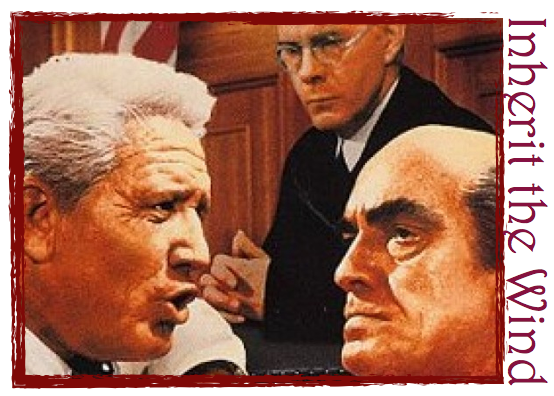
Pictured above, publicity for Inherit the Wind, a 1960 movie about the trial, but with the names changed, fictionalized. The movie starred Spencer Tracy in the Clarence Darrow (lawyer for the defense) role; Frederic March in the prosecutorial part, “Matthew Harrison Brady,” the pseudonymous name for politician William Jennings Bryan; Dick York as the defendant, Mr. Scopes; and Gene Kelly as the Baltimore journalist, a stand-in for H. L. Mencken, whose infamous coverage of the story shocked the nation almost as much as the trial itself. It was Mencken who dubbed the affair “The Scopes ‘Monkey’ Trial.”
At the end of the movie (spoiler alert!) the famous prosecutor dies in the courtroom. In the historical case, Bryan died five days after the verdict. The movie was based on the 1955 play of the same name, written by Jerome Lawrence and Robert Edwin Lee, directed by Stanley Kramer. The script was adapted by Nedrick Young (originally as Nathan E. Douglas) and Harold Jacob Smith.
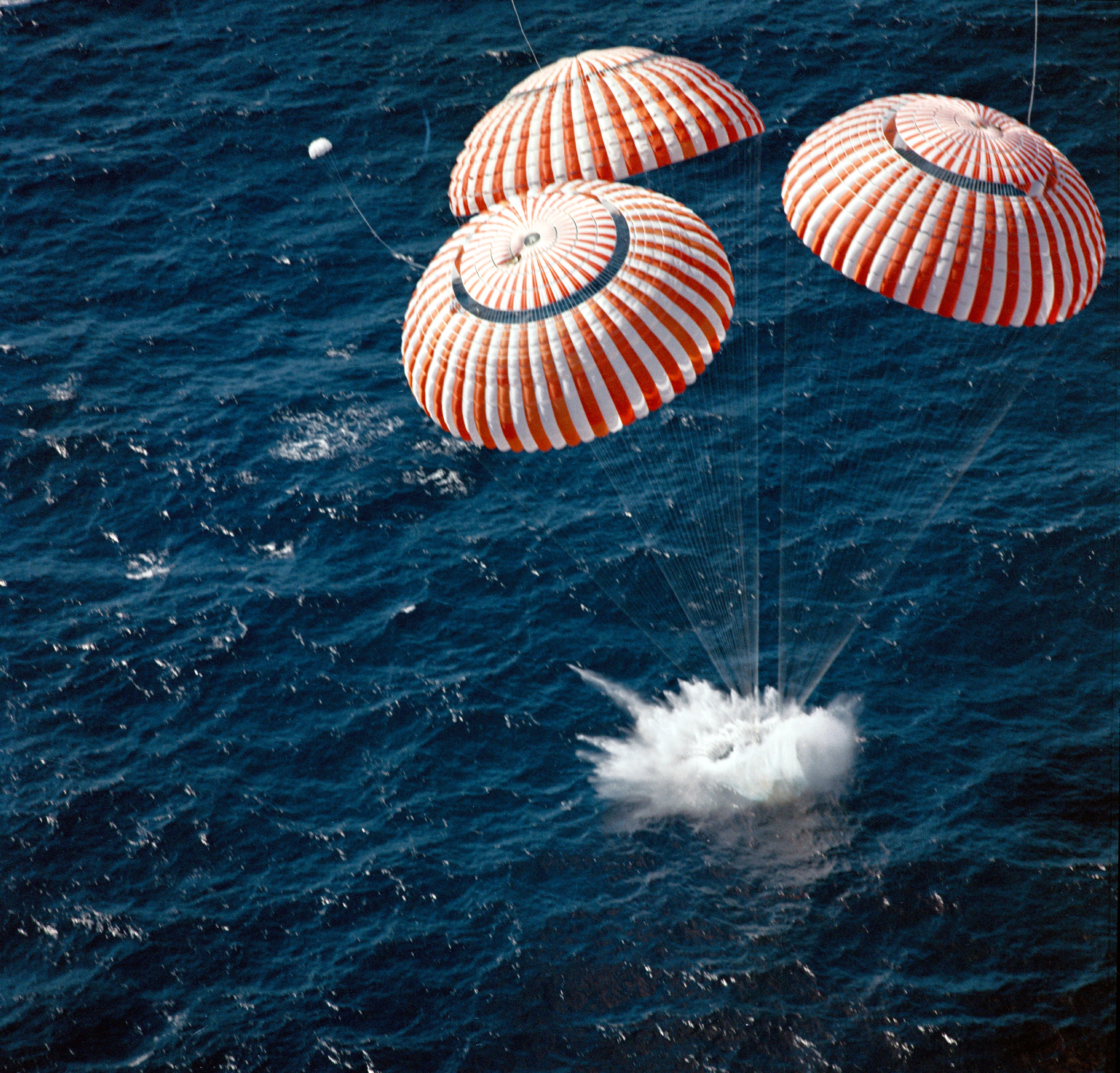
Today is the 51st anniversary of the Apollo 11 mission’s perambulation upon the Moon, on July 21, 1969. Neil Armstrong and Buzz Aldrin walked upon the surface of Mare Tranquillitatis for about two hours and 15 minutes. They spent over 21 hours on the surface, total, most of it inside the Lunar Module, at the site they called Tranquillity Base, before launching to rejoin astronaut Michael Collins in lunar orbit, and returning to Earth on July 24.