Categories
Thought

Eugen von Böhm-Bawerk

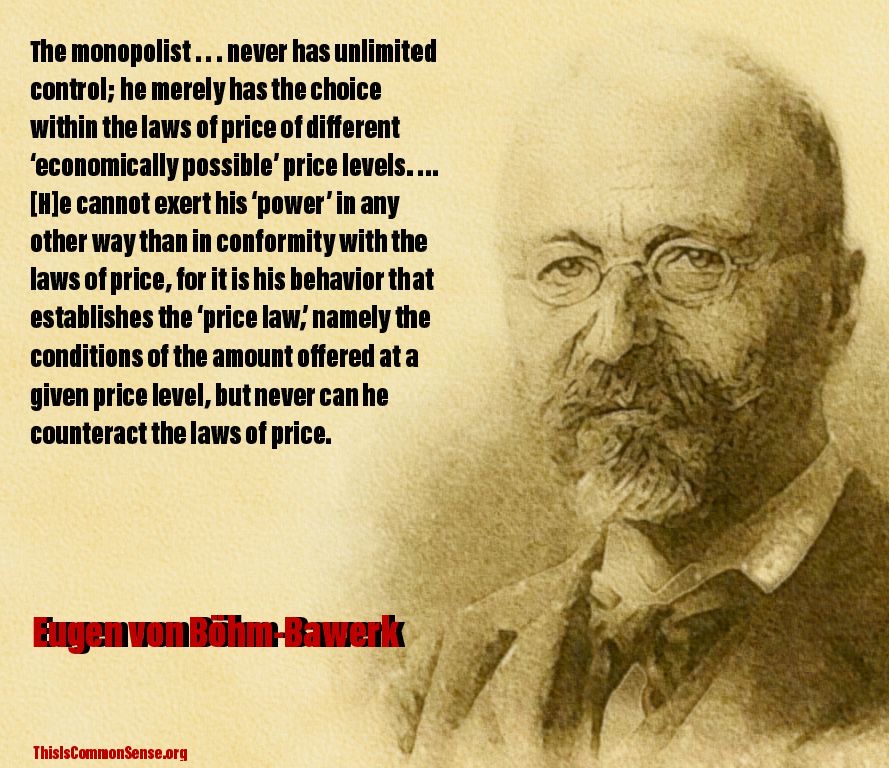
The monopolist . . . never has unlimited control; he merely has the choice within the laws of price of different ‘economically possible’ price levels. He can select that price at which the combination of profit for each article, and the number of articles to be sold at that price, are likely to promise the greatest total profit, but he cannot exert his ‘power’ in any other way than in conformity with the laws of price, for it is his behavior that establishes the ‘price law,’ namely the conditions of the amount offered at a given price level, but never can he counteract the laws of price.

Eugen von Böhm-Bawerk, “Control or Economic Law,” Zeitschrift für Volkswirtshaft, Sozialpolitik und Verwaltung, Volume XXIII (1914): 205–71; John Richard Mez, Ph.D., translator.
Categories
Thought

Alexander von Humboldt

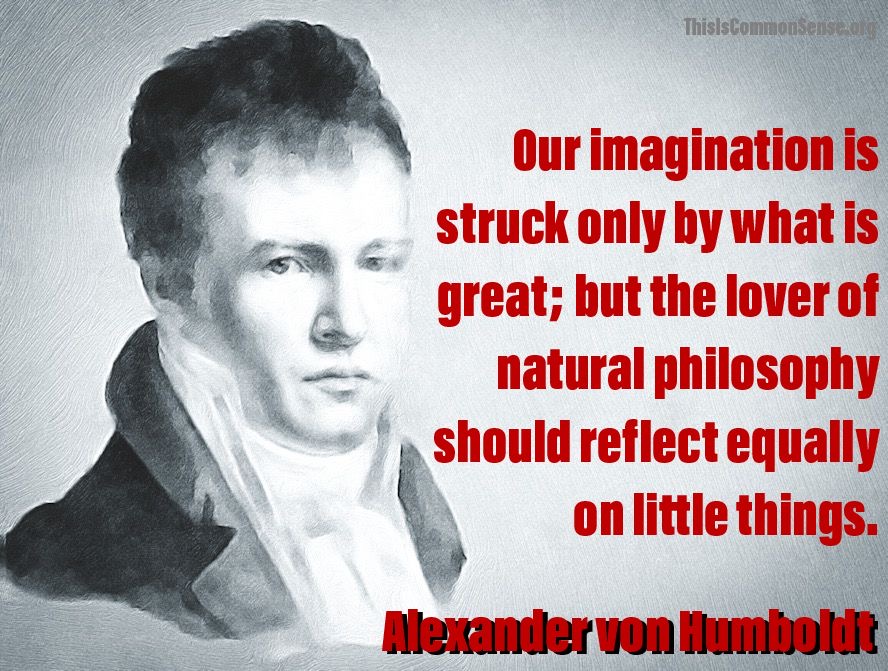
Our imagination is struck only by what is great; but the lover of natural philosophy should reflect equally on little things.

Alexander von Humboldt, Equinoctial Regions of America (1814-1829).
Categories
Thought

Eugen von Böhm-Bawerk

[T]here is one . . . thing that not even the most imposing dictate of power will accomplish: It can never effect anything in contradiction to the economic laws of value, price, and distribution; it must always be in conformity with these; it cannot invalidate them; it can merely confirm and fulfill them.

Eugen von Böhm-Bawerk, “Control or Economic Law,” Zeitschrift für Volkswirtshaft, Sozialpolitik und Verwaltung, Volume XXIII (1914): 205–71; John Richard Mez, Ph.D., translator.
Categories
Thought

Christoph Probst

Every word that comes from Hitler’s mouth is a lie. When he says peace, he means war, and when he blasphemously uses the name of the Almighty, he means the power of evil, the fallen angel, Satan. His mouth is the foul-smelling maw of Hell, and his might is at bottom accursed. True, we must conduct a struggle against the National Socialist terrorist state with rational means; but whoever today still doubts the reality, the existence of demonic powers, has failed by a wide margin to understand the metaphysical background of this war.

From the fourth leaflet by “The White Rose,” composed by Christoph Probst (tried & executed by the German Reich on February 22, 1943).
Categories
Thought

H.L. Mencken

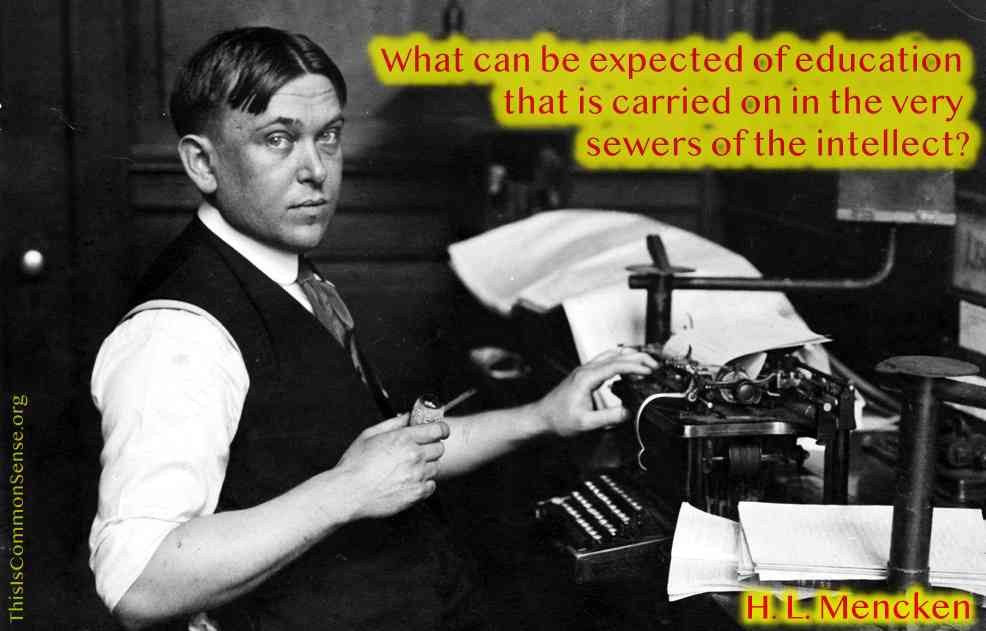
I have maintained for years, sometimes perhaps with undue heat: that pedagogy in the United States is fast descending to the estate of a childish necromancy, and that the worst idiots, even among pedagogues, are the teachers of English. It is positively dreadful to think that the young of the American species are exposed day in and day out to the contamination of such dark minds. What can be expected of education that is carried on in the very sewers of the intellect? How can morons teach anything that is worth knowing?

H.L. Mencken, On ”Teachers of English” in “The Schoolmarm’s Goal” in The Lower Depths: A Play in Four Acts (1925).
Categories
Thought

Kurt Huber

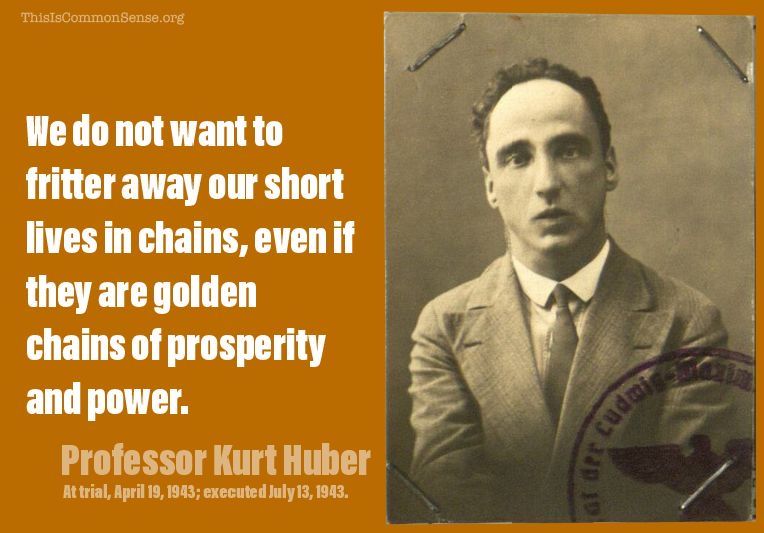
We do not want to fritter away our short lives in chains, even if they are golden chains of prosperity and power.

Professor Kurt Huber of The White Rose pamphleteers, at trial on April 19, 1943. He was executed on July 13, 1943.
Categories
Thought

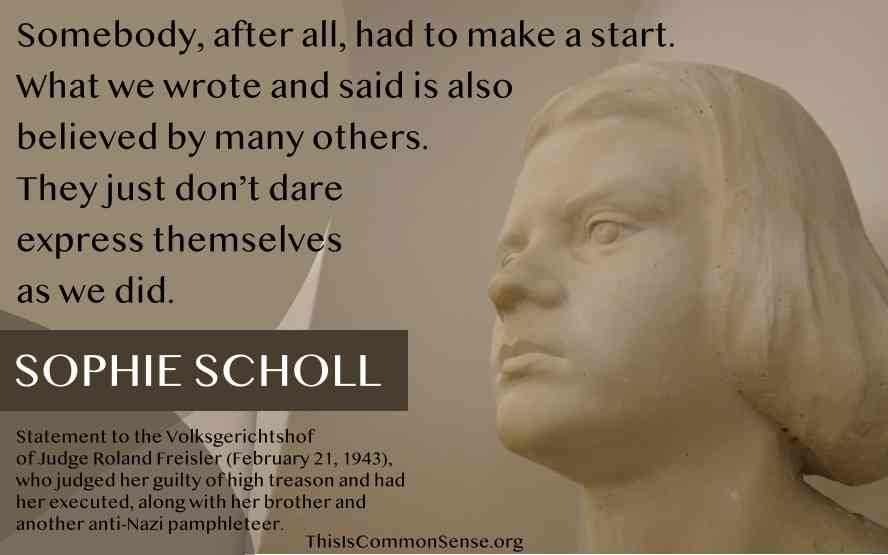
Sophie Scholl

Somebody, after all, had to make a start. What we wrote and said is also believed by many others. They just don’t dare express themselves as we did.

Sophie Scholl, testimony before the “People’s Court” (Volksgerichtshof) of Judge Roland Freisler (February 21, 1943). Search for more about their group, “The White Rose,” and their pamphlets, on this website.
Categories
Thought

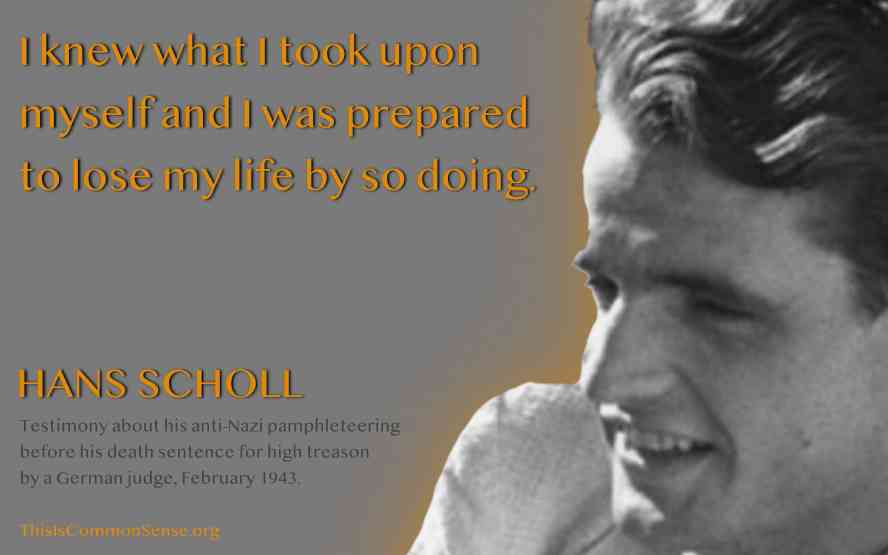
Hans Scholl

I knew what I took upon myself and I was prepared to lose my life by so doing.

Hans Scholl’s explanation of his and his sister Sophie’s opposition to Germany regime. He and his sister were beheaded by the German government on February 22, 1943, having been found guilty of high treason for writing, producing and distributing political pamphlets.
Categories
Thought

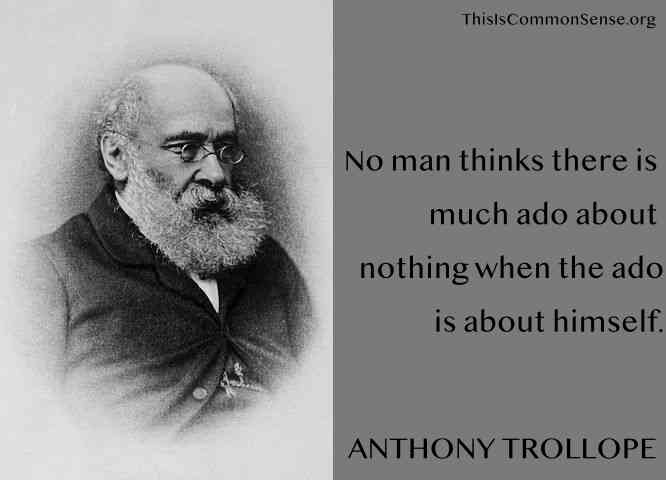
Anthony Trollope

No man thinks there is much ado about nothing when the ado is about himself.

Anthony Trollope, The Bertrams (1859), Ch. 27.
Categories
Thought

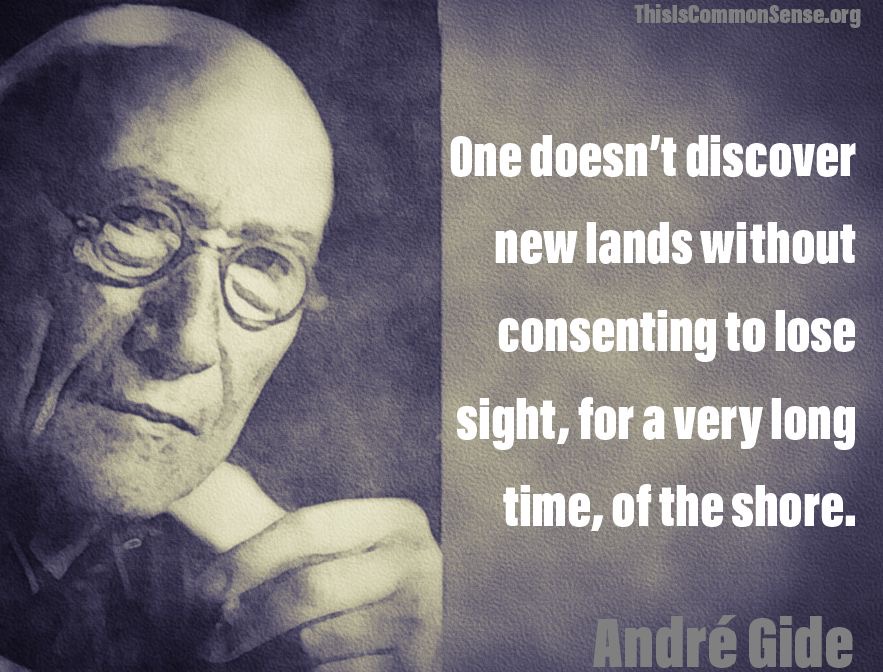
André Gide

On ne découvre pas de terre nouvelle sans consentir
à perdre de vue, d’abord et longtemps, tout rivage.

One doesn’t discover new lands without consenting to lose sight, for a very long time, of the shore.

André Gide, Les faux-monnayeurs [The Counterfeiters] (1925).