Categories
Thought

Arthur Latham Perry

Suppose for a moment, that all taxes of every name could be abolished instantaneously, and the Governments, like the Israelites, live on manna for forty years. What harm would ensue? What industry would decline? Who would be impoverished? What stimulus to work and save and grow rich would be weakened thereby? Would not wages, and profits, and rents, all be lifted thereby, with no damage to anybody? A child can see that Taxes from their very nature are a burden, are a subtraction from income, are a minus and not a plus. Who, then, except from sinister motives, can imagine and represent, that Taxes are a good in themselves, a positive blessing, a spur to the progress of Society?

Arthur Latham Perry, Principles of Political Economy (1891).
Categories
Thought

Bliss Perry

Wherever a mob can gather, there are still the dangers of the old demagogic vocabulary and rhetoric. The mob state of mind is lurking still in the excitable American temperament.

The intellectual temptations of that temperament are revealed no less in our popular journalism. This journalism, it is needless to say, is extremely able, but it is reckless to the last degree. The extravagance of its head-lines and the over-statements of its news columns are direct sources of profit, since they increase the circulation and it is circulation which wins advertising space. I think it is fair to say that the American people, as a whole, like precisely the sort of journalism which they get. The tastes of the dwellers in cities control, more and more, the character of our newspapers.

Bliss Perry, The American Mind (1912), p. 67.
Categories
Thought

Arthur Latham Perry

By far the most important of all the conditions, under which the production of material commodities goes broadly forward, is liberty of action on the part of the individual; because, wherever such liberty is conceded, association and invention and all other needful conditions follow right along by laws of natural sequence.

Arthur Latham Perry, Principles of Political Economy, 1891.
Categories
Thought

Bliss Perry

“To be an American,” it has been declared, “is to be a radical.” That statement needs qualification. Intellectually the American is inclined to radical views; he is willing to push certain social theories very far; he will found a new religion, a new philosophy, a new socialistic community, at the slightest notice or provocation; but he has at bottom a fund of moral and political conservatism. Thomas Jefferson, one of the greatest of our radical idealists, had a good deal of the English squire in him after all. Jeffersonianism endures, not merely because it is a radical theory of human nature, but because it expresses certain facts of human nature. The American mind looks forward, not back; but in practical details of land, taxes, and governmental machinery we are instinctively cautious of change. 

Bliss Perry, The American Mind (1912), p. 77.
Categories
Thought

H. Beam Piper

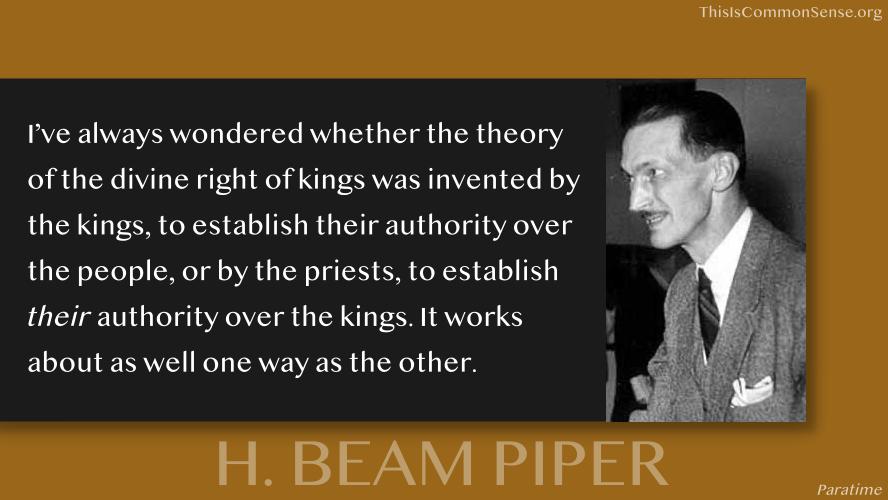
I’ve always wondered whether the theory of the divine right of kings was invented by the kings, to establish their authority over the people, or by the priests, to establish their authority over the kings. It works about as well one way as the other.

H. Beam Piper, “Temple Trouble” (Astounding Science Fiction, April 1951), collected in Paratime (1981) and The Complete Paratime (2001).

Categories
Thought

Vernor Vinge

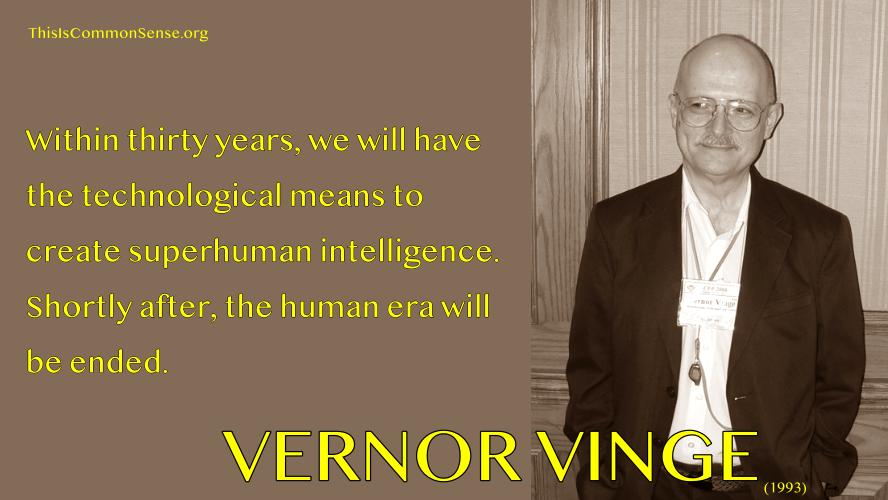
Within thirty years, we will have the technological means to create superhuman intelligence. Shortly after, the human era will be ended.

Computer scientist and science fiction author Vernor Vinge (1944–2024), “The Coming Technological Singularity” (presented at the VISION-21 Symposium sponsored by NASA Lewis Research Center and the Ohio Aerospace Institute, March 30–31, 1993.)
Categories
Thought

J. G. Ballard

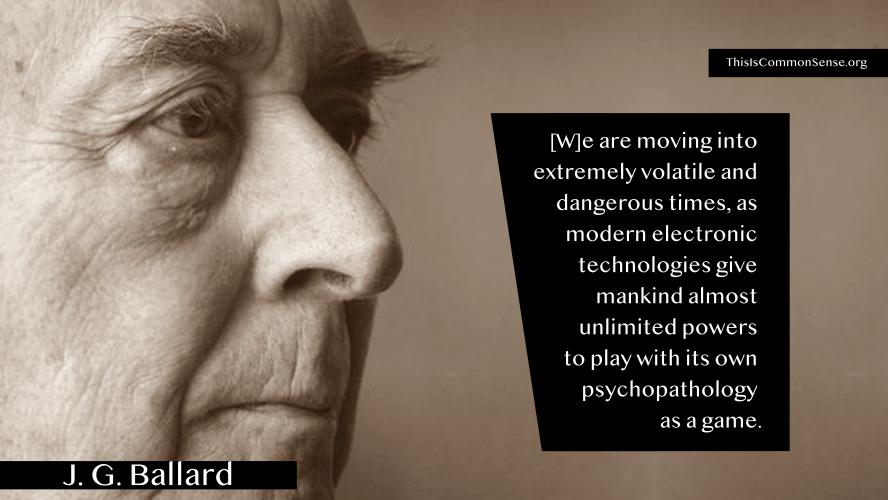
For the sake of my children and grandchildren, I hope that the human talent for self-destruction can be successfully controlled, or at least channelled into productive forms, but I doubt it. I think we are moving into extremely volatile and dangerous times, as modern electronic technologies give mankind almost unlimited powers to play with its own psychopathology as a game.

J. G. Ballard, as interviewed by Jean-Paul Coillard, “JG Ballard: Theatre of Cruelty,” Disturb (1998).
Categories
Thought

Alfred Bester

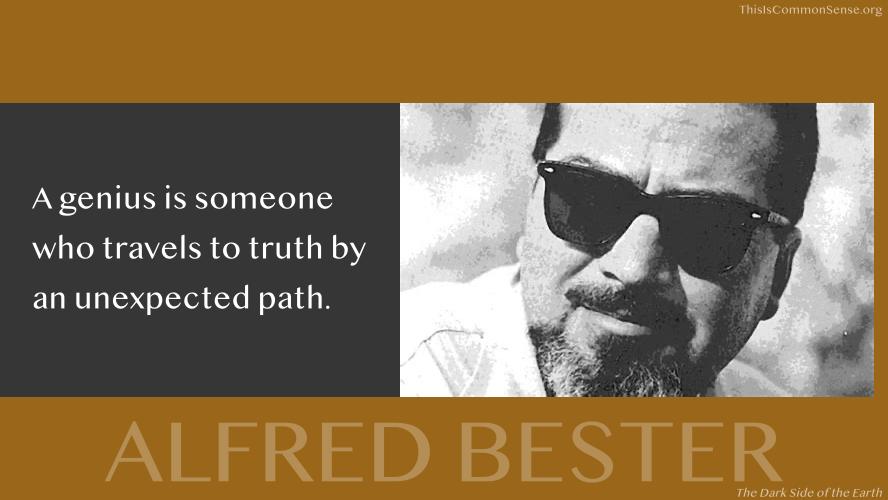
Now, these men weren’t idiots. They were geniuses who paid a high price for their genius because the rest of their thinking was other-world. A genius is someone who travels to truth by an unexpected path. Unfortunately, unexpected paths lead to disaster in everyday life.

Alfred Bester, “The Men Who Murdered Mohammed,” The Magazine of Fantasy & Science Fiction, October 1958; reprinted in The Dark Side of the Earth (1964) and David Hartwell, ed., The World Treasury of Science Fiction, p. 268.

Categories
Thought

H. Beam Piper

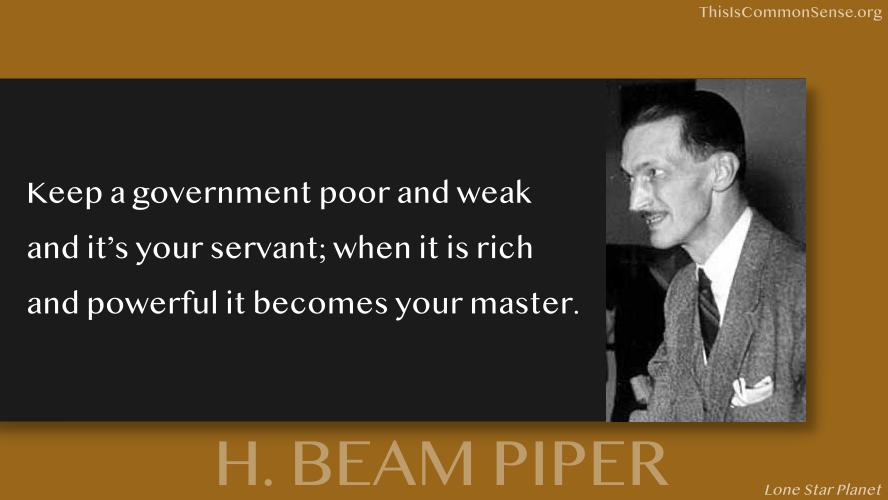
Keep a government poor and weak and it’s your servant; when it is rich and powerful it becomes your master.

The character Colonel Andrew Jackson Hickock in H. Beam Piper‘s Lone Star Planet (1958). This short novel has been published as A Planet for Texans, too, and its story idea was suggested by an infamous H. L. Mencken squib.

Categories
Thought

Alfred Bester

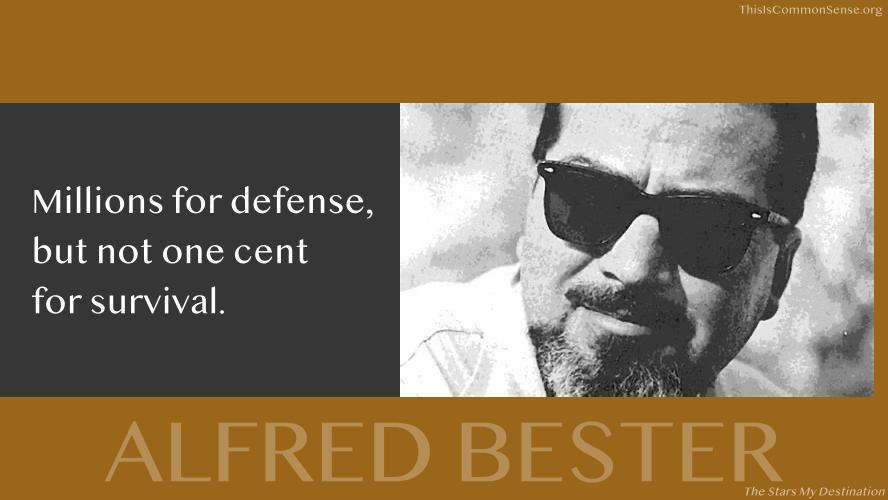
Millions for defense, but not one cent for survival.

Alfred Bester, The Stars My Destination, Chapter 16. The novel was first published under its author’s preferred title, Tiger! Tiger! (1956), in Britain.