Conversation means being able to disagree and still continue the discussion.
Categories
Dwight Macdonald
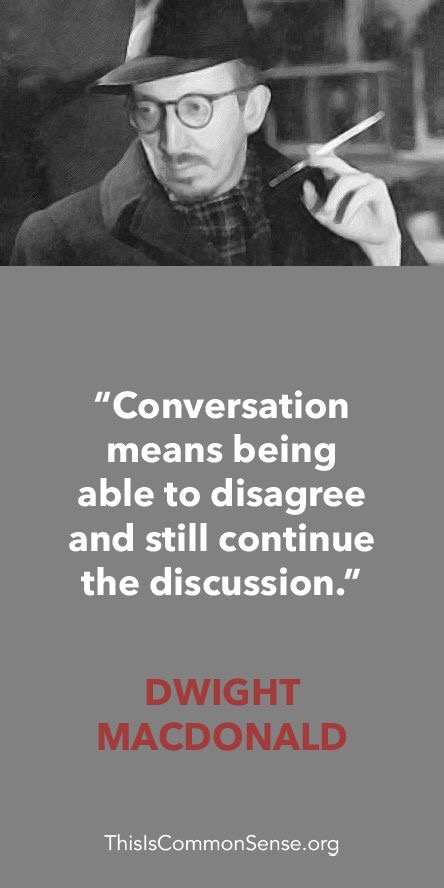
Conversation means being able to disagree and still continue the discussion.
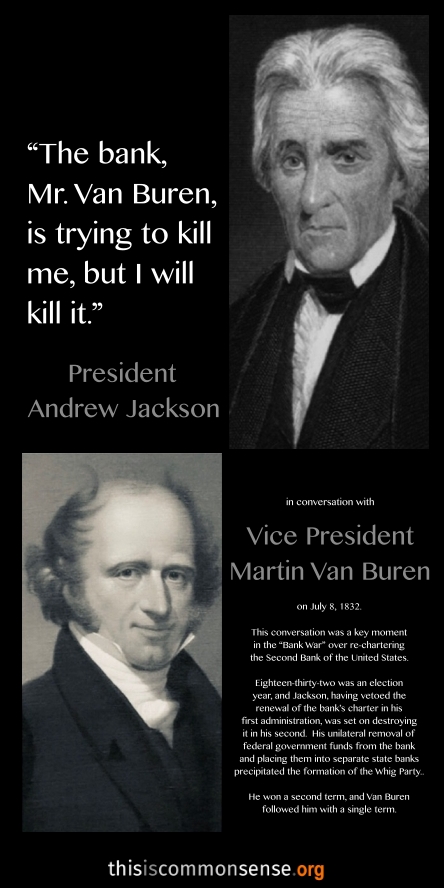
The bank, Mr. Van Buren, is trying to kill me, but I will kill it.
President Andrew Jackson, to Vice President Martin Van Buren, July 8, 1832
This conversation was a key moment in the “Bank War” over re-chartering the Second Bank of the United States.
Eighteen-thirty-two was an election year, and Jackson, having vetoed the renewal of the bank’s charter in his first administration, was set on destroying it in his second. His unilateral removal of federal government funds from the bank and placing them into separate state banks precipitated the formation of the opposition Whig Party.
He won a second term, and Van Buren followed him with a single term.

No man has a natural right to commit aggression on the equal rights of another; and this is all from which the laws ought to restrain him: every man is under the natural duty of contributing to the necessities of the society; and this is all the laws should enforce on him: and, no man having a natural right to be the judge between himself and another, it is his natural duty to submit to the umpirage of an impartial third. [W]hen the laws have declared and enforced all this, they have fulfilled their functions, and the idea is quite unfounded that on entering into society we give up any natural right.
Thomas Jefferson to Francis W. Gilmore, June 7, 1816.

We should never doubt that nationalizing the moral life is the first step toward totalitarianism.
Kenneth Minogue, The Servile Mind (2010), Encounter Books, pp. 2-3.
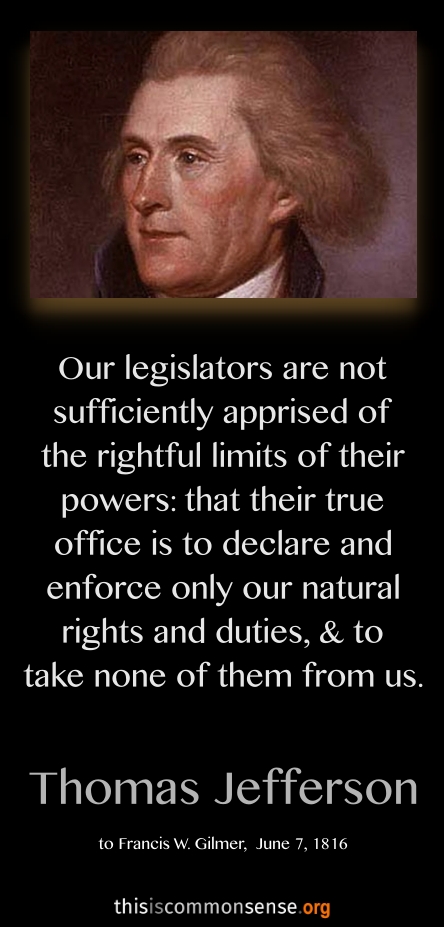
[O]ur legislators are not sufficiently apprised of the rightful limits of their powers: that their true office is to declare and enforce only our natural rights and duties, & to take none of them from us.
Thomas Jefferson to Francis W. Gilmore, June 7, 1816.
On July 2, 1776, the Continental Congress approved the Lee Resolution:
Resolved, That these United Colonies are, and of right ought to be, free and independent States, that they are absolved from all allegiance to the British Crown, and that all political connection between them and the State of Great Britain is, and ought to be, totally dissolved.
That it is expedient forthwith to take the most effectual measures for forming foreign Alliances.
That a plan of confederation be prepared and transmitted to the respective Colonies for their consideration and approbation.
The Lee Resolution, July 2, 1776, as adopted by the Continental Congress.
That evening the news hit the papers:
This day the Continental Congress declared the United Colonies Free and Independent States.
Pennsylvania Evening Post, July 2, 1776.
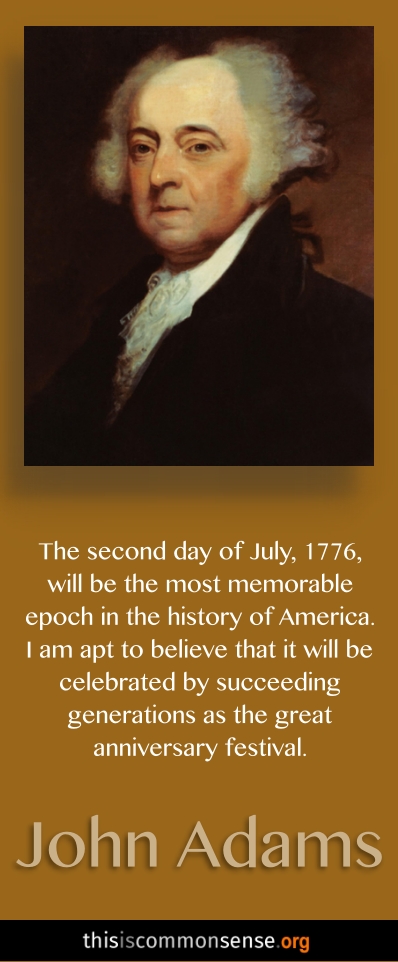
John Adams wrote to his wife Abigail:
The second day of July, 1776, will be the most memorable epoch in the history of America. I am apt to believe that it will be celebrated by succeeding generations as the great anniversary festival. It ought to be commemorated as the day of deliverance, by solemn acts of devotion to God Almighty. It ought to be solemnized with pomp and parade, with shows, games, sports, guns, bells, bonfires, and illuminations, from one end of this continent to the other, from this time forward forever more.
John Adams to Abigail Adams, personal correspondence, July 3, 1776.
John Adams was almost immediately proven wrong: July 4, 1776, when the Declaration of Independence was approved by Congress, was the day Americans chose to celebrate the dissolution of ties with Great Britain.
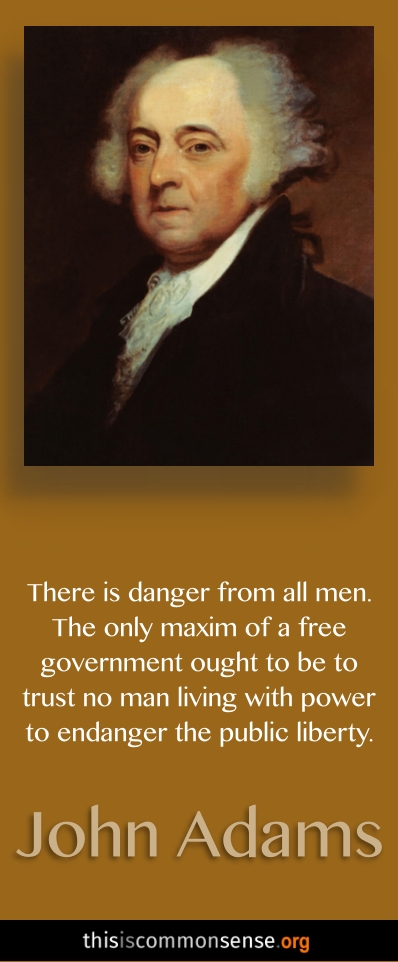
There is danger from all men. The only maxim of a free government ought to be to trust no man living with power to endanger the public liberty.
John Adams, in notes for an oration at Braintree (Spring 1772).
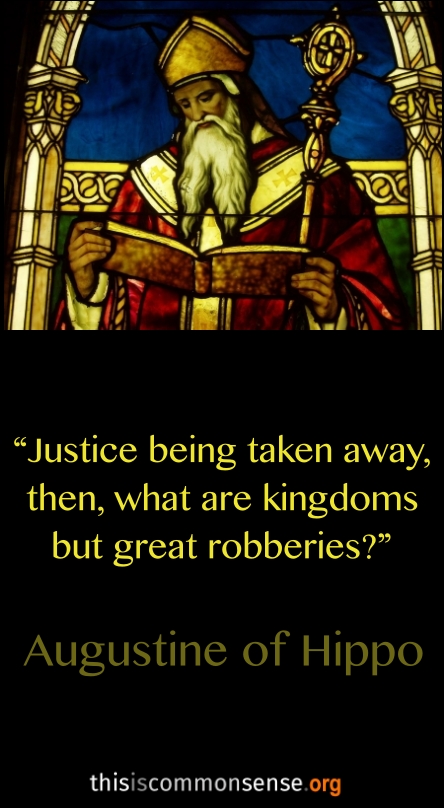
Remota itaque iustitia quid sunt regna nisi magna latrocinia? quia et latrocinia quid sunt nisi parua regna? Manus et ipsa hominum est, imperio principis regitur, pacto societatis astringitur, placiti lege praeda diuiditur. Hoc malum si in tantum perditorum hominum accessibus crescit, ut et loca teneat sedes constituat, ciuitates occupet populos subiuget, euidentius regni nomen adsumit, quod ei iam in manifesto confert non dempta cupiditas, sed addita inpunitas. Eleganter enim et ueraciter Alexandro illi Magno quidam comprehensus pirata respondit. Nam cum idem rex hominem interrogaret, quid ei uideretur, ut mare haberet infestum, ille libera contumacia: Quod tibi, inquit, ut orbem terrarum; sed quia ego exiguo nauigio facio, latro uocor; quia tu magna classe, imperator.
Augustine of Hippo, De Civitate Dei (c. 400 AD), IV, 4
Justice being taken away, then, what are kingdoms but great robberies? For what are robberies themselves, but little kingdoms? The band itself is made up of men; it is ruled by the authority of a prince, it is knit together by the pact of the confederacy; the booty is divided by the law agreed on. If, by the admittance of abandoned men, this evil increases to such a degree that it holds places, fixes abodes, takes possession of cities, and subdues peoples, it assumes the more plainly the name of a kingdom, because the reality is now manifestly conferred on it, not by the removal of covetousness, but by the addition of impunity. Indeed, that was an apt and true reply which was given to Alexander the Great by a pirate who had been seized. For when that king had asked the man what he meant by keeping hostile possession of the sea, he answered with bold pride, “What thou meanest by seizing the whole earth; but because I do it with a petty ship, I am called a robber, whilst thou who dost it with a great fleet art styled emperor.” St. Augustine, The City of God (c.400), IV, 4, Rev. George Wilson and Rev. J. J. Smith, translators.
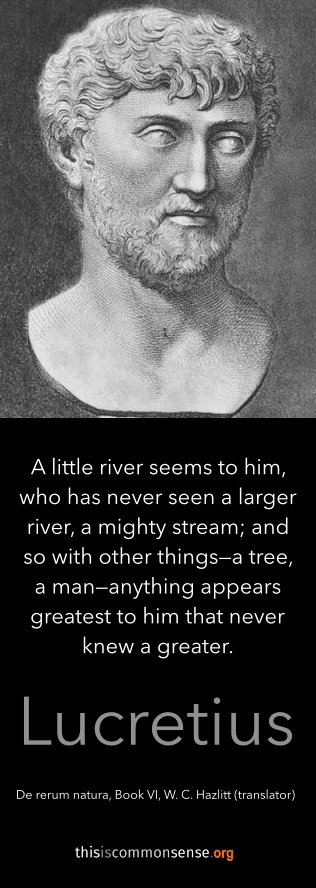
Scilicet et fluvius qui visus maximus ei,
Titus Lucretius Carus, De rerum natura, Book VI.
Qui non ante aliquem majorem vidit; et ingens
Arbor, homoque videtur, et omnia de genere omni
Maxima quae vidit quisque, haec ingentia fingit.
“A little river seems to him, who has never seen a larger river, a mighty stream; and so with other things — a tree, a man — anything appears greatest to him that never knew a greater.”
Lucretius, On the Nature of Things, Book VI (quoted in The Essays of Michel de Montaigne, tr. W. C. Hazlitt)

The great virtue of a free market system is that it does not care what color people are; it does not care what their religion is; it only cares whether they can produce something you want to buy. It is the most effective system we have discovered to enable people who hate one another to deal with one another and help one another.