Categories
Thought

Umberto Eco

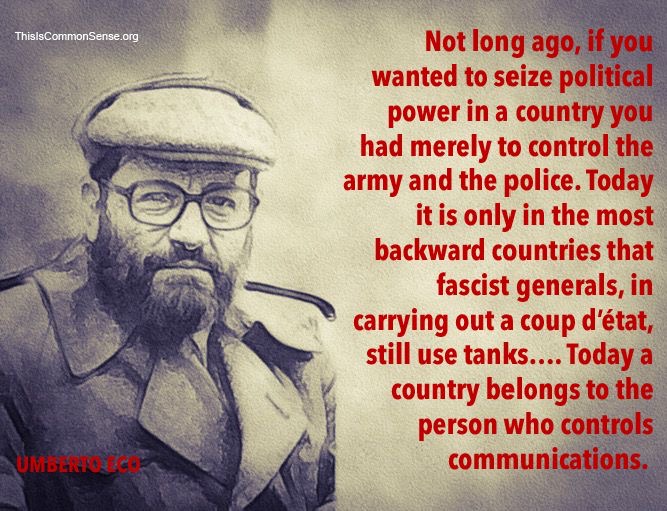
Not long ago, if you wanted to seize political power in a country you had merely to control the army and the police. Today it is only in the most backward countries that fascist generals, in carrying out a coup d’état, still use tanks. If a country has reached a high degree of industrialization the whole scene changes. The day after the fall of Khrushchev, the editors of Pravda, Izvestiia, the heads of the radio and television were replaced; the army wasn’t called out. Today a country belongs to the person who controls communications.

Umberto Eco, Il costume di casa (1973); as translated in Travels in Hyperreality (1986).
Categories
Thought

The Thomas Theorem

If men define situations as real, they are real in their consequences.

W.I. Thomas and D.S. Thomas, The Child in America: Behavior Problems and Programs (New York: Knopf, 1928). This idea was developed by sociologist Robert K. Merton in regards to “the self-fulfilling prophecy,” see  “The Thomas Theorem and the Matthew Effect”. Social Forces74 (2): 379–422.

Categories
Thought

Norman Angell

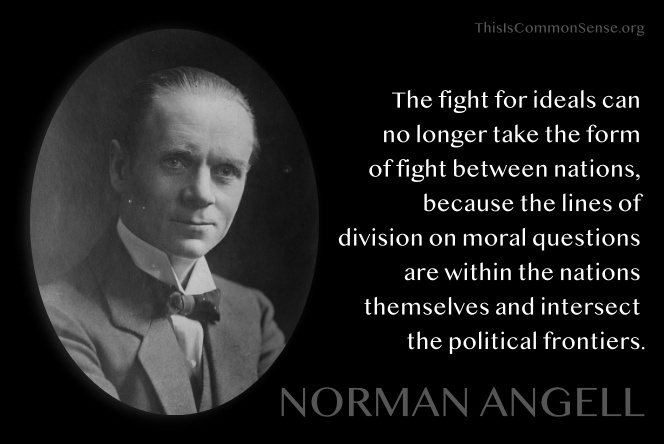
The fight for ideals can no longer take the form of fight between nations, because the lines of division on moral questions are within the nations themselves and intersect the political frontiers. There is no modern State which is completely Catholic or Protestant, or liberal or autocratic, or aristocratic or democratic, or socialist or individualist; the moral and spiritual struggles of the modern world go on between citizens of the same State in unconscious intellectual cooperation with corresponding groups in other states, not between the public powers of rival States.

Norman Angell, The Great Illusion (1910).
Categories
Thought

Samuel Butler

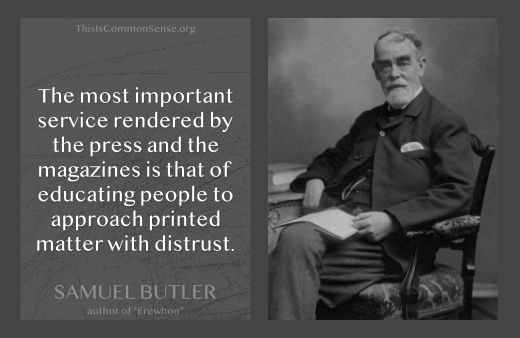
The most important service rendered by the press and the magazines is that of educating people to approach printed matter with distrust.

Samuel Butler’s Notebooks (1951), p. 221.
Categories
Thought

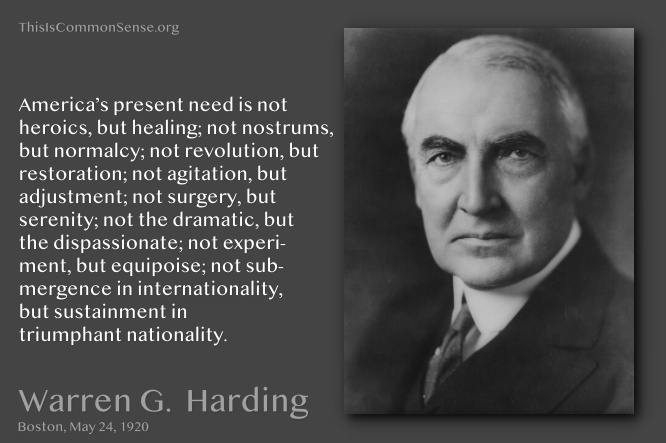
Warren G. Harding

America’s present need is not heroics, but healing; not nostrums, but normalcy; not revolution, but restoration; not agitation, but adjustment; not surgery, but serenity; not the dramatic, but the dispassionate; not experiment, but equipoise; not submergence in internationality, but sustainment in triumphant nationality.

Warren Gamaliel Harding, speech in Boston, May 24, 1920.
Categories
Thought

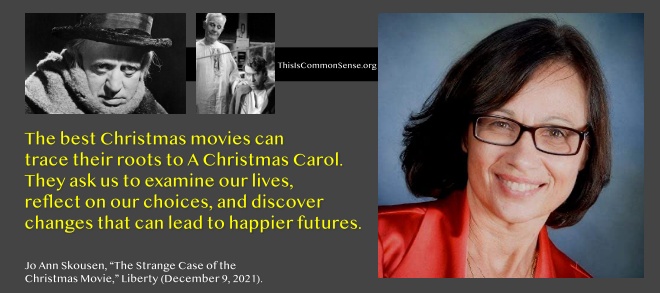
Jo Ann Skousen

The best Christmas movies can trace their roots to A Christmas Carol. They ask us to examine our lives, reflect on our choices, and discover changes that can lead to happier futures.

Jo Ann Skousen, “The Strange Case of the Christmas Movie” (December 9, 2021), Liberty.
Categories
Thought

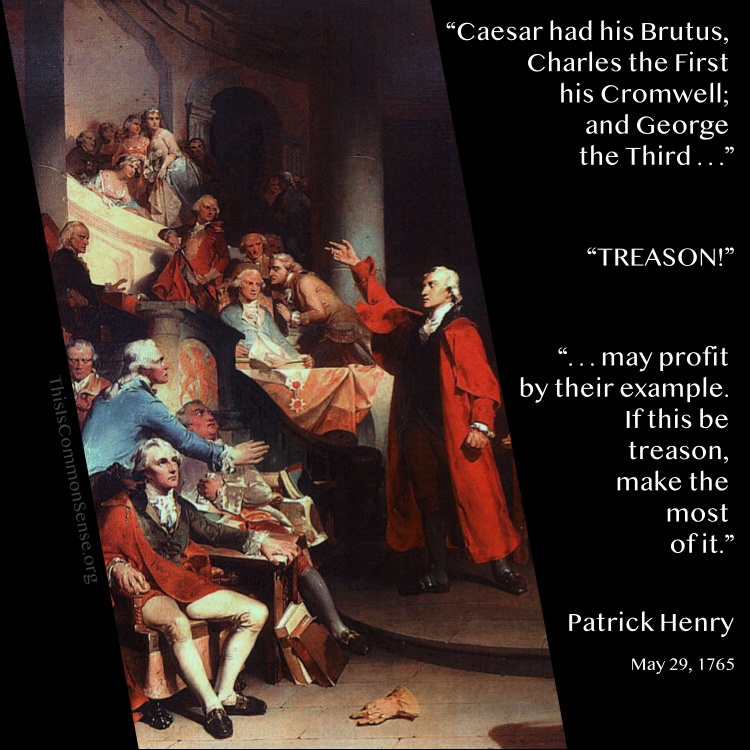
Patrick Henry

Caesar had his Brutus, Charles the First his Cromwell; and George the Third — [“Treason!” cried the Speaker] — may profit by their example. If this be treason, make the most of it.

Patrick Henry, speech on the Stamp Act, Virginia House of Burgesses (May 29, 1765), according to John Burk in The History of Virginia: From Its First Settlement to the Present Day (Dickson & Pescud, 1805), Volume 3, p. 309. Contemporary accounts vary.
Categories
Thought

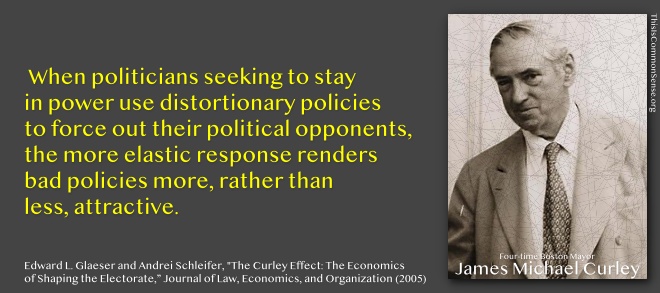
Curley Effect

When politicians seeking to stay in power use distortionary policies to force out their political opponents, the more elastic response renders bad policies more, rather than less, attractive.

Edward L. Glaeser and Andrei Schleifer, “The Curley Effect: The Economics of Shaping the Electorate,” Journal of Law, Economics, and Organization 21 (1): 1-19, (2005). The article’s abstract identifies the principle’s namesake: “James Michael Curley, a four-time mayor of Boston, used wasteful redistribution to his poor Irish constituents and incendiary rhetoric to encourage richer citizens to emigrate from Boston, thereby shaping the electorate in his favor. As a consequence, Boston stagnated, but Curley kept winning elections.” See David Henderson, “Curley Effect in California” (May 4, 2012).
Categories
Thought

Palki Sharma

Look at what’s happening in the U.S. It is now one of the biggest omicron hotspots. The U.S. is running out of everything: testing kits, hospital beds, health workers and now nursing home staff. There’s a shortage of everything in America. And these shortages are getting worse by the day. . . . The Biden Administration was clearly not prepared for this.

Palki Sharma, reporting for WION (The World Is One News), an Indian-based media company (Dec. 28, 2021).
Categories
Thought

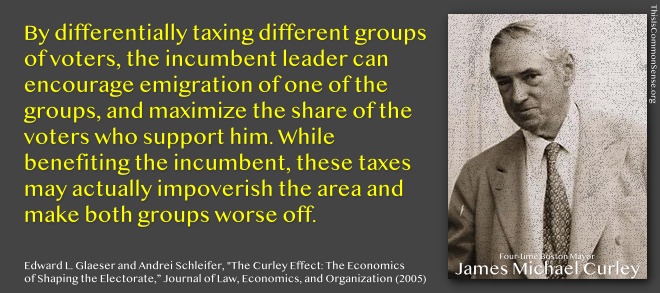
The Curley Effect

By differentially taxing different groups of voters, the incumbent leader can encourage emigration of one of the groups, and maximize the share of the voters who support him. While benefiting the incumbent, these taxes may actually impoverish the area and make both groups worse off.

Edward L. Glaeser and Andrei Schleifer, “The Curley Effect: The Economics of Shaping the Electorate,” Journal of Law, Economics, and Organization 21 (1): 1-19, (2005). The article’s abstract identifies the principle’s namesake: “James Michael Curley, a four-time mayor of Boston, used wasteful redistribution to his poor Irish constituents and incendiary rhetoric to encourage richer citizens to emigrate from Boston, thereby shaping the electorate in his favor. As a consequence, Boston stagnated, but Curley kept winning elections.” See David Henderson, “Curley Effect in California” (May 4, 2012).