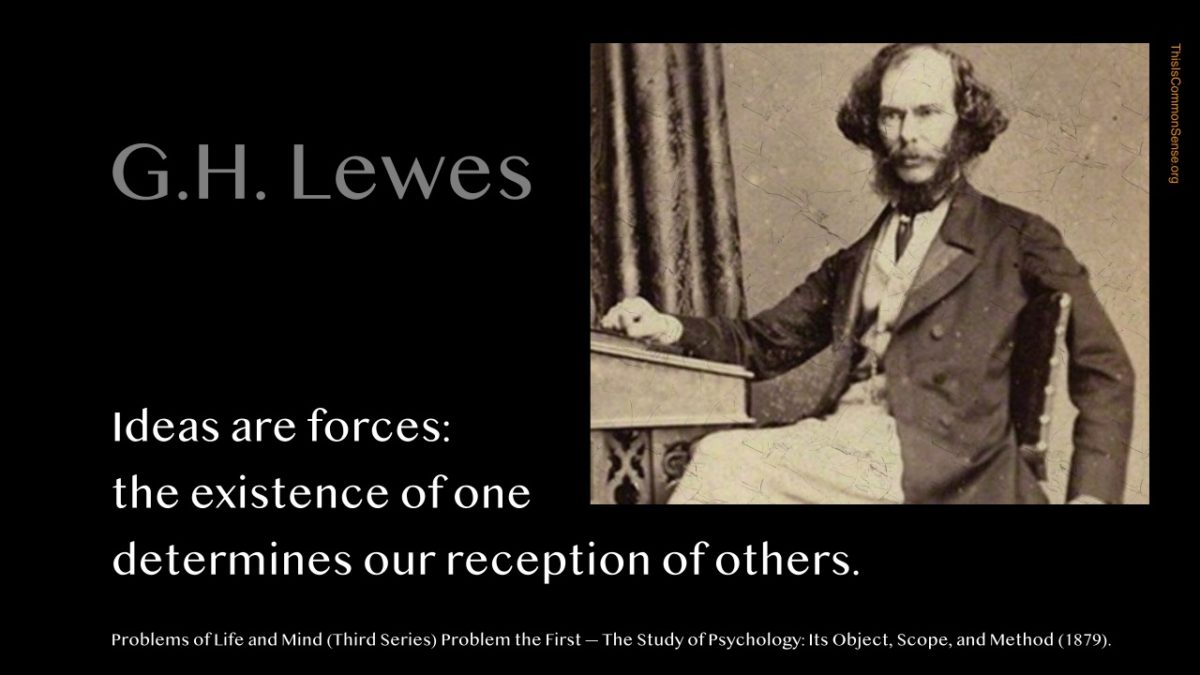
Ideas are forces: the existence of one determines our reception of others.
G. H. Lewes, Problems of Life and Mind (Third Series) Problem the First — The Study of Psychology: Its Object, Scope, and Method (1879).
George H. Lewes
Ideas are forces: the existence of one determines our reception of others.
G. H. Lewes, Problems of Life and Mind (Third Series) Problem the First — The Study of Psychology: Its Object, Scope, and Method (1879).
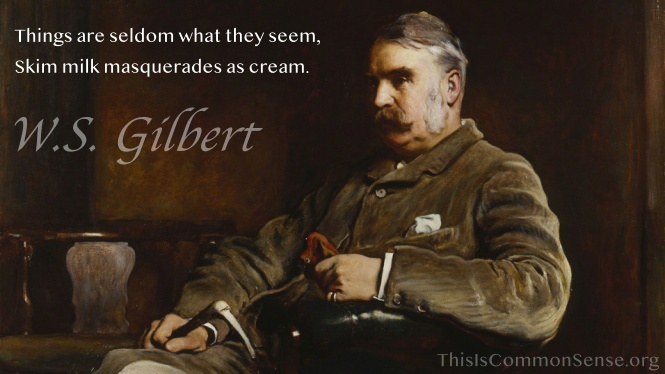
Things are seldom what they seem,
Sir William Schwenck Gilbert, opening lines to the famous duet between Buttercup and the Captain in the “Gilbert and Sullivan” operetta H.M.S. Pinafore (1878; Sir Arthur Sullivan, composer).
Skim milk masquerades as cream.
In a society in which there is no law, and in theory no compulsion, the only arbiter of behaviour is public opinion. But public opinion, because of the tremendous urge to conformity in gregarious animals, is less tolerant than any system of law. When human beings are governed by ‘thou shalt not’, the individual can practise a certain amount of eccentricity: when they are supposedly governed by ‘love’ or ‘reason’, he is under continuous pressure to make him behave and think in exactly the same way as everyone else.
George Orwell on “the totalitarian tendency which is implicit in the Anarchist or pacifist vision of society,” Collected Essays, Journalism and Letters, Vol. 4, p. 252.
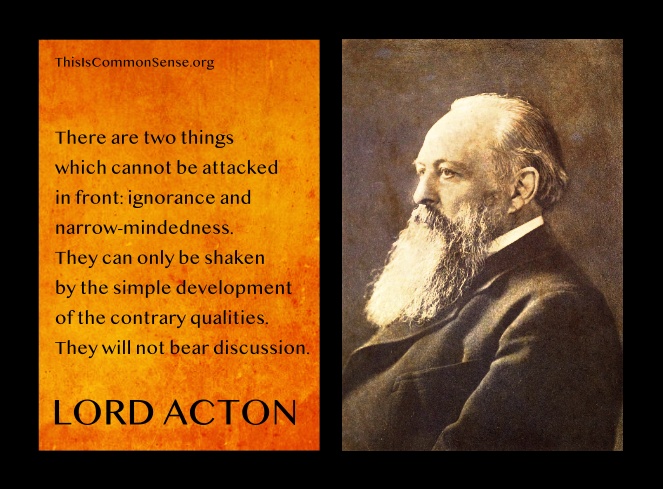
There are two things which cannot be attacked in front: ignorance and narrow-mindedness. They can only be shaken by the simple development of the contrary qualities. They will not bear discussion.
John Emerich Edward Dalberg Acton, 1st Baron Acton (January 10, 1834 – June 19, 1902), Letter (23 January 1861), published in Lord Acton and his Circle (1906), by Abbot Francis Aidan Gasquet, Letter 74.
It is a general law in politics, that the power most to be distrusted, is that which, possessing the greatest force, is the least responsible.
James Fenimore Cooper, The American Democrat (1838).
At all times sincere friends of freedom have been rare, and its triumphs have been due to minorities, that have prevailed by associating themselves with auxiliaries whose objects often differed from their own; and this association, which is always dangerous, has been sometimes disastrous, by giving to opponents just grounds of opposition, and by kindling dispute over the spoils in the hour of success.
John Emerich Edward Dalberg Acton, 1st Baron Acton (January 10, 1834 – June 19, 1902), The History of Freedom in Antiquity (1877).
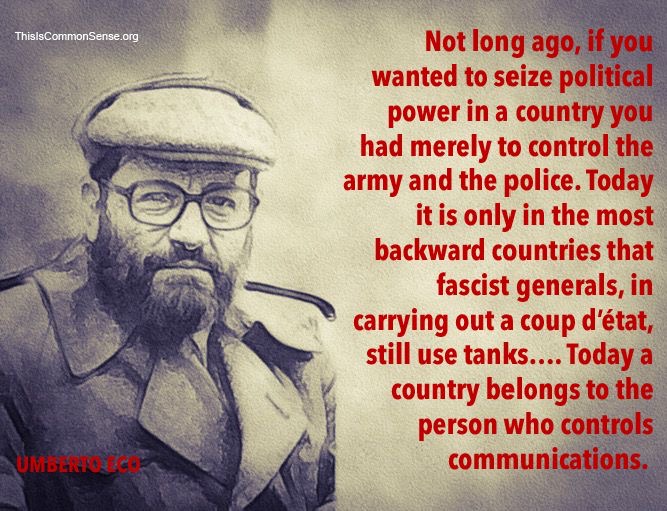
A democratic civilization will save itself only if it makes the language of the image into a stimulus for critical reflection — not an invitation for hypnosis.
Umberto Eco, “Can Television Teach?” in Screen Education 31 (1979), p. 12.
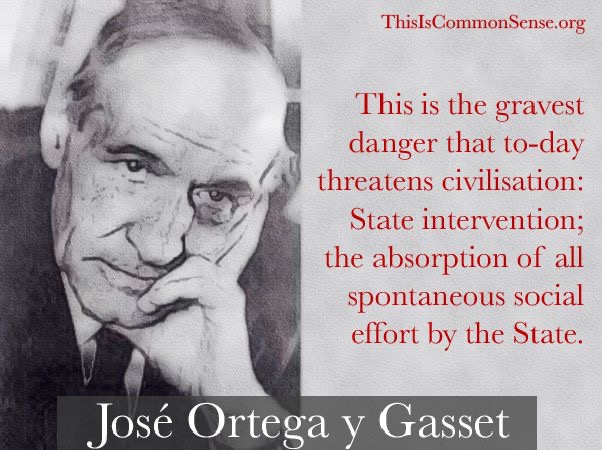
This is the gravest danger that to-day threatens civilisation: State intervention; the absorption of all spontaneous social effort by the State.
José Ortega y Gasset, The Revolt of the Masses (1929).
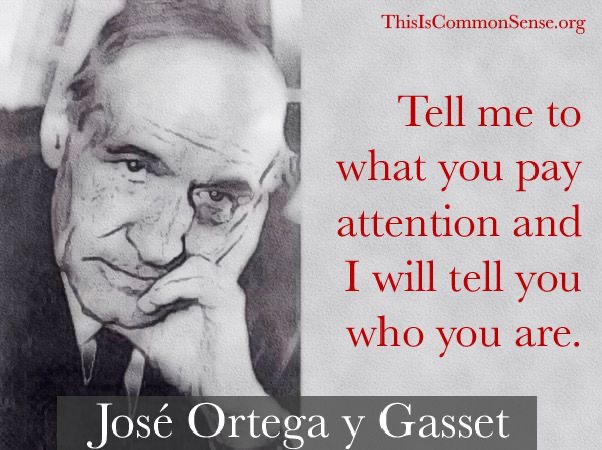
Tell me to what you pay attention and I will tell you who you are.
José Ortega y Gasset, Man and Crisis (1962).
How selfish soever man may be supposed, there are evidently some principles in his nature, which interest him in the fortune of others, and render their happiness necessary to him, though he derives nothing from it except the pleasure of seeing it.
Adam Smith, The Theory of Moral Sentiments (1759), opening sentence.