Categories
Thought

Immanuel Kant

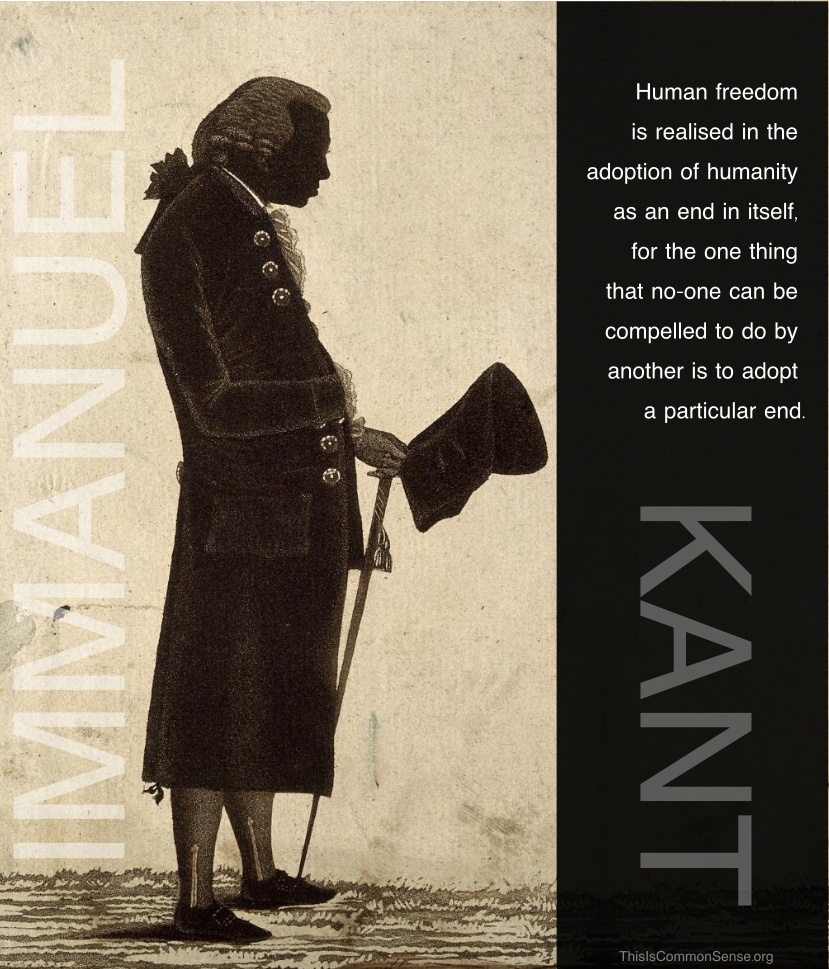
Human freedom is realised in the adoption of humanity as an end in itself, for the one thing that no-one can be compelled to do by another is to adopt a particular end.

Immanuel Kant, Metaphysics of Morals (1797), Part Two: “Metaphysics of Virtue.”

Image incorporating aquatint silhouette by J.T. Puttrich, 1793. Wellcome CollectionPublic Domain Mark

Categories
Thought

Omer Kanat

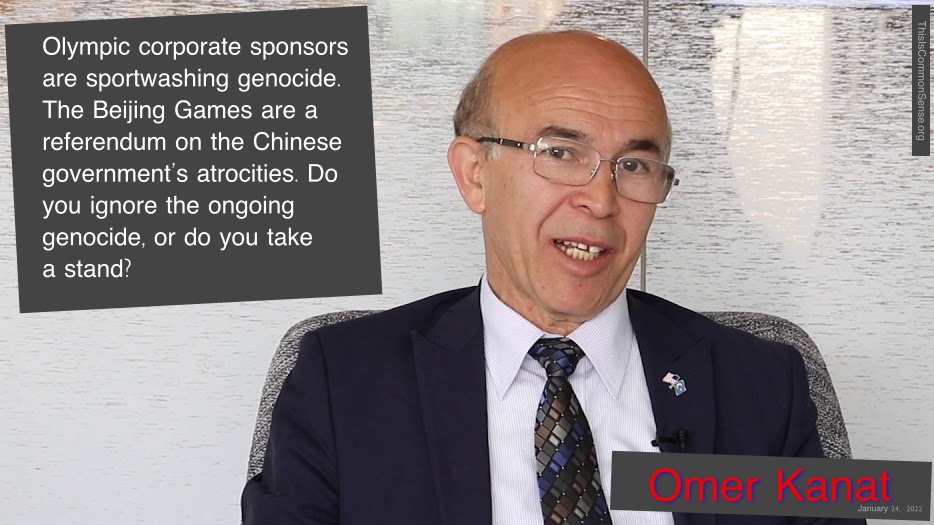
Olympic corporate sponsors are sportwashing genocide. The Beijing Games are a referendum on the Chinese government’s atrocities. Do you ignore the ongoing genocide, or do you take a stand?

Omer Kanat, Executive Director of the Uyghur Human Rights Project, as quoted on Senator Rick Scott’s website, “Communist China Cannot Whitewash Genocide with Olympic Games” (January 24, 2022).
Categories
Thought

Chamath Palihapitiya

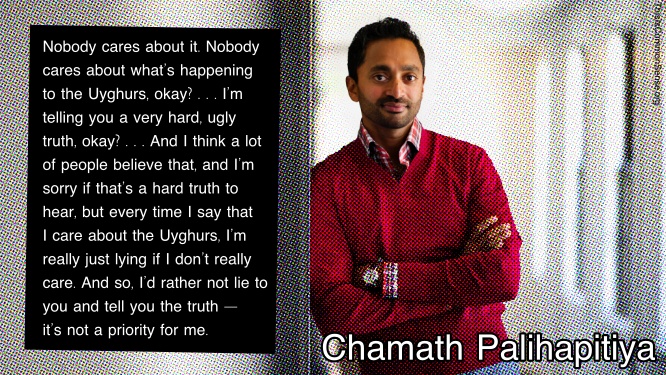
Nobody cares about it. Nobody cares about what’s happening to the Uyghurs, okay? . . . I’m telling you a very hard, ugly truth, okay? . . . And I think a lot of people believe that, and I’m sorry if that’s a hard truth to hear, but every time I say that I care about the Uyghurs, I’m really just lying if I don’t really care. And so, I’d rather not lie to you and tell you the truth — it’s not a priority for me.

Chamath Palihapitiya, a Sri Lankan-born Canadian and American billionaire venture capitalist, quoted in “Investor’s Uyghur Comments Are Even Worse Than You’ve Heard,” by Jim Geraghty, National Review (January 18, 2022).
Categories
Thought

Omer Kanat

The spectacle of the Olympics cannot cover up genocide. It’s hard to understand why anyone feels it’s even possible to celebrate international friendship and ‘Olympic values’ in Beijing this year.

Omer Kanat, in “Beijing Olympics Begin Amid Atrocity Crimes” (January 27, 2022), a joint statement of the Uyghur Human Rights Project.
Categories
Thought

Gustave de Molinari

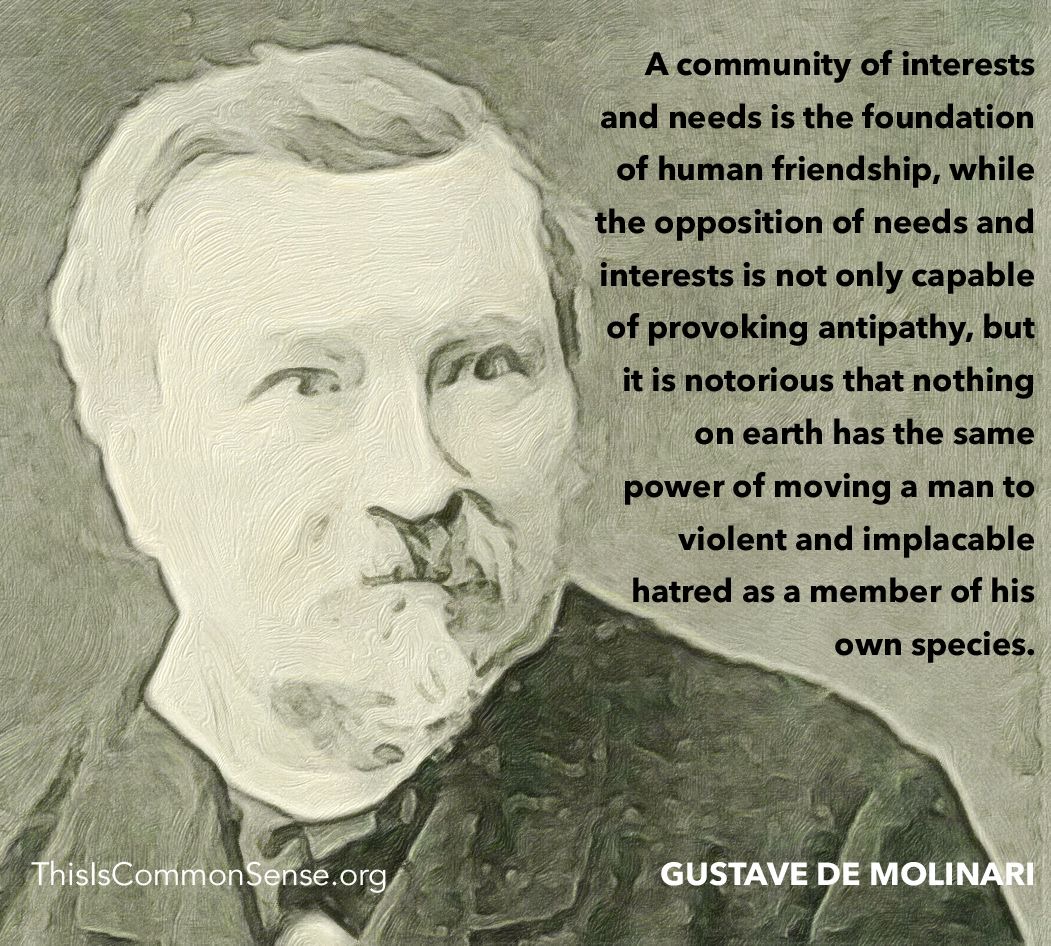
A community of interests and needs is the foundation of human friendship, while the opposition of needs and interests is not only capable of provoking antipathy, but it is notorious that nothing on earth has the same power of moving a man to violent and implacable hatred as a member of his own species.

Gustave de Molinari, The Society of To-morrow: A Forecast of Its Political and Economic Organisation (1899-1904), I.1.1.

Categories
Thought

Vilfredo Pareto

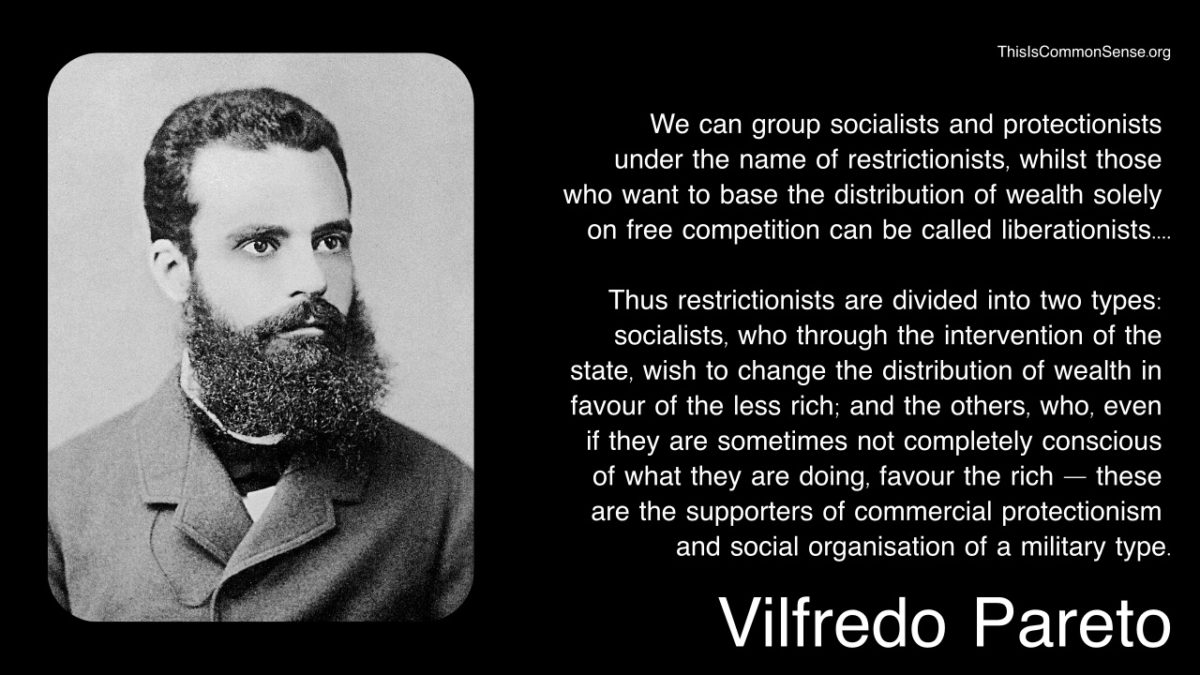
We can group socialists and protectionists under the name of restrictionists, whilst those who want to base the distribution of wealth solely on free competition can be called liberationists….

Thus restrictionists are divided into two types: socialists, who through the intervention of the state, wish to change the distribution of wealth in favour of the less rich; and the others, who, even if they are sometimes not completely conscious of what they are doing, favour the rich — these are the supporters of commercial protectionism and social organisation of a military type.

Vilfredo Pareto, “Socialism and Freedom,” 1891.

Categories
Thought

Vilfredo Pareto

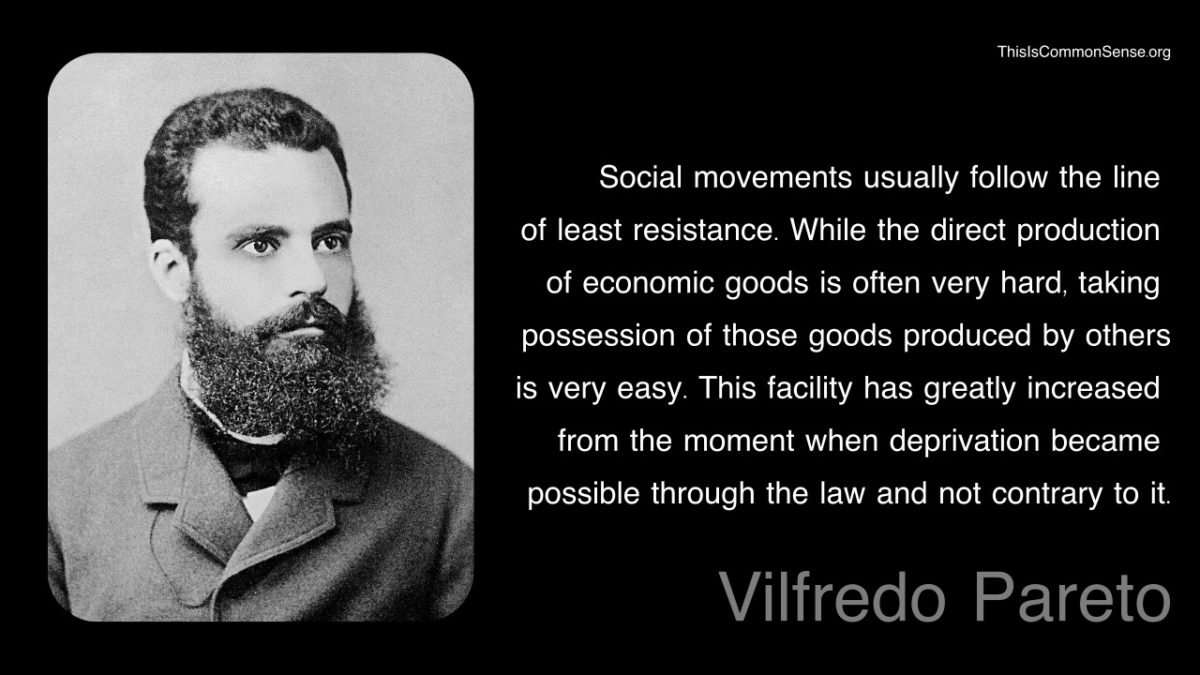
Social movements usually follow the line of least resistance. While the direct production of economic goods is often very hard, taking possession of those goods produced by others is very easy. This facility has greatly increased from the moment when deprivation became possible through the law and not contrary to it.

Vilfredo Pareto, “Socialism and Freedom,” 1891.
Categories
Thought

Fisher Ames

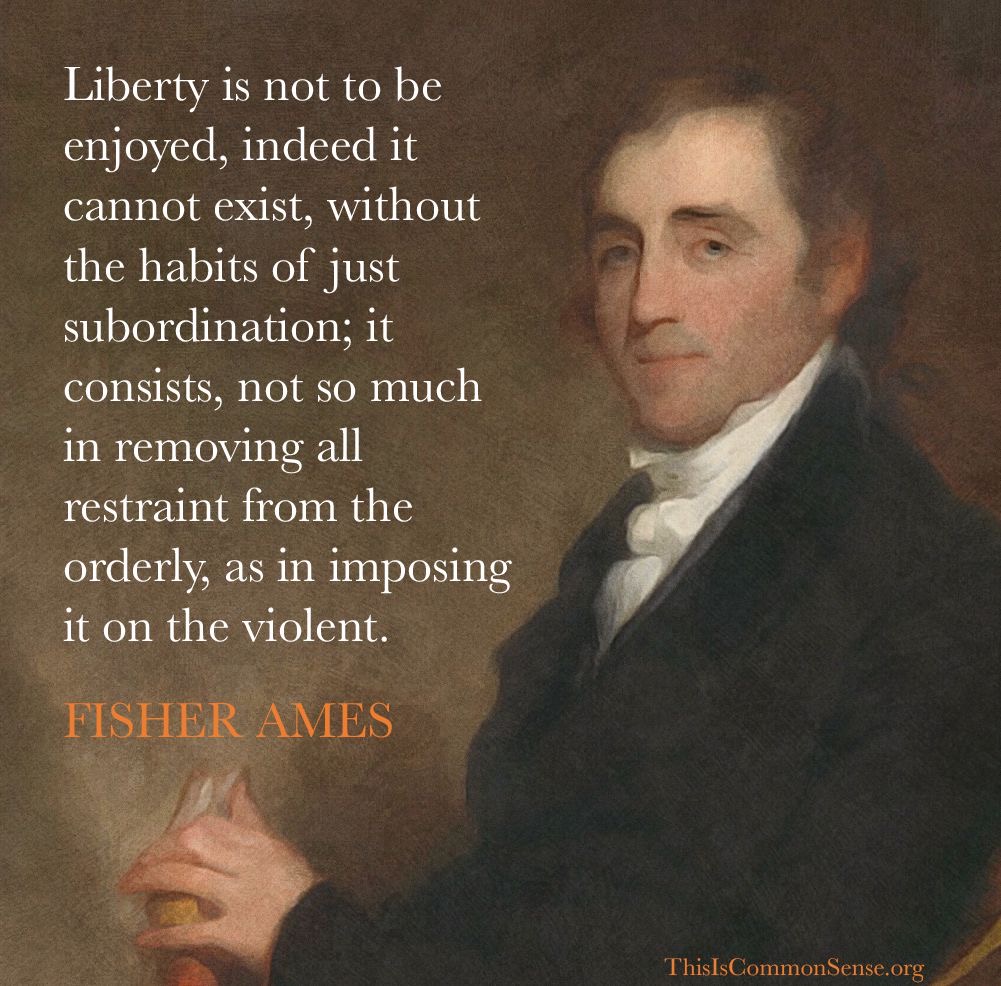
Liberty is not to be enjoyed, indeed it cannot exist, without the habits of just subordination; it consists, not so much in removing all restraint from the orderly, as in imposing it on the violent.

Categories
Thought

Orbach & Huang

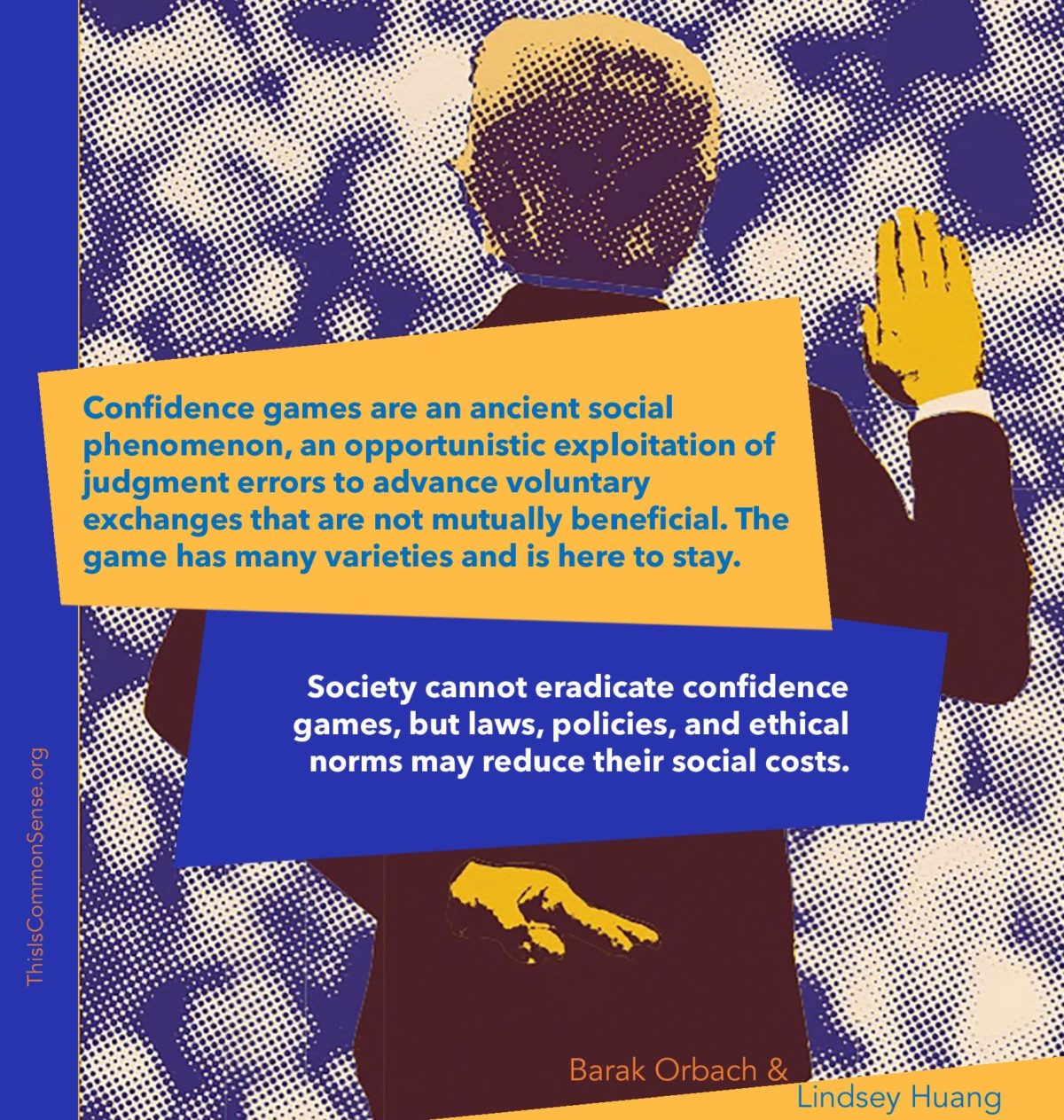
Confidence games are an ancient social phenomenon, an opportunistic exploitation of judgment errors to advance voluntary exchanges that are not mutually beneficial. The game has many varieties and is here to stay. Society cannot eradicate confidence games, but laws, policies, and ethical norms may reduce their social costs.

Barak Orbach and Lindsey Huang, “Con Men and Their Enablers: The Anatomy of Confidence Games” (Social Research: An International Quarterly, Volume 85, Number 4, Winter 2018),
Categories
Thought

Philip

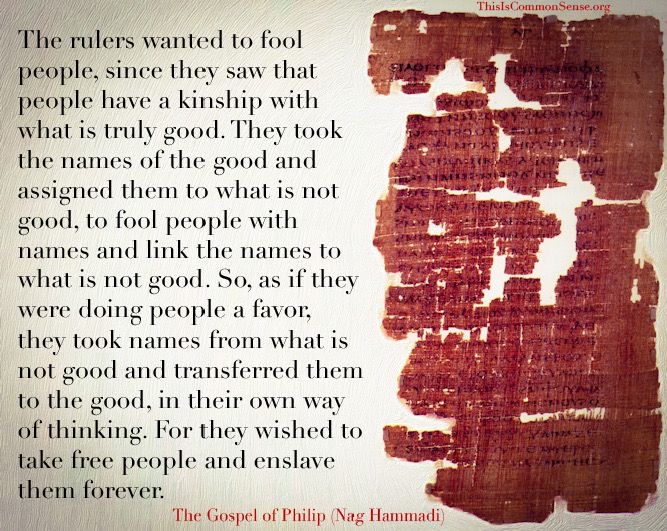
The rulers wanted to fool people, since they saw that people have a kinship with what is truly good. They took the names of the good and assigned them to what is not good, to fool people with names and link the names to what is not good. So, as if they were doing people a favor, they took names from what is not good and transferred them to the good, in their own way of thinking. For they wished to take free people and enslave them forever.

“The Gospel of Philip,” as translated by M. Meyer, in The Nag Hammadi Scriptures (2007), p. 163.