Governing a large country is like frying a small fish.
Lǎozi was a Chinese philosopher (also called Lao Zi, Lao Tze, Lao Tse, or Lao Tzu), The Tao Te Ching (6th–5th century BC), Ch. 60.

Governing a large country is like frying a small fish.
Lǎozi was a Chinese philosopher (also called Lao Zi, Lao Tze, Lao Tse, or Lao Tzu), The Tao Te Ching (6th–5th century BC), Ch. 60.
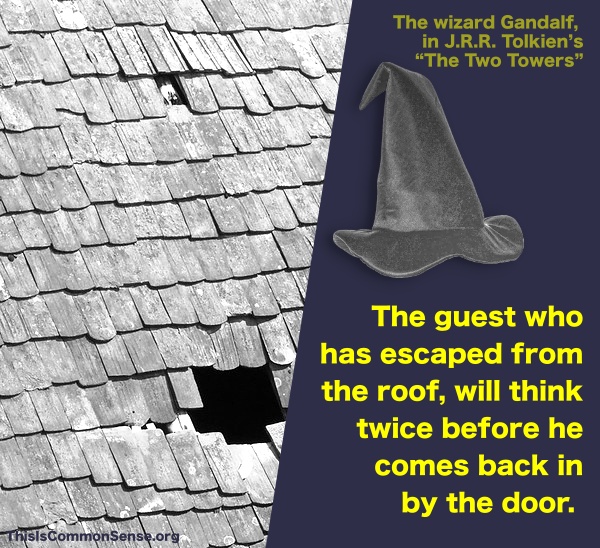
The guest who has escaped from the roof, will think twice before he comes back in by the door.
Gandalf, the wizard, in J.R.R. Tolkien’s The Two Towers (1954).

Knowing others is intelligence; knowing yourself is true wisdom. Mastering others is strength; mastering yourself is true power.
Lǎozi was a Chinese philosopher (also called Lao Zi, Lao Tzu, Lao Tse, or Lao Tze), The Tao Te Ching (6th–5th century BC), Ch. 33, as interpreted by Stephen Mitchell (1992).

Were we directed from Washington when to sow and when to reap, we should soon want bread.
Thomas Jefferson, Autobiography (1821), reprinted in Basic Writings of Thomas Jefferson, ed. Philip S. Foner, New York: Wiley Book Company (1944} p. 464.


Thus human economy and property have a joint economic origin since both have, as the ultimate reason for their existence, the fact that goods exist whose available quantities are smaller than the requirements of men. Property, therefore, like human economy, is not an arbitrary invention but rather the only practically possible solution of the problem that is, in the nature of things, imposed upon us by the disparity between requirements for, and available quantities of, all economic goods.
Carl Menger, Principles of Economics (1871), Chapter II: “Economy and Economic Goods”: 3. “The Origin of Human Economy and Economic Goods” A. “Economic goods.”

The government and the people are under a moral necessity of acting together; a free press compels them to bend to one another.
James Mill, The Edinburgh Review, vol. 18 (1811), p. 121.
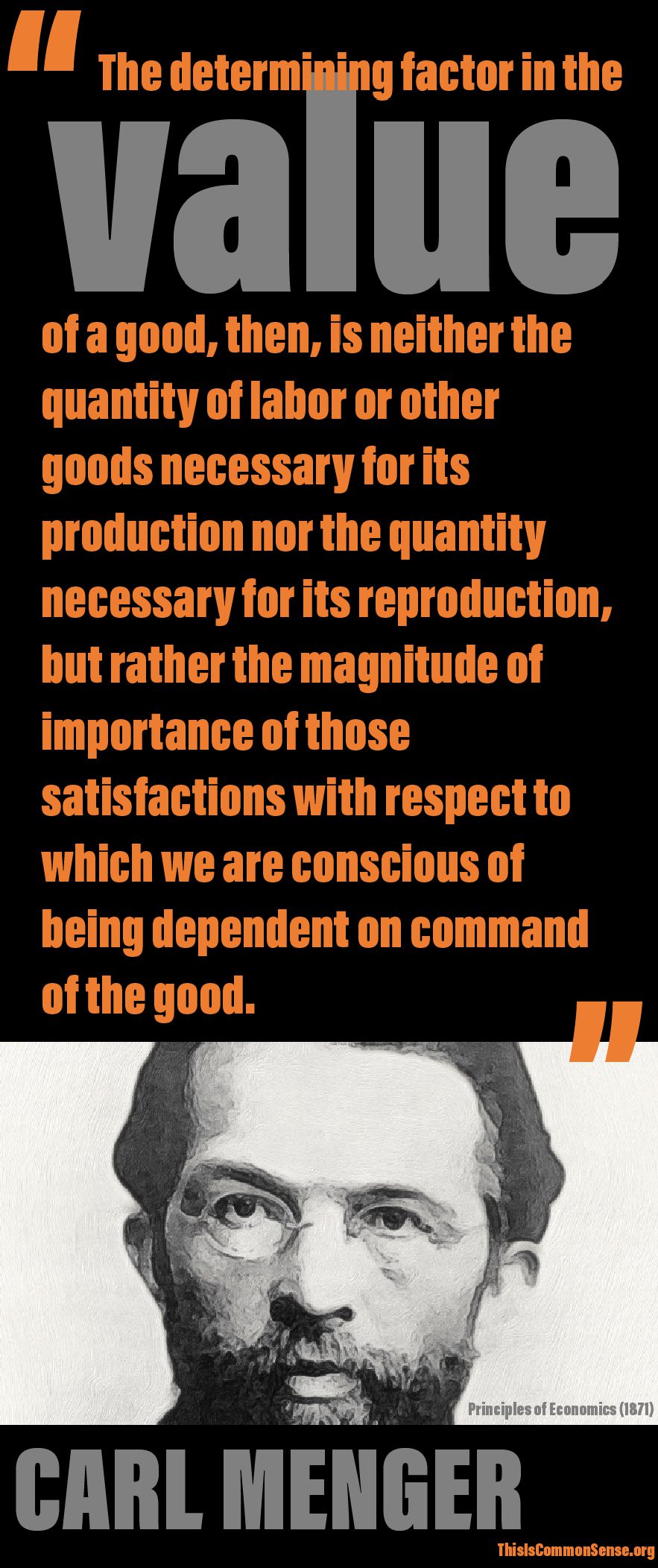
Carl Menger, Principles of Economics (1871; English translation, 1950), chapter III, “The Theory of Value.”
The determining factor in the value of a good, then, is neither the quantity of labor or other goods necessary for its production nor the quantity necessary for its reproduction, but rather the magnitude of importance of those satisfactions with respect to which we are conscious of being dependent on command of the good. This principle of value determination is universally valid, and no exception to it can be found in human economy.

It never ought to be forgotten, that, in every country, there is ‘a Few,’ and there is ‘a Many’; that in all countries in which the government is not very good, the interest of ‘the Few’ prevails over the interest of ‘the Many,’ and is promoted at their expence. ‘The Few’ is the part that governs; ‘the Many’ the part that is governed.
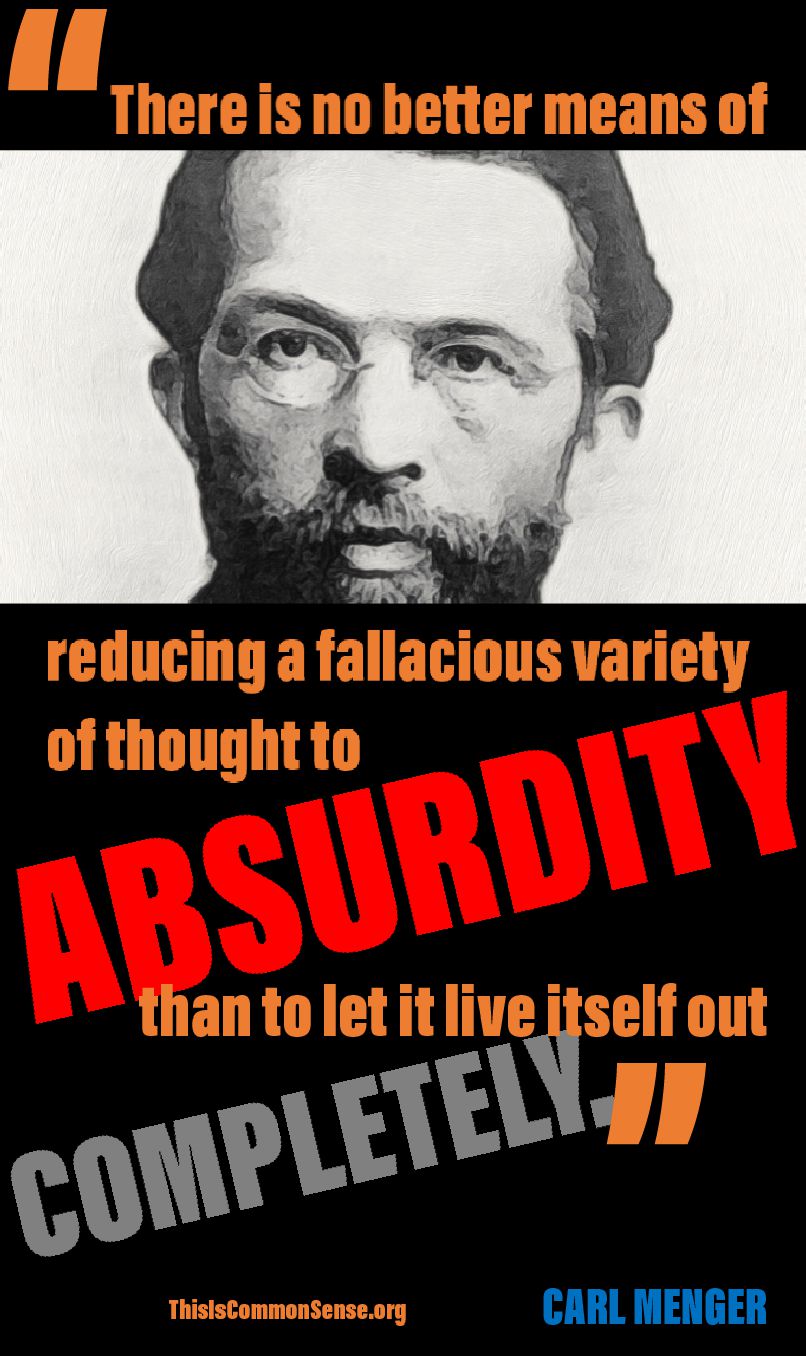
There is no better means of reducing a fallacious variety of thought to absurdity than to let it live itself out completely.
Attributed to Carl Menger in Ludwig Von Mises, “Comments about the mathematical treatment of economic problems.” Journal of Libertarian Studies, Spring 1977, 1(2), p. 100.
