Difficile est saturam non scribere.
It is difficult not to write satire.
Decimus Iunius Iuvenalis (c. 55 – c. 140), Satire One, Line 30.
Difficile est saturam non scribere.
It is difficult not to write satire.
Decimus Iunius Iuvenalis (c. 55 – c. 140), Satire One, Line 30.
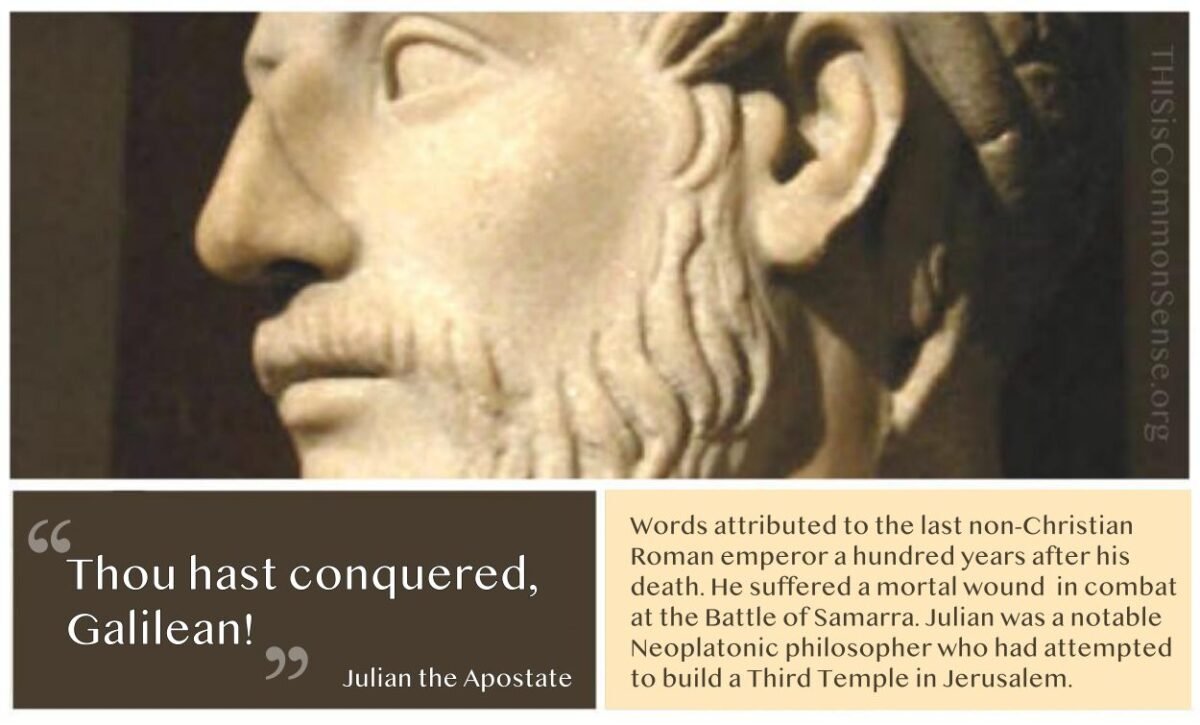
Thou hast conquered, Galilean!
Alleged famous last words of Imperator Caesar Flavius Claudius Julianus Augustus, as first attributed to him a century after his death (June 26, A.D. 363, from wounds fighting the Sassanid Empire in the Battle of Samarra) by Theodoret in his Ecclesiastical History, Book III, Ch. 20. The reference, of course, is to Jesus of Nazareth; Julian, a neoplatonic philosopher, was the last pagan (non-Christian/anti-Christian) Roman emperor, nephew to Constantine the Great.
Demand creates, and the loss of demand annihilates, supply. When an increased demand arises for any commodity, an increase of supply, if the supply is capable of increase, follows, as a regular effect. If the demand for any commodity altogether ceases, the commodity is no longer produced.
James Mill, Elements of Political Economy, Second Edition, Revised and Corrected (1824), p. 87.

Men do not stumble over mountains, but over molehills.
K’ung-fu-tzu (Master Kong), as reported in United States Congress House Committee on Agriculture (1973) Hearings Before the Committee on Agriculture, House of Representatives, Ninety-second Congress, p. 21.

There is nothing in the world, where a government is, in any degree, limited and restrained, so useful for getting rid of all limit and restraint, as wars. The power of almost all governments is greater during war than during peace. But in the case of limited governments, it is so, in a very remarkable degree.
James Mill, “Colony,” Supplement to the Encyclopaedia Britannica, Vol. IV. Edinburgh: A. & C. Black / London: J. Innes, 1832: p. 32.

To study and not think is a waste. To think and not study is dangerous.
K’ung-fu-tzu (Master Kong), The Analects, Book II, Chapter XV.
To understand this unhappy position of a portion of our fellow-citizens, we must call to mind the division which philosophers have made of men placed in society. They are divided into two classes, Ceux qui pillent, — et Ceux qui sont pillés; and we must consider with some care what this division, the correctness of which has not been disputed, implies.The first class, Ceux qui pillent, are the small number. They are the ruling Few. The second class, Ceux qui sont pillés, are the great number. They are the subject Many.
James Mill, “The State of the Nation,” London Review 25 (April–July 1835): p. 6.
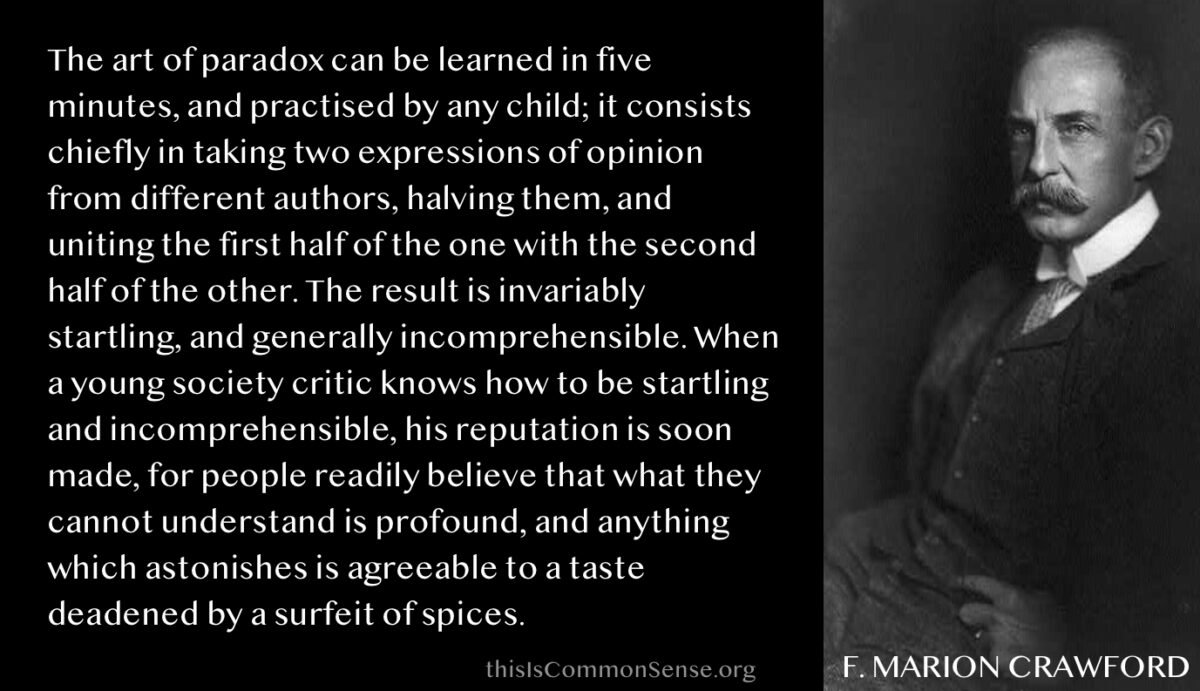
The art of paradox can be learned in five minutes, and practised by any child; it consists chiefly in taking two expressions of opinion from different authors, halving them, and uniting the first half of the one with the second half of the other. The result is invariably startling, and generally incomprehensible. When a young society critic knows how to be startling and incomprehensible, his reputation is soon made, for people readily believe that what they cannot understand is profound, and anything which astonishes is agreeable to a taste deadened by a surfeit of spices.
F. Marion Crawford, Saracinesca (1887).
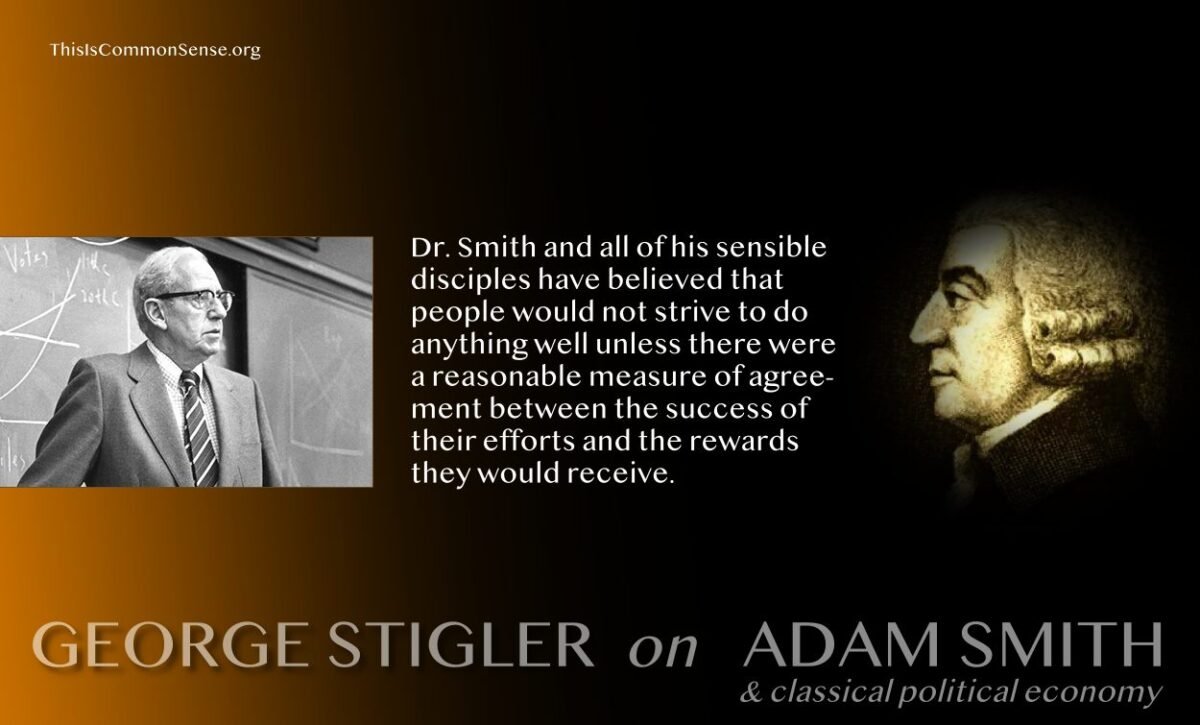
Dr. Smith and all of his sensible disciples have believed that people would not strive to do anything well unless there were a reasonable measure of agreement between the success of their efforts and the rewards they would receive.
George J. Stigler, “The Effect of Government on Economic Efficiency,” Business Economics (1988): pp. 7-13.
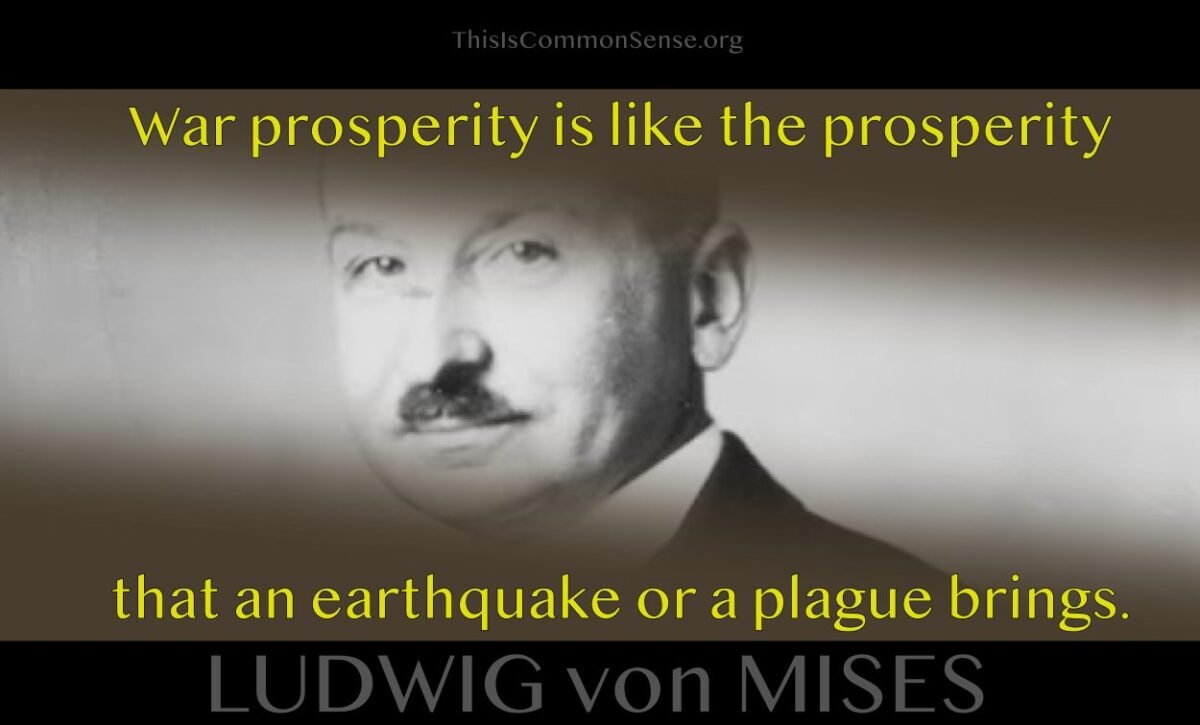
War prosperity is like the prosperity that an earthquake or a plague brings.
Ludwig von Mises, Nation, State, and Economy (1919).