Categories
Thought

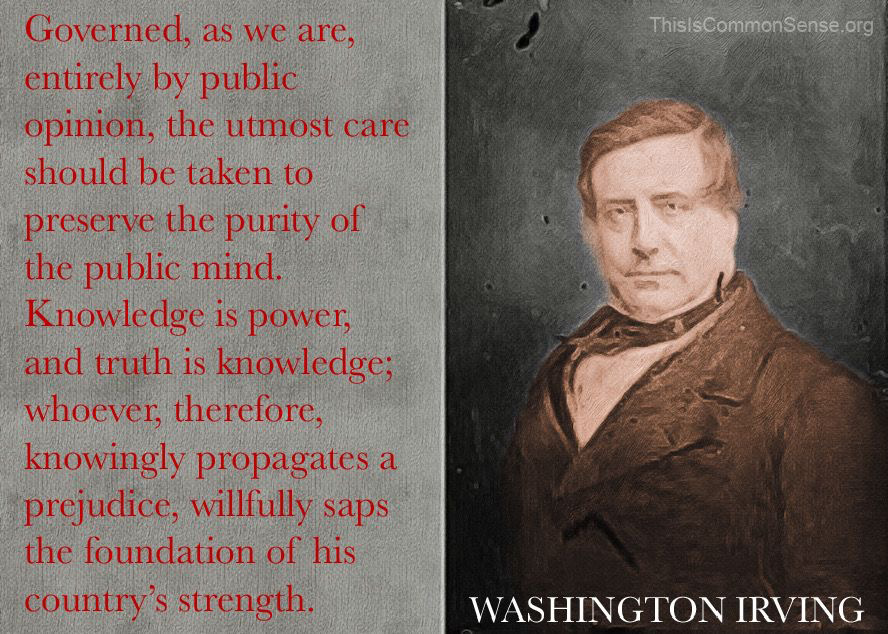
Washington Irving

Governed, as we are, entirely by public opinion, the utmost care should be taken to preserve the purity of the public mind. Knowledge is power, and truth is knowledge; whoever, therefore, knowingly propagates a prejudice, willfully saps the foundation of his country’s strength.

Washington Irving, writing under the pseudonym “Geoffrey Crayon, Gent.,” The Sketch Book (1819), as excerpted in The American Scene: 1600–1860 (1964), William J. Chute, editor, p. 127.
Categories
Thought

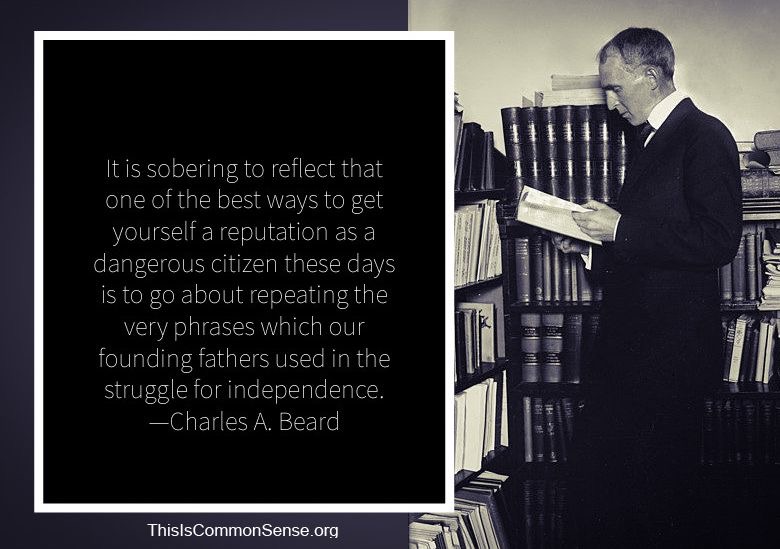
Charles A. Beard

It is sobering to reflect that one of the best ways to get yourself a reputation as a dangerous citizen these days is to go about repeating the very phrases which our founding fathers used in the struggle for independence.

Categories
Thought

S. D. Merton

Moral restraints which arise from custom are one thing; legal restraints which are supported by the force of law are quite another.

Seth D. Merton, “Where Philosophy Fails,” The Monist (July 1904).

Illustration created with PicFinder.ai

Categories
Thought

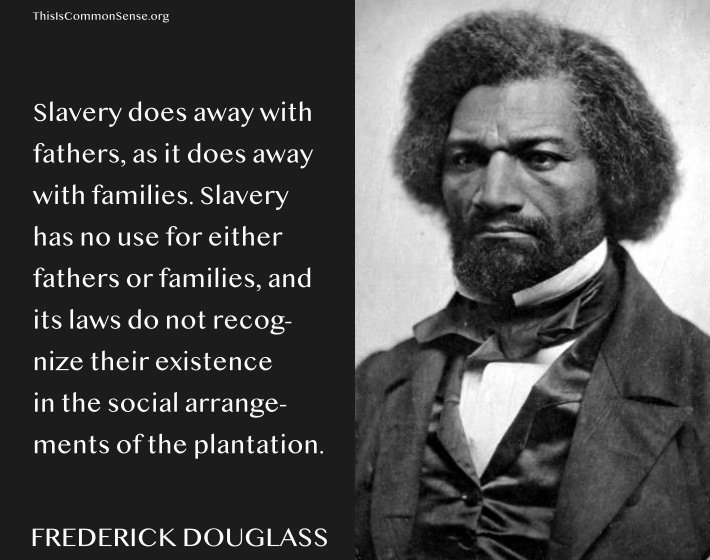
Frederick Douglass

I say nothing of father, for he is shrouded in a mystery I have never been able to penetrate. Slavery does away with fathers, as it does away with families. Slavery has no use for either fathers or families, and its laws do not recognize their existence in the social arrangements of the plantation.

Frederick Douglass, My Bondage and My Freedom (1855), Chapter 3.
Categories
Thought

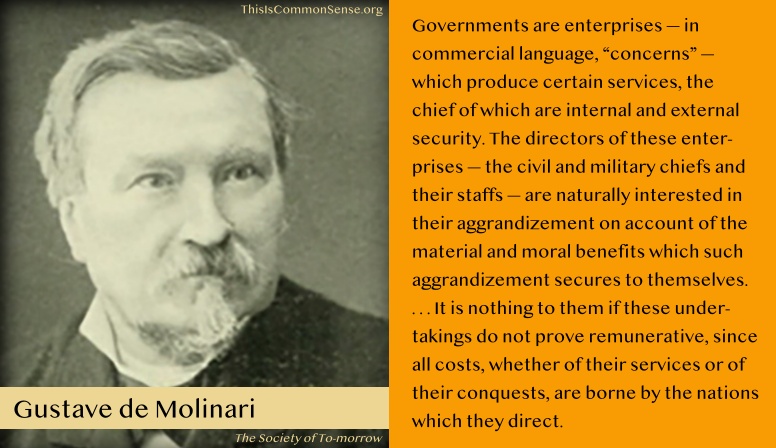
Gustave de Molinari

War has ceased to be productive of security, but the masses, whose existence depends upon the industries of production, are compelled to pay its costs and suffer its losses without either receiving compensation or possessing means to end the contradiction. Governments do possess this power, but if the interests of governments ultimately coincide with the interests of the governed they are, in the first instance, opposed to them.

Governments are enterprises — in commercial language, “concerns” — which produce certain services, the chief of which are internal and external security. The directors of these enterprises — the civil and military chiefs and their staffs — are naturally interested in their aggrandizement on account of the material and moral benefits which such aggrandizement secures to themselves. Their home policy is therefore to augment their own functions within the State by arrogating ground properly belonging to other enterprises; abroad they enlarge their domination by a policy of territorial expansion. It is nothing to them if these undertakings do not prove remunerative, since all costs, whether of their services or of their conquests, are borne by the nations which they direct.

Gustave de Molinari, The Society of To-morrow (1899)
Categories
Thought

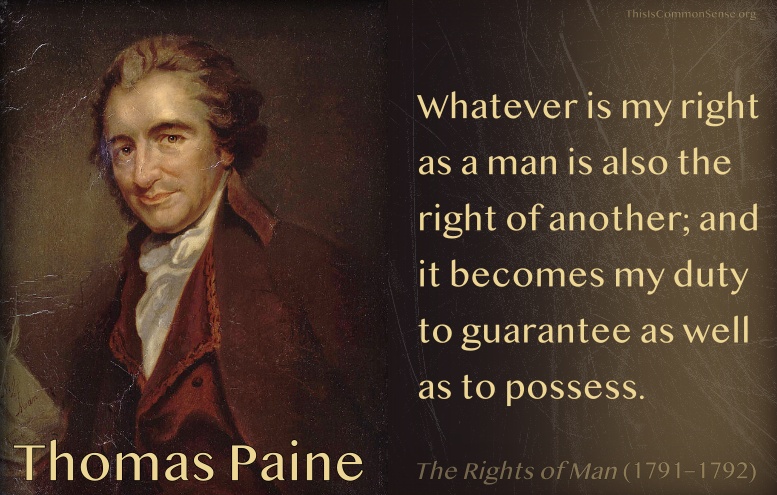
Thomas Paine

Whatever is my right as a man is also the right of another; and it becomes my duty to guarantee as well as to possess.

Thomas Paine, Rights of Man (1791-1792).
Categories
Thought

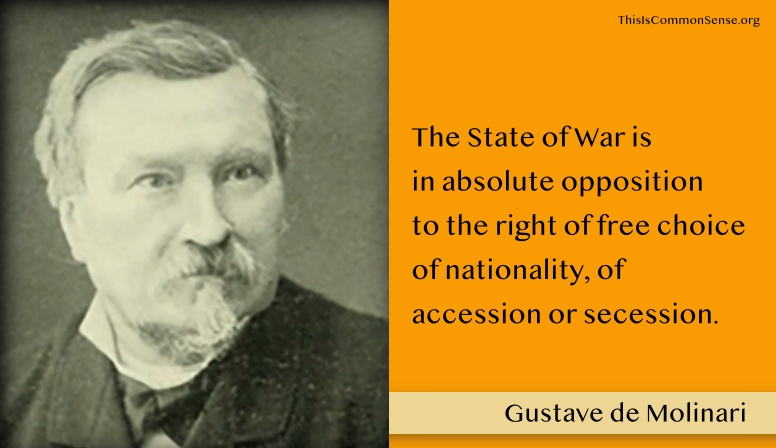
Gustave de Molinari

The State of War is in absolute opposition to the right of free choice of nationality, of accession or secession.

Gustave de Molinari, The Society of To-morrow (1899).
Categories
Thought

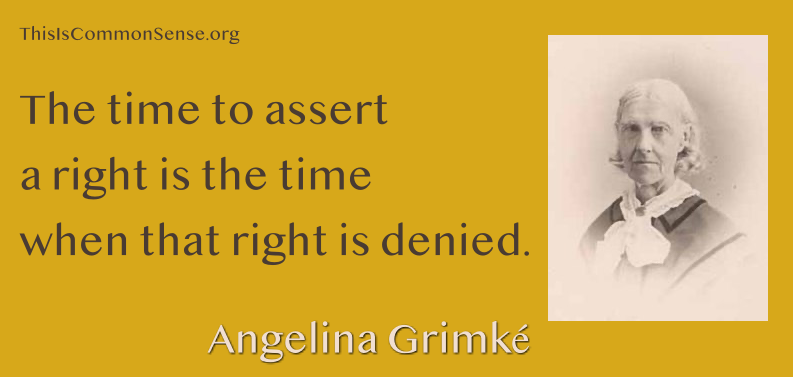
Angelina Grimké

The time to assert a right is the time when that right is denied.

Angelina Grimké, Pastorial Letter, as quoted in Stephen H. Browne (January 1, 2012). Angelina Grimke: Rhetoric, Identity, and the Radical Imagination. MSU Press. p. 128..
Categories
Thought

Sarah Grimké

I know nothing of man’s rights, or woman’s rights; human rights are all that I recognise.

Sarah Grimké, Letters on the Equality of the Sexes and the Condition of Woman (1837), Letter 15 (October 20, 1837).
Categories
Thought

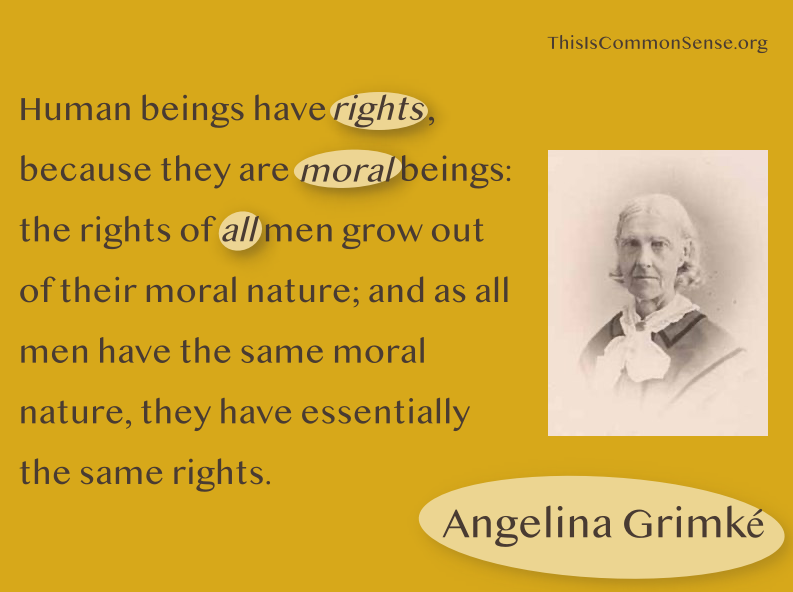
Angelina Grimké

Human beings have rights, because they are moral beings: the rights of all men grow out of their moral nature; and as all men have the same moral nature, they have essentially the same rights.

Angelina Grimké, “Letter XII. Human Rights Not Founded On Sex” (October 2, 1837); reported in Isaac Knapp, Letters to Catherine Beecher (1838).