You do not win by struggling to the top of a caste system, you win by refusing to be trapped within one at all.
Naomi Wolf, The Beauty Myth (1991), eighth chapter, “Beyond the Beauty Myth,” p. 290.
Categories
Naomi Wolf
You do not win by struggling to the top of a caste system, you win by refusing to be trapped within one at all.
Naomi Wolf, The Beauty Myth (1991), eighth chapter, “Beyond the Beauty Myth,” p. 290.
I particularly reject what I call “ideaism,” which is the belief that you can explain the world by looking at what thinkers have said or ideological doctrine without knowing all that much about historical or policy specifics.
Richard Hanania, “Against Ideaism” [Hanania Newsletter, Substack], October 24, 2023.
I have noticed that in the real world, the nominal “impact” of bending Paul Ryan’s ear, or whatever, which is the sad currency of the Respected Public Intellectual, is fool’s gold. Everyone takes it seriously and pretends it is real. Sometimes, rarely, it is slightly real. Generally everyone just pretends, and the pyrite vanishes in a bookseller’s season. Who reads the Respected Public Intellectuals of the ’70s, the ’80s, the ’90s?
Curtis Yarvin, the blogger previously known as “Mencius Moldbug,” in “Three Questions for Richard Hanania,” Gray Mirror [Substack].

Freedom is not free, as many veterans have said. I never understood what that meant except superficially. But you don’t get freedom back so easily if you yourself committed massive crimes. Freedom is not free. You don’t get to take away the freedom of others and enjoy it, without penalty for yourselves. The people you harmed, the parents of the children you burned — they are coming. Not violently, not vengefully, but with the righteous sword of justice in hand. Don’t rest too easy, leaders who did wrong, in this bright American sunlight. You don’t get America back as if nothing had happened.
Naomi Rebekah Wolf, described by Wikipedia as “an American feminist author, journalist, and conspiracy theorist,” in Facing the Beast: Courage, Faith, and Resistance in a New Dark Age (2023).
Those who are capable of tyranny are capable of perjury to sustain it.
Lysander Spooner, An Essay on the Trial by Jury (1852), p. 14.

Happily for the busy lunatics who rule over us, we are permanently the United States of Amnesia. We learn nothing because we remember nothing.
Gore Vidal, “The State of the Union,” The Nation (September 13, 2004).

One may ride upon a tiger’s back but it is fatal to dismount.
Ernest Bramah, Kai Lung Unrolls His Mat (1928), “The Story of Kin Wen and the Miraculous Tusk.”
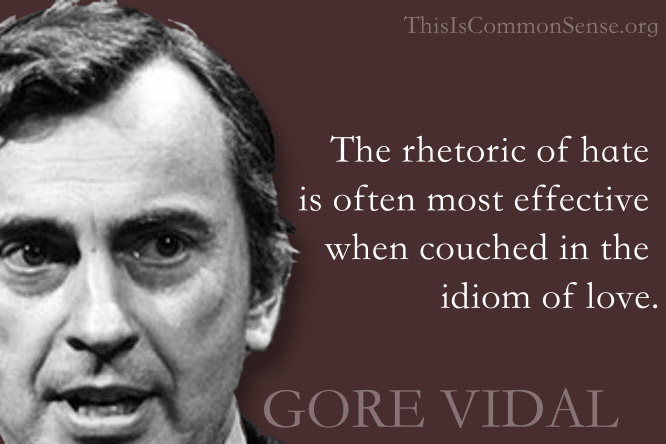
The rhetoric of hate is often most effective when couched in the idiom of love.
Gore Vidal, Julian (1964), sixth chapter.

It was quite dark when he went by the towers of Tor, where archers shoot ivory arrows at strangers lest any foreigner should alter their laws, which are bad, but not to be altered by mere aliens.
Edward John Moreton Drax Plunkett, 18th Baron of Dunsany, Distressing Tale of Thangobrind the Jeweller,” The Book of Wonder (1912).

On Tuesday Marsha Blackburn, the senior United States senator from Tennessee, asked Judge Jackson a simple question: “Can you provide a definition for the word ‘woman’?” Jackson, a magna cum laude graduate of Harvard College and sometime supervising editor of the Harvard Law Review answered: “Can I provide a definition? No. I can’t. Not in this context. I’m not a biologist.” The judge, brow furrowed, seemed equal parts annoyed and genuinely confused.
Declan Leary, “I’m Not a Biologist,” The American Conservative, March 26, 2022, relating a moment in Judge Jackson’s interrogation by the Senate Judiciary Committee hearing on her nomination to the Supreme Court.